Abdominal Aortic Aneurysm and Medication: Systematic Review with ☸️SAIMSARA.


saimsara.com Download PDF

Abstract: Systematic review with multilayer AI research agent: keyword normalization, retrieval & structuring, and paper synthesis (see SAIMSARA About section for details). The review utilises 166 studies with 1599485 total participants (naïve ΣN). Metformin was associated with a reduction in abdominal aortic aneurysm growth rate, with a median reduction of -0.38 mm/year and a reported range from -0.30 mm/year to -1.30 mm/year. These findings, alongside evidence for other medications like statins and RAASIs, suggest a promising role for pharmacological interventions in modulating AAA progression and improving patient outcomes, particularly in the context of small aneurysms and perioperative care. However, the prevalence of retrospective designs and heterogeneous study populations represents the most significant limitation to the certainty and generalizability of these findings. Therefore, a concrete next step is to conduct large-scale, high-quality randomized controlled trials to definitively validate the efficacy of metformin and other promising medications in limiting AAA progression and reducing rupture risk.

Keywords: Abdominal aortic aneurysm; Medication therapy; Metformin; AAA growth rate; ACE inhibitors; Angiotensin receptor blockers; Medication adherence; Perianeurysmal fibrosis; Endovascular aneurysm repair; Antihypertensive drugs

Review Stats
Identification of studies via Semantic Scholar (all fields) Identification Screening Included Records identified:n=798Records excluded:n=0 Records assessed for eligibilityn=798Records excluded:n=632 Studies included in reviewn=166 PRISMA Diagram generated by ☸️ SAIMSARA
⛛OSMA Triangle Effect-of Predictor → Outcome medication  →  abdominal aortic aneurysm Beneficial for patients ΣN=524277 (33%) Harmful for patients ΣN=103767 (6%) Neutral ΣN=971441 (61%) 0 ⛛OSMA Triangle generated by ☸️SAIMSARA
Show OSMA legend
Outcome-Sentiment Meta-Analysis (OSMA): (LLM-only)
Frame: Effect-of Predictor → Outcome • Source: Semantic Scholar
Outcome: abdominal aortic aneurysm Typical timepoints: peri/post-op, 1-y. Reported metrics: %, CI, p.
Common endpoints: Common endpoints: mortality, complications, los.
Predictor: medication — exposure/predictor. Routes seen: intravenous. Typical comparator: usual care, single antiplatelet therapy, placebo, control….

  • 1) Beneficial for patients — abdominal aortic aneurysm with medication — [5], [7], [10], [31], [35], [39], [40], [41], [42], [44], [47], [53], [54], [56], [59], [66], [69], [71], [72], [80], [84], [98], [112], [119], [120], [141], [161] — ΣN=524277
  • 2) Harmful for patients — abdominal aortic aneurysm with medication — [3], [20], [32], [60], [97], [110], [162] — ΣN=103767
  • 3) No clear effect — abdominal aortic aneurysm with medication — [1], [2], [4], [6], [8], [9], [11], [12], [13], [14], [15], [16], [17], [18], [19], [21], [22], [23], [24], [25], [26], [27], [28], [29], [30], [33], [34], [36], [37], [38], [43], [45], [46], [48], [49], [50], [51], [52], [55], [57], [58], [61], [62], [63], [64], [65], [67], [68], [70], [73], [74], [75], [76], [77], [78], [79], [81], [82], [83], [85], [86], [87], [88], [89], [90], [91], [92], [93], [94], [95], [96], [99], [100], [101], [102], [103], [104], [105], [106], [107], [108], [109], [111], [113], [114], [115], [116], [117], [118], [121], [122], [123], [124], [125], [126], [127], [128], [129], [130], [131], [132], [133], [134], [135], [136], [137], [138], [139], [140], [142], [143], [144], [145], [146], [147], [148], [149], [150], [151], [152], [153], [154], [155], [156], [157], [158], [159], [160], [163], [164], [165], [166] — ΣN=971441
1) Introduction
Abdominal aortic aneurysm (AAA) represents a significant cardiovascular pathology characterized by localized dilatation of the abdominal aorta, carrying substantial risks of rupture and associated mortality. The management of AAA encompasses surveillance, surgical intervention (open repair or endovascular aneurysm repair (EVAR)), and increasingly, pharmacological strategies aimed at mitigating disease progression and associated complications. The intricate interplay between various medications and AAA development, growth, and perioperative outcomes is a critical area of research. This paper synthesizes current evidence on the role of medication in the context of AAA, from its incidence and growth suppression to perioperative management and long-term survival.

2) Aim
Systematic review with multilayer AI research agent: keyword normalization, retrieval & structuring, and paper synthesis (see SAIMSARA About section for details).

3) Methods


4) Results
4.1 Study characteristics:
The reviewed literature comprises a diverse range of study designs, predominantly cohort studies (retrospective and prospective), mixed-design studies, and randomized controlled trials. Populations frequently include patients undergoing elective EVAR for infrarenal AAA, individuals with small AAAs under surveillance, and broader cohorts from screening programs. Follow-up periods vary significantly, ranging from a few months (e.g., 4 months [2]) to several years (e.g., 5.99 years [141], median 16 years [126], 24.3 years [50]), with some studies not specifying follow-up duration.

4.2 Main numerical result aligned to the query:
Metformin was associated with a reduction in abdominal aortic aneurysm growth rate, with a median reduction of -0.38 mm/year [5] and a reported range from -0.30 mm/year to -1.30 mm/year [10]. This suggests a potential therapeutic effect of metformin in slowing AAA expansion.

4.3 Topic synthesis:


5) Discussion
5.1 Principal finding:
The principal finding indicates that metformin is associated with a reduction in abdominal aortic aneurysm growth rate, with a median reduction of -0.38 mm/year [5] and a reported range from -0.30 mm/year to -1.30 mm/year [10].

5.2 Clinical implications:


5.3 Research implications / key gaps:


5.4 Limitations:


5.5 Future directions:


6) Conclusion
Metformin was associated with a reduction in abdominal aortic aneurysm growth rate, with a median reduction of -0.38 mm/year [5] and a reported range from -0.30 mm/year to -1.30 mm/year [10]. These findings, alongside evidence for other medications like statins and RAASIs, suggest a promising role for pharmacological interventions in modulating AAA progression and improving patient outcomes, particularly in the context of small aneurysms and perioperative care. However, the prevalence of retrospective designs and heterogeneous study populations represents the most significant limitation to the certainty and generalizability of these findings. Therefore, a concrete next step is to conduct large-scale, high-quality randomized controlled trials to definitively validate the efficacy of metformin and other promising medications in limiting AAA progression and reducing rupture risk.

References
SAIMSARA Session Index — session.json

Figure 1. Publication-year distribution of included originals

Figure 2. Study-design distribution of included originals
Figure 2. Study-design distribution

Figure 3. Study-type (directionality) distribution of included originals
Figure 3. Directionality distribution

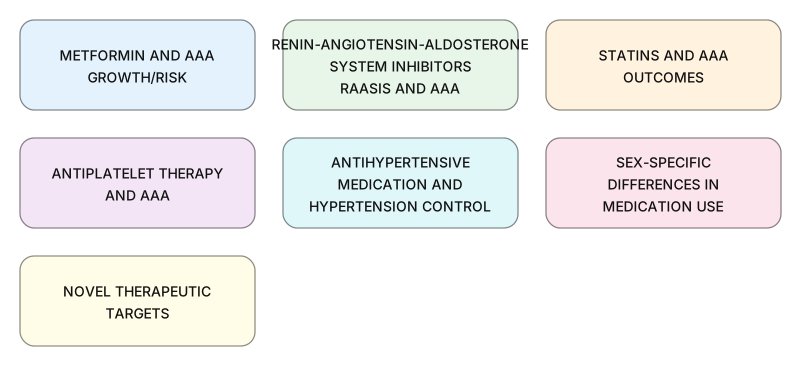
Figure 4. Main extracted research topics
Figure 4. Main extracted research topics (Results)

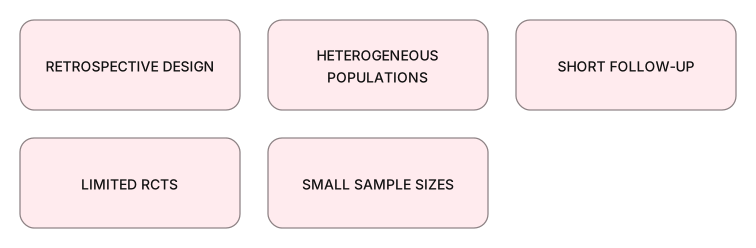
Figure 5. Limitations of current studies (topics)

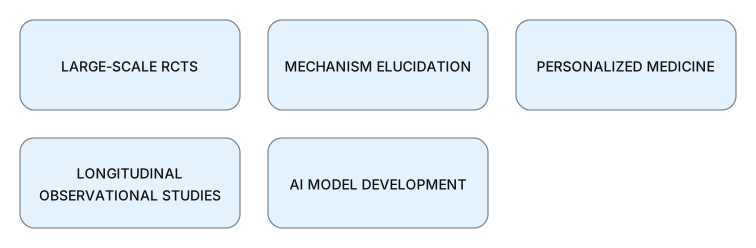
Figure 6. Future research directions (topics)