Abdominal Aortic Aneurysm and Ultrasound: Systematic Review with ☸️SAIMSARA.


saimsara.com Download PDF

Abstract: The aim of this paper is to synthesize current evidence on the role of ultrasound in the assessment and management of abdominal aortic aneurysms. The review utilises 264 studies with 80729 total participants (naïve ΣN). For endoleak detection following endovascular abdominal aortic aneurysm repair (EVAR), ultrasound-based methods demonstrate a median sensitivity of 91.5% and a median specificity of 96.15%, with accuracy ranging from 60% to 97%. These findings underscore ultrasound's critical role in AAA management, from population screening and growth monitoring to post-EVAR surveillance. However, the inherent operator dependence of ultrasound remains a significant limitation affecting the certainty and generalizability of results. Future efforts should focus on developing standardized protocols and integrating AI-assisted diagnostics to further enhance the reliability and widespread utility of ultrasound in abdominal aortic aneurysm care.

Keywords: Abdominal Aortic Aneurysm; Ultrasound Imaging; AAA Screening; AAA Surveillance; Aneurysm Measurement; 3D Ultrasound; Endovascular Aortic Repair; Endoleak Detection; Point-of-Care Ultrasound; Aneurysm Growth

Review Stats
Identification of studies via Semantic Scholar (all fields) Identification Screening Included Records identified:n=2768Records excluded:n=1768 Records assessed for eligibilityn=1000Records excluded:n=736 Studies included in reviewn=264 PRISMA Diagram generated by ☸️ SAIMSARA
⛛OSMA Triangle Effect-of Predictor → Outcome Predictor  →  Outcome Beneficial for patients ΣN=147 (0%) Harmful for patients ΣN=30027 (37%) Neutral ΣN=50555 (63%) 0 ⛛OSMA Triangle generated by ☸️SAIMSARA
Show OSMA legend
Outcome-Sentiment Meta-Analysis (OSMA): (LLM-only)
Frame: Effect-of Predictor → Outcome • Source: Semantic Scholar
Outcome: Outcome Typical timepoints: 3-day, 2-day. Reported metrics: %, CI, p.
Common endpoints: Common endpoints: mortality, complications, recurrence.
Predictor: Predictor — exposure/predictor. Typical comparator: conventional segmentation, ct angiography in detecting, computed tomography, color doppler flow imaging….

  • 1) Beneficial for patients — Outcome with Predictor — [41], [47], [48], [219] — ΣN=147
  • 2) Harmful for patients — Outcome with Predictor — [25], [26], [42], [45], [49], [52], [66], [69], [71], [209], [212], [245], [246] — ΣN=30027
  • 3) No clear effect — Outcome with Predictor — [1], [2], [3], [4], [5], [6], [7], [8], [9], [10], [11], [12], [13], [14], [15], [16], [17], [18], [19], [20], [21], [22], [23], [24], [27], [28], [29], [30], [31], [32], [33], [34], [35], [36], [37], [38], [39], [40], [43], [44], [46], [50], [51], [53], [54], [55], [56], [57], [58], [59], [60], [61], [62], [63], [64], [65], [67], [68], [70], [72], [73], [74], [75], [76], [77], [78], [79], [80], [81], [82], [83], [84], [85], [86], [87], [88], [89], [90], [91], [92], [93], [94], [95], [96], [97], [98], [99], [100], [101], [102], [103], [104], [105], [106], [107], [108], [109], [110], [111], [112], [113], [114], [115], [116], [117], [118], [119], [120], [121], [122], [123], [124], [125], [126], [127], [128], [129], [130], [131], [132], [133], [134], [135], [136], [137], [138], [139], [140], [141], [142], [143], [144], [145], [146], [147], [148], [149], [150], [151], [152], [153], [154], [155], [156], [157], [158], [159], [160], [161], [162], [163], [164], [165], [166], [167], [168], [169], [170], [171], [172], [173], [174], [175], [176], [177], [178], [179], [180], [181], [182], [183], [184], [185], [186], [187], [188], [189], [190], [191], [192], [193], [194], [195], [196], [197], [198], [199], [200], [201], [202], [203], [204], [205], [206], [207], [208], [210], [211], [213], [214], [215], [216], [217], [218], [220], [221], [222], [223], [224], [225], [226], [227], [228], [229], [230], [231], [232], [233], [234], [235], [236], [237], [238], [239], [240], [241], [242], [243], [244], [247], [248], [249], [250], [251], [252], [253], [254], [255], [256], [257], [258], [259], [260], [261], [262], [263], [264] — ΣN=50555
1) Introduction
Abdominal aortic aneurysm (AAA) is a localized dilatation of the abdominal aorta, representing a significant public health concern due to its potential for rupture and associated high mortality. Early detection and continuous surveillance are critical for effective management. Ultrasound, a non-invasive and widely accessible imaging modality, has emerged as a cornerstone in the screening, diagnosis, and post-interventional follow-up of AAAs. This paper systematically synthesizes recent research on the application of ultrasound in AAA, covering its utility in prevalence studies, growth monitoring, advanced imaging techniques, and surveillance after endovascular repair.

2) Aim
The aim of this paper is to synthesize current evidence on the role of ultrasound in the assessment and management of abdominal aortic aneurysms.

3) Methods
Systematic review with multilayer AI research agent: keyword normalization, retrieval & structuring, and paper synthesis (see SAIMSARA About section for details).


4) Results
4.1 Study characteristics:
The evidence base primarily comprises cohort studies (both prospective and retrospective), mixed-design studies, and experimental/synthetic studies, often utilizing animal models or simulations. Populations range from general community screenings in elderly males and high-risk women to specific patient cohorts such as those with coronary artery disease, peripheral arterial disease, or post-endovascular aneurysm repair (EVAR). Follow-up periods, when specified, vary from short-term (e.g., 28 days in animal models) to long-term surveillance spanning up to 10 years in human cohorts.

4.2 Main numerical result aligned to the query:
For endoleak detection following endovascular abdominal aortic aneurysm repair (EVAR), ultrasound-based methods demonstrate high diagnostic performance. The median sensitivity for endoleak detection is 91.5% [169], with reported values ranging from 27% [151] to 100% [40, 151]. The median specificity is 96.15% [30], with values ranging from 92% [17] to 100% [40, 169]. Accuracy for endoleak detection ranges from 60% [151] to 97% [151, 169]. These figures highlight the significant, though variable, efficacy of ultrasound in post-EVAR surveillance.

4.3 Topic synthesis:


5) Discussion
5.1 Principal finding:
Ultrasound-based methods, including conventional duplex ultrasound (DUS) and advanced techniques like contrast-enhanced ultrasound (CEUS) and superb micro-vascular imaging (SMI), demonstrate a median sensitivity of 91.5% [169] and a median specificity of 96.15% [30] for detecting endoleaks after endovascular aneurysm repair (EVAR), indicating their strong utility in post-procedural surveillance.

5.2 Clinical implications:


5.3 Research implications / key gaps:


5.4 Limitations:


5.5 Future directions:


6) Conclusion
For endoleak detection following endovascular abdominal aortic aneurysm repair (EVAR), ultrasound-based methods demonstrate a median sensitivity of 91.5% [169] and a median specificity of 96.15% [30], with accuracy ranging from 60% [151] to 97% [151, 169]. These findings underscore ultrasound's critical role in AAA management, from population screening and growth monitoring to post-EVAR surveillance. However, the inherent operator dependence of ultrasound remains a significant limitation affecting the certainty and generalizability of results. Future efforts should focus on developing standardized protocols and integrating AI-assisted diagnostics to further enhance the reliability and widespread utility of ultrasound in abdominal aortic aneurysm care.

References
SAIMSARA Session Index — session.json

Figure 1. Publication-year distribution of included originals

Figure 2. Study-design distribution of included originals
Figure 2. Study-design distribution

Figure 3. Study-type (directionality) distribution of included originals
Figure 3. Directionality distribution

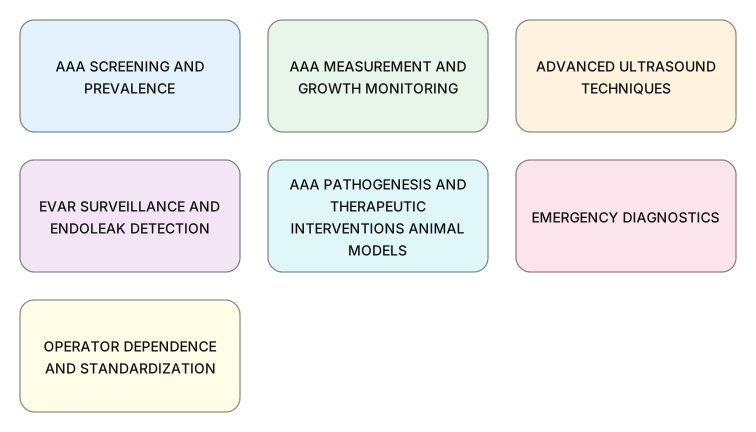
Figure 4. Main extracted research topics
Figure 4. Main extracted research topics (Results)

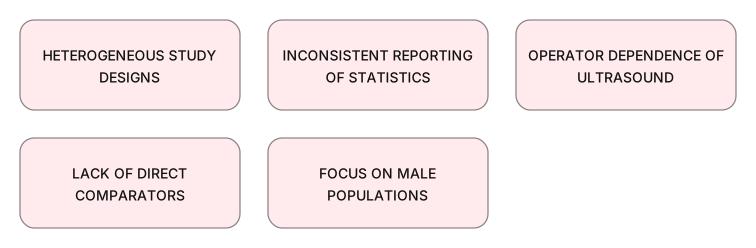
Figure 5. Limitations of current studies (topics)

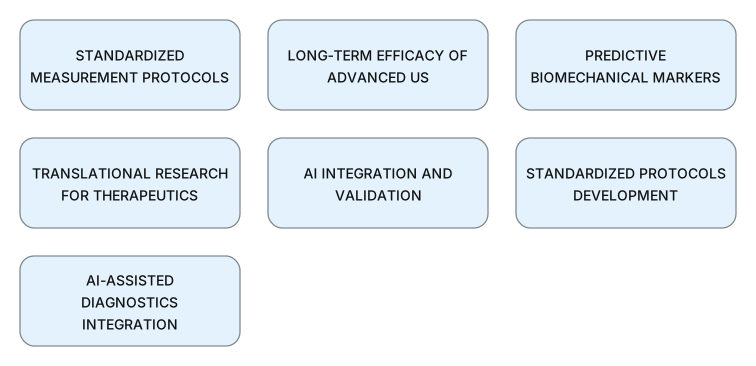
Figure 6. Future research directions (topics)