Acute Limb Ischemia and Risk Factors: Systematic Review with ☸️SAIMSARA.


saimsara.com Download PDF

Abstract: The aim of this paper is to systematically review and synthesize the current evidence regarding acute limb ischemia and its associated risk factors, treatment approaches, and patient outcomes. The review utilises 173 studies with 51224 total participants (naïve ΣN). Acute limb ischemia (ALI) is associated with significant morbidity and mortality, with reported amputation rates ranging from 4.1% to 28.9% and mortality rates from 0.3% to 42.1% across various patient cohorts. These findings generally apply to diverse patient populations, including those with peripheral artery disease, COVID-19, and those undergoing complex medical procedures like ECMO. The heterogeneity of study designs and outcome reporting significantly affects the certainty of generalized conclusions. Therefore, timely diagnosis and intervention, coupled with aggressive management of identified risk factors, remain paramount for improving limb salvage and survival in ALI patients.

Keywords: Acute limb ischemia; Risk factors; Peripheral artery disease; COVID-19; Inflammatory biomarkers; Amputation; Mortality; Atrial fibrillation; End-stage renal disease; Extracorporeal membrane oxygenation

Review Stats
Identification of studies via Semantic Scholar (all fields) Identification Screening Included Records identified:n=120553Records excluded:n=119553 Records assessed for eligibilityn=1000Records excluded:n=827 Studies included in reviewn=173 PRISMA Diagram generated by ☸️ SAIMSARA
⛛OSMA Triangle Effect-of Predictor → Outcome risk factors  →  acute limb ischemia Beneficial for patients ΣN=0 (0%) Harmful for patients ΣN=13533 (26%) Neutral ΣN=37691 (74%) 0 ⛛OSMA Triangle generated by ☸️SAIMSARA
Show OSMA legend
Outcome-Sentiment Meta-Analysis (OSMA): (LLM-only)
Frame: Effect-of Predictor → Outcome • Source: Semantic Scholar
Outcome: acute limb ischemia Typical timepoints: 30-day, peri/post-op. Reported metrics: %, CI, p.
Common endpoints: Common endpoints: mortality, complications, admission.
Predictor: risk factors — exposure/predictor. Routes seen: intravenous. Typical comparator: surgical and hybrid treatments, surgical revascularization in, patients treated for chronic, diabetic mice with acute or….

  • 1) Beneficial for patients — acute limb ischemia with risk factors — — — ΣN=0
  • 2) Harmful for patients — acute limb ischemia with risk factors — [1], [4], [5], [6], [9], [11], [15], [30], [31], [36], [37], [38], [39], [42], [45], [50], [55], [57], [59], [101], [109], [111], [122], [134], [136], [137], [138], [139], [141], [142], [143], [148], [149] — ΣN=13533
  • 3) No clear effect — acute limb ischemia with risk factors — [2], [3], [7], [8], [10], [12], [13], [14], [16], [17], [18], [19], [20], [21], [22], [23], [24], [25], [26], [27], [28], [29], [32], [33], [34], [35], [40], [41], [43], [44], [46], [47], [48], [49], [51], [52], [53], [54], [56], [58], [60], [61], [62], [63], [64], [65], [66], [67], [68], [69], [70], [71], [72], [73], [74], [75], [76], [77], [78], [79], [80], [81], [82], [83], [84], [85], [86], [87], [88], [89], [90], [91], [92], [93], [94], [95], [96], [97], [98], [99], [100], [102], [103], [104], [105], [106], [107], [108], [110], [112], [113], [114], [115], [116], [117], [118], [119], [120], [121], [123], [124], [125], [126], [127], [128], [129], [130], [131], [132], [133], [135], [140], [144], [145], [146], [147], [150], [151], [152], [153], [154], [155], [156], [157], [158], [159], [160], [161], [162], [163], [164], [165], [166], [167], [168], [169], [170], [171], [172], [173] — ΣN=37691
1) Introduction
Acute limb ischemia (ALI) represents a critical vascular emergency characterized by a sudden decrease in limb perfusion, threatening limb viability and often associated with high rates of amputation and mortality. The rapid onset and severe consequences necessitate immediate diagnosis and intervention. Understanding the diverse risk factors contributing to ALI, its prognosis, and the efficacy of various treatment modalities is crucial for improving patient outcomes. This paper synthesizes current evidence on the epidemiology, risk factors, management strategies, and prognostic indicators associated with ALI.

2) Aim
The aim of this paper is to systematically review and synthesize the current evidence regarding acute limb ischemia and its associated risk factors, treatment approaches, and patient outcomes.

3) Methods
Systematic review with multilayer AI research agent: keyword normalization, retrieval & structuring, and paper synthesis (see SAIMSARA About section for details).


4) Results
4.1 Study characteristics
The included studies predominantly comprised retrospective cohort designs, mixed methodologies, and case reports, with a smaller number of prospective cohort studies and randomized controlled trials. Sample sizes varied widely, from single case reports to large cohorts exceeding 6,500 patients [8, 112], and follow-up periods ranged from 30 days to several years, with many studies not specifying a follow-up duration.

4.2 Main numerical result aligned to the query
Acute limb ischemia (ALI) is associated with significant morbidity and mortality, with reported amputation rates ranging from 4.1% [59] to 28.9% [55] and mortality rates from 0.3% [34] to 42.1% [134] across various patient cohorts. The median amputation rate reported was 8.8%, and the median mortality rate was 4.9%.

4.3 Topic synthesis


5) Discussion
5.1 Principal finding
Acute limb ischemia (ALI) is associated with significant morbidity and mortality, with reported amputation rates ranging from 4.1% to 28.9% and mortality rates from 0.3% to 42.1% across various patient cohorts [3, 34, 38, 44, 55, 57, 59, 84, 134].

5.2 Clinical implications


5.3 Research implications / key gaps


5.4 Limitations


5.5 Future directions


6) Conclusion
Acute limb ischemia (ALI) is associated with significant morbidity and mortality, with reported amputation rates ranging from 4.1% to 28.9% and mortality rates from 0.3% to 42.1% across various patient cohorts [3, 34, 38, 44, 55, 57, 59, 84, 134]. These findings generally apply to diverse patient populations, including those with peripheral artery disease, COVID-19, and those undergoing complex medical procedures like ECMO. The heterogeneity of study designs and outcome reporting significantly affects the certainty of generalized conclusions. Therefore, timely diagnosis and intervention, coupled with aggressive management of identified risk factors, remain paramount for improving limb salvage and survival in ALI patients.

References
SAIMSARA Session Index — session.json

Figure 1. Publication-year distribution of included originals

Figure 2. Study-design distribution of included originals
Figure 2. Study-design distribution

Figure 3. Study-type (directionality) distribution of included originals
Figure 3. Directionality distribution

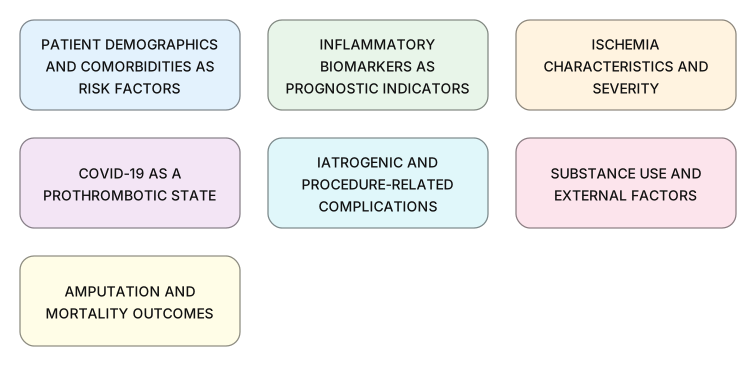
Figure 4. Main extracted research topics
Figure 4. Main extracted research topics (Results)

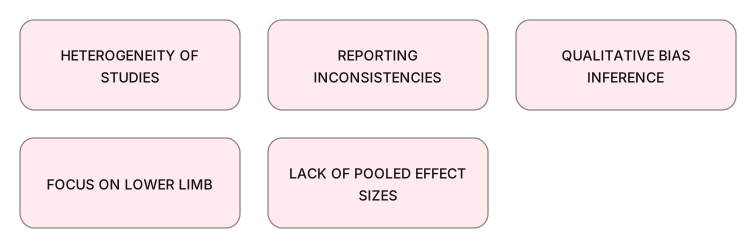
Figure 5. Limitations of current studies (topics)

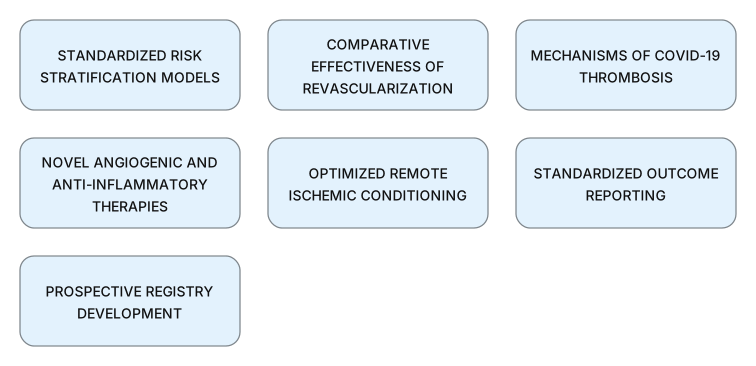
Figure 6. Future research directions (topics)