Alprostadil Iloprost PAD: Systematic Review with ☸️SAIMSARA.


saimsara.com Download PDF

Abstract: Systematic review with multilayer AI research agent: keyword normalization, retrieval & structuring, and paper synthesis (see SAIMSARA About section for details). The review utilises 14 studies with 1400 total participants (naïve ΣN). For ulcer healing and pain relief in conditions like Buerger's disease, comparisons between iloprost and alprostadil showed no clear difference, though iloprost infusion therapy in Peripheral Arterial Disease (PAD) patients was associated with a 41.86% incidence of acute kidney injury (AKI). Both drugs demonstrate efficacy in improving outcomes for patients with microvascular conditions like systemic sclerosis-related Raynaud's phenomenon and digital ulcers, as well as in PAD. The heterogeneity of study designs and small sample sizes represent the most significant limitations affecting the certainty and generalizability of findings. Future research should prioritize large-scale, head-to-head comparative efficacy randomized controlled trials for alprostadil and iloprost in Peripheral Arterial Disease.

Keywords: Alprostadil; Iloprost; Peripheral Arterial Disease

Review Stats
Identification of studies via Semantic Scholar (all fields) Identification Screening Included Records identified:n=88Records excluded:n=0 Records assessed for eligibilityn=88Records excluded:n=74 Studies included in reviewn=14 PRISMA Diagram generated by ☸️ SAIMSARA
⛛OSMA Triangle Effect-of Predictor → Outcome Alprostadil Iloprost  →  Outcome Beneficial for patients ΣN=614 (44%) Harmful for patients ΣN=86 (6%) Neutral ΣN=700 (50%) 0 ⛛OSMA Triangle generated by ☸️SAIMSARA
Show OSMA legend
Outcome-Sentiment Meta-Analysis (OSMA): (LLM-only)
Frame: Effect-of Predictor → Outcome • Source: Semantic Scholar
Outcome: Outcome Reported metrics: %, CI, p.
Common endpoints: Common endpoints: healing, complications.
Predictor: Alprostadil Iloprost — exposure/predictor. Routes seen: intravenous, oral. Typical comparator: alprostadil, ilomedin, control, aspirin in buerger….

  • 1) Beneficial for patients — Outcome with Alprostadil Iloprost — [4], [6], [8], [9], [11], [12], [13] — ΣN=614
  • 2) Harmful for patients — Outcome with Alprostadil Iloprost — [7] — ΣN=86
  • 3) No clear effect — Outcome with Alprostadil Iloprost — [1], [2], [3], [5], [10], [14] — ΣN=700

1) Introduction
Peripheral Arterial Disease (PAD) and related microvascular conditions, such as Raynaud's phenomenon (RP) and digital ulcers (DUs) associated with systemic sclerosis (SSc), represent significant clinical challenges. Prostaglandin I2 (PGI2) analogs, including iloprost and alprostadil, are established therapeutic agents used for their vasodilatory and anti-platelet properties. These agents aim to improve blood flow, facilitate ulcer healing, and alleviate pain in patients suffering from ischemic conditions. This paper synthesizes current evidence on the comparative efficacy, safety, and mechanisms of alprostadil and iloprost in the context of PAD and related vascular disorders.

2) Aim
Systematic review with multilayer AI research agent: keyword normalization, retrieval & structuring, and paper synthesis (see SAIMSARA About section for details).

3) Methods
Systematic review with multilayer AI research agent: keyword normalization, retrieval & structuring, and paper synthesis (see SAIMSARA About section for details).


4) Results
4.1 Study characteristics (1–2 sentences):
The included studies comprised a mix of prospective, retrospective, and cohort designs, including randomized controlled trials and mixed methodologies. Populations primarily consisted of patients with systemic sclerosis, Raynaud's phenomenon, digital ulcers, or Peripheral Arterial Disease, alongside animal models (rats, rabbits) and human smooth muscle cells, with follow-up periods ranging from 30 minutes to 3 years.

4.2 Main numerical result aligned to the query (2–4 sentences):
For ulcer healing and pain relief in conditions like Buerger's disease, comparisons between iloprost and alprostadil showed no clear difference [14]. However, iloprost infusion therapy in Peripheral Arterial Disease (PAD) patients was associated with a 41.86% incidence of acute kidney injury (AKI) [7]. No comparable numerical outcomes for direct head-to-head efficacy between alprostadil and iloprost across the same metric, unit, and timepoint were consistently reported.

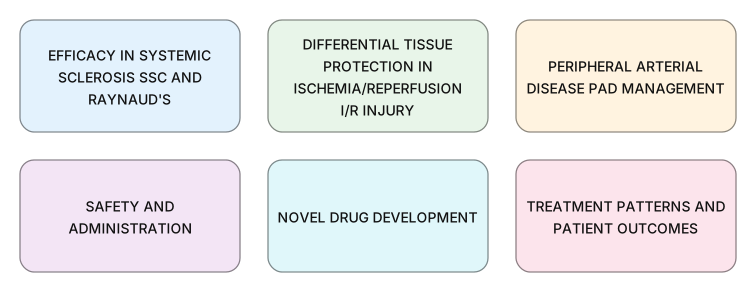
4.3 Topic synthesis (5–7 topics):


5) Discussion
5.1 Principal finding (1–2 sentences):
For ulcer healing and pain relief in conditions like Buerger's disease, comparisons between iloprost and alprostadil showed no clear difference [14], though both demonstrated efficacy in various vascular disorders. Notably, iloprost infusion therapy in Peripheral Arterial Disease (PAD) patients was associated with a 41.86% incidence of acute kidney injury (AKI) [7].

5.2 Clinical implications (3–5 bullets):


5.3 Research implications / key gaps (3–5 bullets):


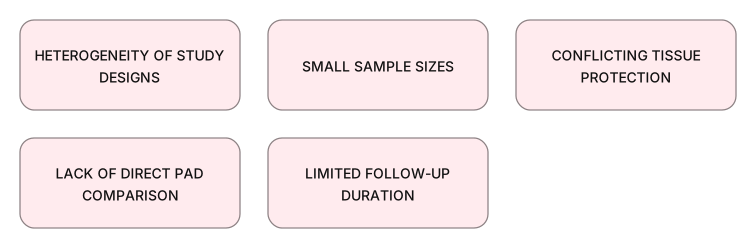
5.4 Limitations (up to 5; parse-friendly):


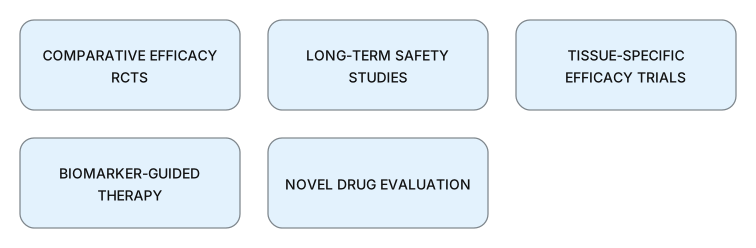
5.5 Future directions (up to 5; parse-friendly):


6) Conclusion
For ulcer healing and pain relief in conditions like Buerger's disease, comparisons between iloprost and alprostadil showed no clear difference [14], though iloprost infusion therapy in Peripheral Arterial Disease (PAD) patients was associated with a 41.86% incidence of acute kidney injury (AKI) [7]. Both drugs demonstrate efficacy in improving outcomes for patients with microvascular conditions like systemic sclerosis-related Raynaud's phenomenon and digital ulcers, as well as in PAD. The heterogeneity of study designs and small sample sizes represent the most significant limitations affecting the certainty and generalizability of findings. Future research should prioritize large-scale, head-to-head comparative efficacy randomized controlled trials for alprostadil and iloprost in Peripheral Arterial Disease.

References
SAIMSARA Session Index — session.json

Figure 1. Publication-year distribution of included originals

Figure 2. Study-design distribution of included originals
Figure 2. Study-design distribution

Figure 3. Study-type (directionality) distribution of included originals
Figure 3. Directionality distribution

Figure 4. Main extracted research topics
Figure 4. Main extracted research topics (Results)

Figure 5. Limitations of current studies (topics)

Figure 6. Future research directions (topics)