Atherectomy for PAD: Systematic Review with ☸️SAIMSARA.


saimsara.com Download PDF

Abstract: The aim of this paper is to systematically review and synthesize the available evidence regarding the performance, safety, and clinical outcomes associated with atherectomy procedures in the treatment of peripheral artery disease. The review utilises 76 studies with 23255 total participants (naïve ΣN). Atherectomy procedures in Peripheral Artery Disease consistently achieve high procedural and technical success rates, with a median of 97.3% (range 84-100%). These interventions are widely applicable across various anatomical sites and lesion complexities in PAD patients, including those with calcified lesions and critical limb ischemia. The primary limitation affecting certainty is the heterogeneity in study designs and outcome reporting, which complicates direct comparisons and comprehensive meta-analysis. A crucial next step is to conduct large-scale, randomized controlled trials with standardized outcome measures to definitively establish the long-term comparative effectiveness of different atherectomy modalities and their role in contemporary PAD management.

Keywords: Atherectomy; Peripheral Artery Disease; Endovascular Procedures

Review Stats
Identification of studies via Semantic Scholar (all fields) Identification Screening Included Records identified:n=189512Records excluded:n=188512 Records assessed for eligibilityn=1000Records excluded:n=924 Studies included in reviewn=76 PRISMA Diagram generated by ☸️ SAIMSARA
⛛OSMA Triangle Effect-of Predictor → Outcome atherectomy  →  pad Beneficial for patients ΣN=2668 (11%) Harmful for patients ΣN=10302 (44%) Neutral ΣN=10285 (44%) 0 ⛛OSMA Triangle generated by ☸️SAIMSARA
Show OSMA legend
Outcome-Sentiment Meta-Analysis (OSMA): (LLM-only)
Frame: Effect-of Predictor → Outcome • Source: Semantic Scholar
Outcome: pad Typical timepoints: 1-y, 12-mo. Reported metrics: %, CI, p.
Common endpoints: Common endpoints: complications, patency, mortality.
Predictor: atherectomy — exposure/predictor. Typical comparator: 6.1, dcb-only treatment in patients, 94.5, dcb angioplasty alone….

  • 1) Beneficial for patients — pad with atherectomy — [1], [2], [3], [4], [6], [7], [8], [9], [10], [11], [13], [14], [16], [20], [21], [24], [25], [29], [33], [35], [37], [38], [40], [45], [56], [60], [61], [62], [63], [69], [70], [74] — ΣN=2668
  • 2) Harmful for patients — pad with atherectomy — [15], [19], [32], [41], [48], [50], [76] — ΣN=10302
  • 3) No clear effect — pad with atherectomy — [5], [12], [17], [18], [22], [23], [26], [27], [28], [30], [31], [34], [36], [39], [42], [43], [44], [46], [47], [49], [51], [52], [53], [54], [55], [57], [58], [59], [64], [65], [66], [67], [68], [71], [72], [73], [75] — ΣN=10285
1) Introduction
Peripheral Artery Disease (PAD) represents a significant global health burden, characterized by stenotic or occlusive lesions in the peripheral arteries, often leading to claudication, critical limb ischemia (CLI), and a heightened risk of amputation. Endovascular interventions have revolutionized the management of PAD, with atherectomy emerging as a crucial adjunctive or primary technique for plaque modification and luminal gain. Atherectomy devices, encompassing directional, orbital, rotational, and laser systems, aim to physically remove atherosclerotic plaque, thereby improving vessel patency and facilitating subsequent therapies such as drug-coated balloon (DCB) angioplasty or stenting. This paper synthesizes current evidence on the efficacy and safety of various atherectomy modalities in diverse PAD patient populations and anatomical locations.

2) Aim
The aim of this paper is to systematically review and synthesize the available evidence regarding the performance, safety, and clinical outcomes associated with atherectomy procedures in the treatment of peripheral artery disease.

3) Methods
Systematic review with multilayer AI research agent: keyword normalization, retrieval & structuring, and paper synthesis (see SAIMSARA About section for details).


4) Results
4.1 Study characteristics:
The included studies predominantly consisted of retrospective and prospective cohort designs, with several mixed-design studies and a few randomized controlled trials. Populations frequently included patients with symptomatic PAD, often with moderate to severely calcified lesions, femoropopliteal (FP) artery disease, or below-the-knee (BTK) pathology. Follow-up periods varied widely, ranging from acute procedural assessment to 2-year and, in some cases, 5-year observations.

4.2 Main numerical result aligned to the query:
Procedural and technical success rates for atherectomy in PAD demonstrated a median of 97.3%, with a range from 84% to 100% across various studies [5, 7, 9, 37, 53, 57, 62, 70]. This indicates a consistently high rate of successful plaque removal and luminal gain during the initial procedure. Heterogeneity exists in the specific definitions of "procedural success" and "technical success" across studies, but the overall trend points to a high immediate efficacy of atherectomy techniques.

4.3 Topic synthesis:


5) Discussion
5.1 Principal finding:
The central finding of this review is that atherectomy procedures in Peripheral Artery Disease consistently achieve high procedural and technical success rates, with a median of 97.3% (range 84-100%) [5, 7, 9, 37, 53, 57, 62, 70], indicating effective immediate plaque removal and luminal restoration.

5.2 Clinical implications:


5.3 Research implications / key gaps:


5.4 Limitations:


5.5 Future directions:


6) Conclusion
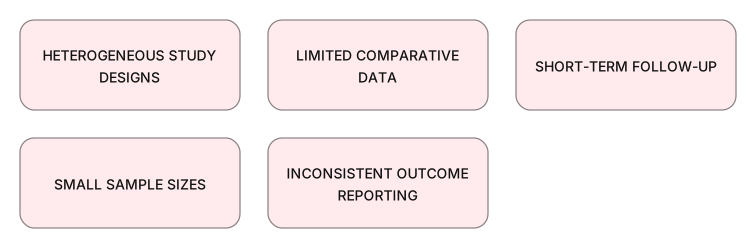
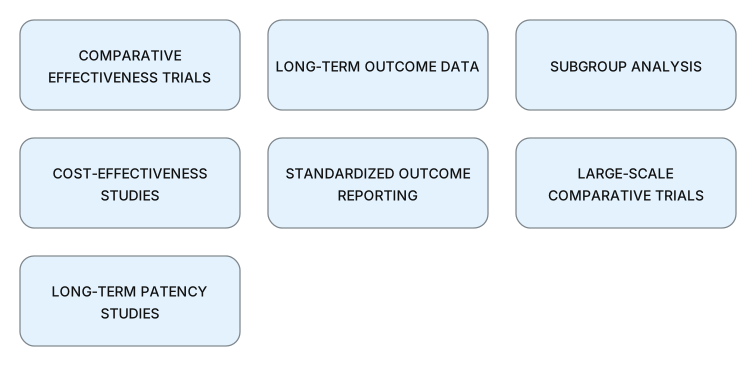
Atherectomy procedures in Peripheral Artery Disease consistently achieve high procedural and technical success rates, with a median of 97.3% (range 84-100%) [5, 7, 9, 37, 53, 57, 62, 70]. These interventions are widely applicable across various anatomical sites and lesion complexities in PAD patients, including those with calcified lesions and critical limb ischemia. The primary limitation affecting certainty is the heterogeneity in study designs and outcome reporting, which complicates direct comparisons and comprehensive meta-analysis. A crucial next step is to conduct large-scale, randomized controlled trials with standardized outcome measures to definitively establish the long-term comparative effectiveness of different atherectomy modalities and their role in contemporary PAD management.

References
SAIMSARA Session Index — session.json

Figure 1. Publication-year distribution of included originals

Figure 2. Study-design distribution of included originals
Figure 2. Study-design distribution

Figure 3. Study-type (directionality) distribution of included originals
Figure 3. Directionality distribution

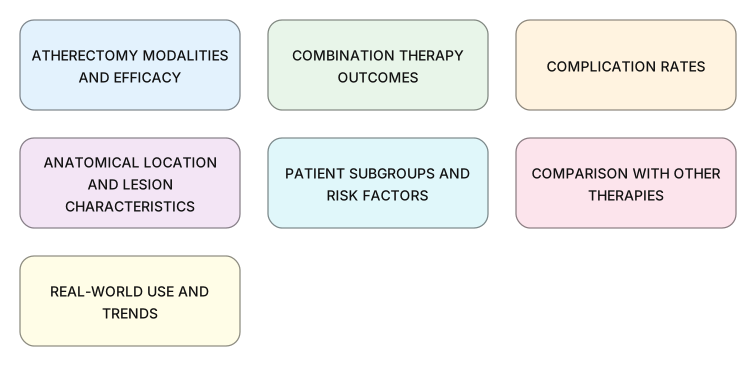
Figure 4. Main extracted research topics
Figure 4. Main extracted research topics (Results)

Figure 5. Limitations of current studies (topics)

Figure 6. Future research directions (topics)