SAIMSARA Journal

Machine Generated Science • ISSN 3054-3991

Brain-Computer Interfaces, Neuroprosthetics, and Neurorehabilitation: Scoping Review with ☸️SAIMSARA.

Digital Health icon

Digital Health

Issue 3, Volume 1, 2026

DOI: 10.62487/saimsarabe9e7f12

Editorial note
• Last update: 2026-05-04 21:46:00
What is this paper about
This review compresses 1,732 original studies into a structured evidence layer for brain-computer interfaces, covering signal decoding, neuroprosthetics, stroke rehabilitation, ALS/SCI communication, implant stability, shared autonomy, and neural-data privacy. It is designed as a dense, citation-linked map for both expert readers and AI systems that need grounded BCI evidence.
Human-verified editorial review Verified by World ID proof-of-human. This editorial layer was submitted from a SAIMSARA account verified as a unique human.

Visual evidence summary
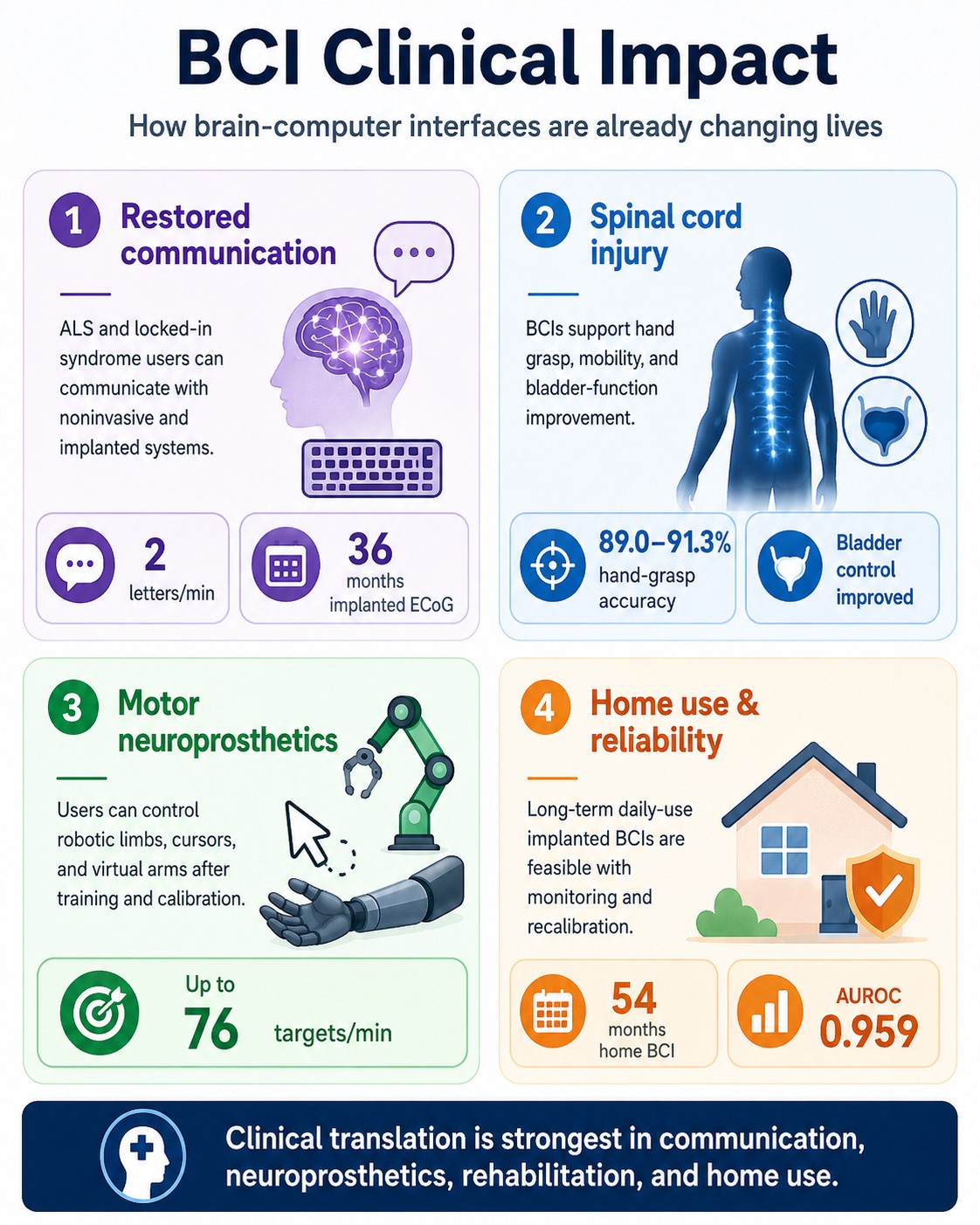
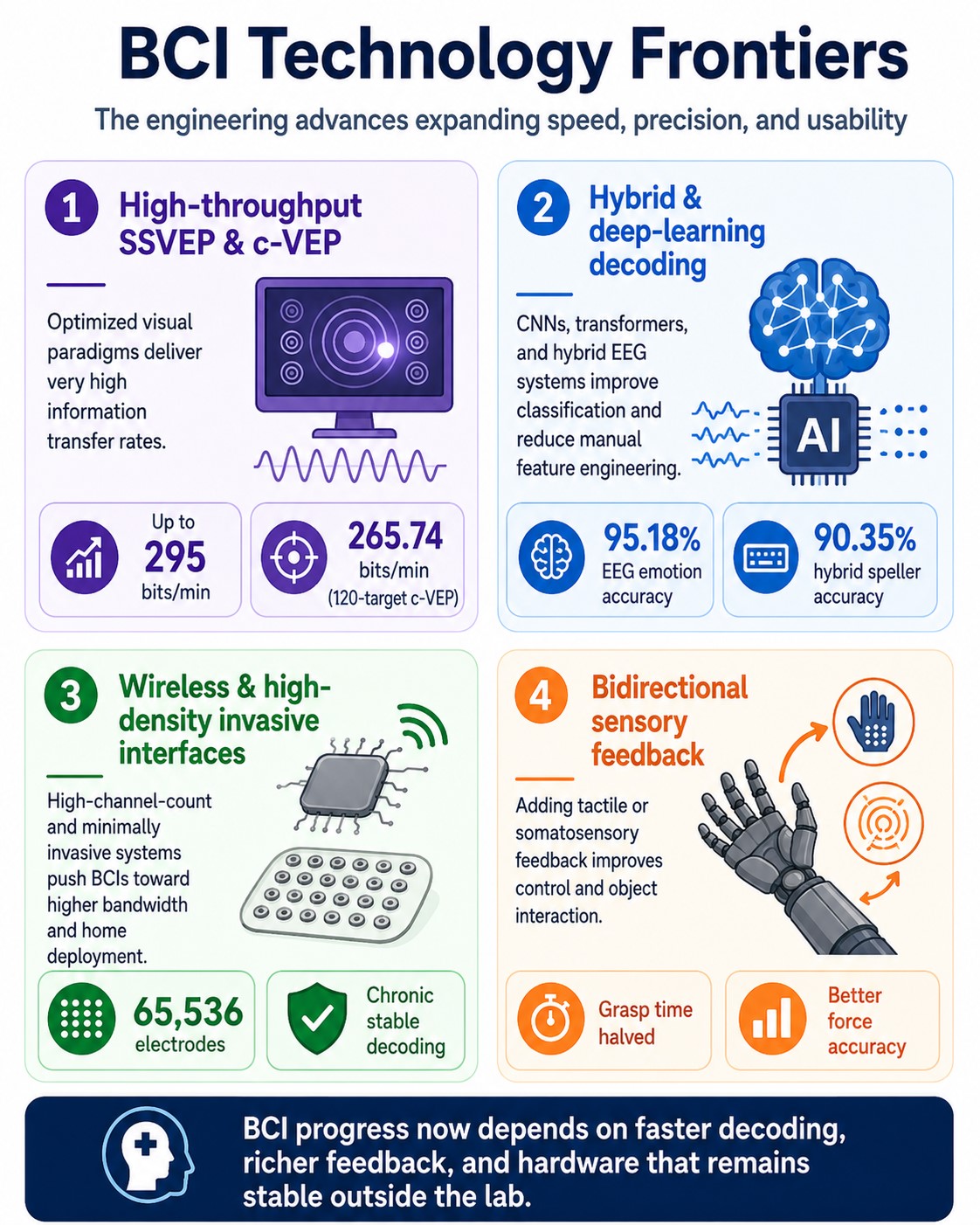
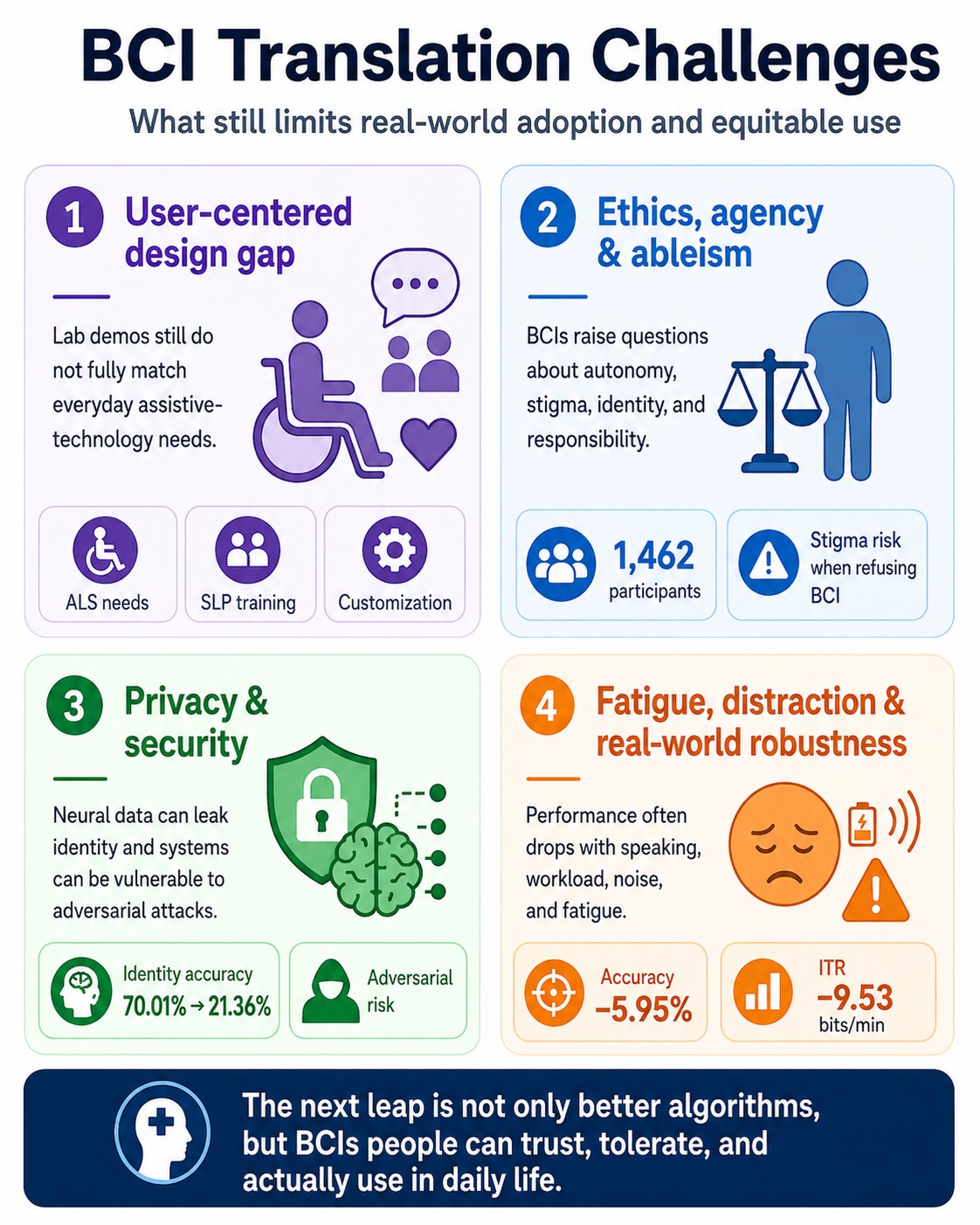
BCI clinical impact summary: restored communication, spinal cord injury applications, motor neuroprosthetics, and home reliability. BCI technology frontiers summary: SSVEP and c-VEP throughput, hybrid deep-learning decoding, wireless invasive interfaces, and sensory feedback. BCI translation challenges summary: user-centered design gap, ethics and agency, privacy and security, fatigue and real-world robustness.
Swipe sideways · tap image to enlarge


Abstract: To synthesize the current state of brain-computer interface research, characterizing technical innovations in signal decoding, clinical efficacy across motor and communication disorders, and the emerging challenges of real-world implementation and ethics. The review utilises 1732 original studies with 49722 total participants (topic deduplicated ΣN). The mapped evidence indicates that brain-computer interfaces have advanced from laboratory demonstrations to clinically meaningful tools, with speech decoding accuracies near 90.59%, information transfer rates exceeding 295 bits/min, and stable implanted electrocorticography systems functioning over 36 to 54 months in users with amyotrophic lateral sclerosis and spinal cord injury. Across the dominant research topics, recurrent signals support a role for brain-computer interfaces in restoring communication for locked-in syndrome, promoting neuroplasticity-driven motor recovery after stroke when paired with functional electrical stimulation or robotics, and detecting residual cognition in disorders of consciousness. Shared autonomy with artificial intelligence copilots, transfer learning, and multimodal sensory feedback emerged as the clearest enablers of practical, low-calibration use, while hybrid paradigms and high-density wireless arrays expanded the technical envelope toward home deployment. Clinically, these findings suggest that brain-computer interface programs are increasingly viable for pediatric, adult, and late-stage neurodegenerative populations, provided thermal, power, artifact, and ethical considerations are managed rigorously. However, the evidence base remains heterogeneous, with small participant cohorts, variable outcome metrics, and persistent gaps between experimental performance and real-world utility under distraction, fatigue, or workload. Future research should prioritize multi-center validation of shared-control and privacy-preserving decoders in domestic settings, alongside longitudinal studies that pair objective aptitude predictors with standardized usability and ethical frameworks to close the user-centered design gap.

Keywords: Brain-Computer Interface; Motor Imagery; Steady-State Visual Evoked Potential; P300 Speller; Implantable BCI; Neurorehabilitation; Amyotrophic Lateral Sclerosis; Sensorimotor Rhythm; Electrocorticography; Virtual Reality

Review Stats

Get access to the full paper

Unlock the full evidence map

The full evidence review, including the Introduction, Methods, Results, Discussion, Conclusion, figures, and complete reference index, opens after purchase or sign-in. The Evidence Object JSON is a separate machine-readable evidence product: a concentrated synthesis of results, topic-level evidence, and discussion across original and non-original studies. It can be directly input into your LLM, agent, or RAG workflow.

Reference Index (186)