Review Stats
- Generated: 2025-09-30 00:06:34 CEST
- Plan: Premium (expanded craft tokens; source: Europe PMC)
- Source: Europe PMC
- Scope: All fields
- Keyword Gate: Fuzzy (≥60% of required terms, minimum 2 terms matched in title/abstract)
- Total Abstracts/Papers: 1013
- Downloaded Abstracts/Papers: 1013
- Included original Abstracts/Papers: 153
- Total study participants (naïve ΣN): 89521
1) Introduction
Bronchiolitis, a common respiratory illness in infants and young children, presents a significant healthcare burden. While supportive care remains the mainstay of treatment, various pharmacological interventions have been explored to alleviate symptoms and shorten disease duration. Among these, nebulized hypertonic saline (HS) has emerged as a subject of considerable research interest, with ongoing debate regarding its efficacy and optimal application. This paper synthesizes the current evidence on the use of hypertonic saline in the management of bronchiolitis.
2) Aim
This systematic review aims to synthesize the available evidence on the efficacy and safety of hypertonic saline in the management of bronchiolitis, focusing on clinical outcomes such as length of hospital stay, clinical severity scores, and hospitalization rates.
3) Methods 3.1 Eligibility criteria: Original studies, including randomized controlled trials (RCTs), cohort studies, and experimental designs, investigating the use of hypertonic saline in patients diagnosed with bronchiolitis were included. Editorials, conference papers, and review articles were excluded.
3.2 Study selection: Studies were selected based on the presence of the keywords "bronchiolitis" and "hypertonic saline" in the structured extraction summary.
3.3 Risk of bias: Risk of bias was inferred from the study design field. RCTs were considered to have lower inherent bias compared to observational studies. However, specific details regarding blinding, randomization completeness, and allocation concealment were not available in the structured summary, limiting a comprehensive risk of bias assessment.
3.4 Synthesis: A three-layer independent agentic AI approach was employed: keyword normalization to identify relevant studies, retrieval and structuring of data from the provided summary, and paper synthesis to generate this review.
4) Results 4.1 Study characteristics: The included studies encompass a range of designs, primarily RCTs and cohort studies, investigating hypertonic saline in pediatric populations, predominantly infants, hospitalized or in outpatient and emergency department settings. Follow-up periods were generally short, often within the hospitalization or immediately post-treatment.
4.2 Main numerical result aligned to the query:
The median reduction in length of hospital stay (LOS) reported across studies is approximately -0.4 days, with a range from -0.21 days to -1.15 days [20, 32, 40, 43, 96, 110, 144, 147, 149]. Some meta-analyses suggest a risk ratio for hospitalization between 0.77 and 0.87 [13, 32, 64, 66, 68, 72, 73], indicating a potential reduction in hospitalization risk. However, significant heterogeneity exists across studies, and some analyses suggest these benefits may represent type I error due to insufficient information size [68].
4.3 Topic synthesis:
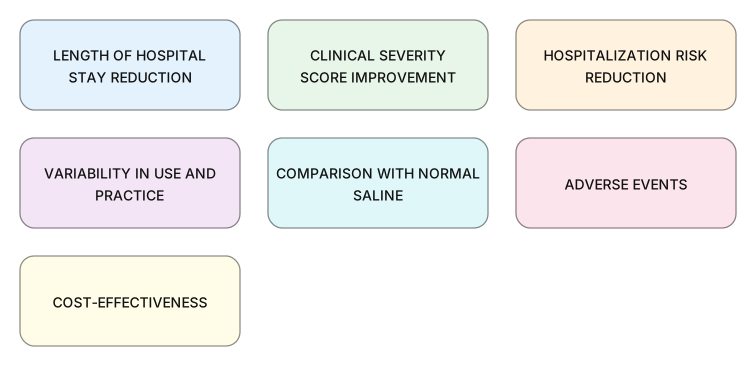
Length of Hospital Stay Reduction: Meta-analyses indicate a modest reduction in LOS, with median reduction around -0.4 days [20, 32, 40, 43, 96, 110, 144, 147, 149]. One study reported a 26% reduction [147]. However, significant heterogeneity and conflicting results exist [64, 68, 94, 101, 111, 115, 119].
Clinical Severity Score Improvement: Several studies report improvements in clinical severity scores (CSS) with hypertonic saline, with one study showing a mean difference of -0.79 on day 1 and -1.27 on day 3 [20]. Other studies also indicate positive effects on CSS [2, 3, 13, 32, 40, 43, 59, 73, 96, 98, 110, 144, 149].
Hospitalization Risk Reduction: Some meta-analyses suggest a reduction in the risk of hospitalization, with risk ratios ranging from 0.77 to 0.87 [13, 32, 64, 66, 68, 72, 73].
Variability in Use and Practice: The use of hypertonic saline varies significantly across hospitals and regions, ranging from 1.3% to 91.7% [6, 10, 15, 21, 35, 44, 50, 56, 61, 71, 86, 89, 91, 100, 124, 136, 144]. Some studies indicate an increase in use post-guideline implementation, potentially contrary to recommendations [15, 23].
Comparison with Normal Saline: Studies comparing hypertonic saline to normal saline show mixed results. Some report no statistically significant difference [1, 11], while others indicate benefits for hypertonic saline [3, 9, 20, 37, 59, 98, 110, 128, 137, 142, 144, 147, 149, 150].
Adverse Events: Mild adverse events, such as increased cough, have been reported [95], and one study noted severe adverse events and parental requests for discontinuation due to discomfort [76].
Cost-Effectiveness: One study suggested that 3% hypertonic saline was cost-saving in emergency settings in Colombia [29], and another found it cost-effective in inpatient treatment [39].
5) Discussion 5.1 Principal finding: Nebulized hypertonic saline may offer a modest benefit in reducing length of hospital stay by approximately -0.4 days [20, 32, 40, 43, 96, 110, 144, 147, 149] and improving clinical severity scores in infants with acute bronchiolitis, though evidence is marked by significant heterogeneity and some studies question its overall efficacy [68, 109, 115, 119].
5.2 Clinical implications:
Inpatient Management: For hospitalized infants with acute bronchiolitis, hypertonic saline may be considered as an adjunctive therapy to potentially shorten hospital stays and improve symptom severity, though its routine use is debated [13, 32, 84, 96].
Outpatient and ED Settings: In outpatient and emergency department settings, hypertonic saline may reduce the risk of hospitalization [13, 66].
Monitoring for Adverse Events: Clinicians should be aware of potential adverse events, such as increased cough or discomfort, and monitor patients accordingly [76, 95].
Variability in Practice: The wide variation in hypertonic saline use across institutions highlights a lack of consistent clinical practice and adherence to guidelines [6, 10, 15, 21, 35, 44, 50, 56, 61, 71, 86, 89, 91, 100, 124, 136, 144].
5.3 Research implications / key gaps:
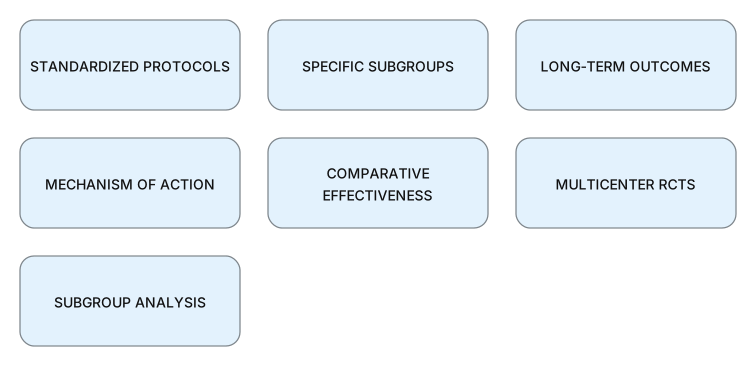
Standardized Protocols: The lack of standardized protocols for hypertonic saline administration (concentration, frequency, duration) across studies hinders direct comparison and meta-analysis [57, 113].
Specific Subgroups: Further research is needed to identify specific patient subgroups (e.g., by severity, age, viral etiology) who might derive the most benefit from hypertonic saline [27].
Long-term Outcomes: The long-term effects and safety profile of hypertonic saline in bronchiolitis management remain under-investigated [18].
Mechanism of Action: While hypertonic saline is known to draw fluid into the airways, its precise cellular and molecular mechanisms in the context of viral bronchiolitis require further elucidation [18].
Comparative Effectiveness: Robust head-to-head comparisons with other emerging therapies or optimal supportive care are needed to establish hypertonic saline's definitive role [117].
5.4 Limitations:
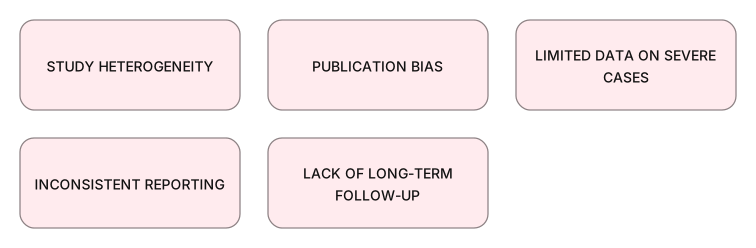
Study Heterogeneity — Significant heterogeneity in study populations, interventions, comparators, and outcome measures limits the ability to draw definitive conclusions.
Publication Bias — The potential for publication bias, where studies with positive results are more likely to be published, may skew the overall findings.
Limited Data on Severe Cases — The majority of studies focus on mild to moderate bronchiolitis, with less data available on critically ill or mechanically ventilated children.
Inconsistent Reporting — Inconsistent reporting of statistical methods, confidence intervals, and specific outcome metrics across studies complicates direct numerical comparisons.
Lack of Long-term Follow-up — Most studies have short follow-up periods, precluding assessment of long-term sequelae or sustained benefits.
5.5 Future directions:
Multicenter RCTs — Conduct large-scale, multicenter RCTs with standardized protocols to definitively assess hypertonic saline's efficacy and safety.
Subgroup Analysis — Design studies to specifically investigate the efficacy of hypertonic saline in well-defined patient subgroups (e.g., by age, severity, RSV status).
Biomarker Identification — Explore biomarkers that predict response to hypertonic saline therapy to personalize treatment.
Cost-Effectiveness Analysis — Perform rigorous cost-effectiveness analyses in diverse healthcare settings to inform resource allocation.
Comparative Effectiveness Studies — Compare hypertonic saline directly against other inhaled therapies and optimal supportive care to establish its relative value.
6) Conclusion
Nebulized hypertonic saline may offer a modest reduction in length of hospital stay by approximately -0.4 days [20, 32, 40, 43, 96, 110, 144, 147, 149] and improve clinical severity scores in infants with acute bronchiolitis, but the evidence is marked by significant heterogeneity and some studies question its overall efficacy [68, 109, 115, 119]. Generalizability is limited by the predominance of studies on mild to moderate cases and the wide variation in clinical practice. The significant heterogeneity across studies is the primary limitation affecting certainty. Further large-scale, standardized trials are needed to definitively establish its role in clinical practice.