Bypass OR PTA for Peripheral Artery Disease: Systematic Review with ☸️SAIMSARA.


saimsara.com Download PDF

Abstract: To systematically review and synthesize the current evidence regarding percutaneous transluminal angioplasty (PTA) and bypass surgery for peripheral artery disease (PAD), identifying key outcomes, influencing factors, and areas for future research. The review utilises 177 studies with 948808 total participants (naïve ΣN). The evidence concerning the comparative effectiveness of percutaneous transluminal angioplasty (PTA) versus bypass surgery for peripheral artery disease (PAD) is varied, with some studies indicating superior outcomes for surgical revascularization in specific patient groups (e.g., CLTI with adequate saphenous vein), while others suggest lower amputation rates post-PTA in diabetic CLI, and many finding comparable outcomes for amputation. This variability underscores the need for a personalized approach to revascularization, considering the specific patient and lesion characteristics. The most significant limitation affecting certainty is the Lack of Direct Comparisons, particularly well-designed, long-term randomized controlled trials. Clinicians should consider advanced endovascular techniques (e.g., drug-coated balloons) as a superior option to plain PTA where applicable, and tailor the overall strategy based on comprehensive patient assessment and available conduits.

Keywords: Peripheral Artery Disease; Bypass Surgery; Percutaneous Transluminal Angioplasty; Revascularization; Critical Limb Ischemia; Limb Salvage; Amputation; Arterial Patency; Endovascular Interventions; Lower Extremity Arterial Disease

Review Stats
Identification of studies via Semantic Scholar (all fields) Identification Screening Included Records identified:n=3985Records excluded:n=2985 Records assessed for eligibilityn=1000Records excluded:n=823 Studies included in reviewn=177 PRISMA Diagram generated by ☸️ SAIMSARA
⛛OSMA Triangle Head-to-Head (A vs B) bypass vs pta — peripheral artery disease Legend: “Favours bypass” = left edge, “Favours pta” = right edge; “Neutral” = vertical. Favours bypass ΣN=30 (0%) Favours pta ΣN=564 (0%) Neutral ΣN=948214 (100%) 0 ⛛OSMA Triangle generated by ☸️SAIMSARA
Show OSMA legend
Outcome-Sentiment Meta-Analysis (OSMA): (LLM-only)
Frame: Head-to-Head (A vs B) • Source: Semantic Scholar
Comparators: A = bypass; B = pta
Outcome: peripheral artery disease Typical timepoints: peri/post-op, 1-y. Reported metrics: %, CI, p.
Common endpoints: Common endpoints: mortality, complications, patency.
Predictor: bypass vs pta — exposure/predictor.

  • 1) A favored (bypass) — peripheral artery disease with bypass vs pta — [4] — ΣN=30
  • 2) B favored (pta) — peripheral artery disease with bypass vs pta — [153] — ΣN=564
  • 3) Neutral (no difference) — peripheral artery disease with bypass vs pta — [1], [2], [3], [5], [6], [7], [8], [9], [10], [11], [12], [13], [14], [15], [16], [17], [18], [19], [20], [21], [22], [23], [24], [25], [26], [27], [28], [29], [30], [31], [32], [33], [34], [35], [36], [37], [38], [39], [40], [41], [42], [43], [44], [45], [46], [47], [48], [49], [50], [51], [52], [53], [54], [55], [56], [57], [58], [59], [60], [61], [62], [63], [64], [65], [66], [67], [68], [69], [70], [71], [72], [73], [74], [75], [76], [77], [78], [79], [80], [81], [82], [83], [84], [85], [86], [87], [88], [89], [90], [91], [92], [93], [94], [95], [96], [97], [98], [99], [100], [101], [102], [103], [104], [105], [106], [107], [108], [109], [110], [111], [112], [113], [114], [115], [116], [117], [118], [119], [120], [121], [122], [123], [124], [125], [126], [127], [128], [129], [130], [131], [132], [133], [134], [135], [136], [137], [138], [139], [140], [141], [142], [143], [144], [145], [146], [147], [148], [149], [150], [151], [152], [154], [155], [156], [157], [158], [159], [160], [161], [162], [163], [164], [165], [166], [167], [168], [169], [170], [171], [172], [173], [174], [175], [176], [177] — ΣN=948214
1) Introduction
Peripheral artery disease (PAD) represents a significant global health burden, characterized by atherosclerotic lesions in arteries outside of the heart and brain, often leading to symptomatic claudication or critical limb ischemia (CLI). Revascularization strategies, primarily percutaneous transluminal angioplasty (PTA) and surgical bypass, are crucial for managing PAD, improving blood flow, alleviating symptoms, and preventing limb loss. The choice between these interventions is complex, influenced by lesion characteristics, patient comorbidities, and anticipated long-term outcomes. This paper synthesizes current evidence on the comparative effectiveness, safety, and influencing factors of PTA and bypass surgery in the context of PAD, drawing insights from a comprehensive review of recent literature.

2) Aim
To systematically review and synthesize the current evidence regarding percutaneous transluminal angioplasty (PTA) and bypass surgery for peripheral artery disease (PAD), identifying key outcomes, influencing factors, and areas for future research.

3) Methods
Systematic review with multilayer AI research agent: keyword normalization, retrieval & structuring, and paper synthesis (see SAIMSARA About section for details).


4) Results
4.1 Study characteristics:
The included studies comprise a diverse range of designs, predominantly retrospective cohort studies and mixed designs, alongside several randomized controlled trials (RCTs), prospective cohort studies, and case series/reports. Populations frequently include patients with peripheral artery disease (PAD), critical limb ischemia (CLI), diabetic foot ulcers (DFU), and those undergoing coronary artery bypass grafting (CABG) with concomitant PAD. Common arterial targets include femoropopliteal, infrapopliteal, iliac, and superficial femoral artery (SFA) lesions. Follow-up periods vary widely, ranging from in-hospital assessments to 12 months, 2 years, 3 years, 5 years, and up to 10 years.

4.2 Main numerical result aligned to the query:
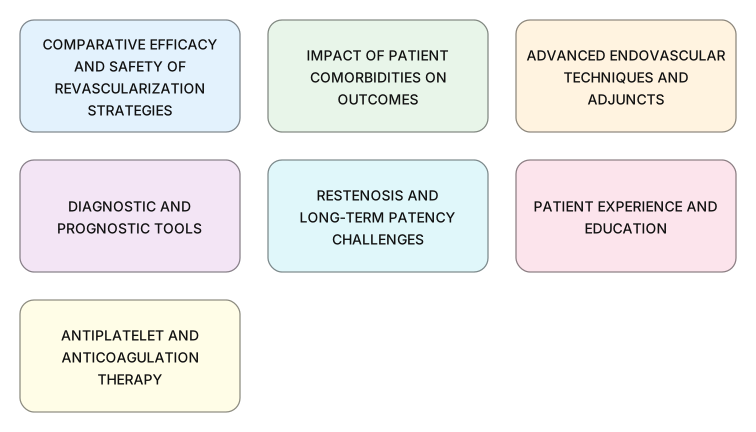
Direct, broadly comparable numerical outcomes for "bypass vs. PTA" across multiple studies with consistent metrics, units, and timepoints are highly heterogeneous due to variations in intervention types (e.g., plain PTA, drug-coated balloon (DCB), drug-eluting resorbable scaffold (DRS), atherectomy, different bypass graft materials), arterial locations, and patient characteristics. However, several studies offer insights into comparative efficacy. For instance, in patients with chronic limb-threatening ischemia (CLTI) and an adequate great saphenous vein, surgical revascularization resulted in significantly fewer major adverse limb events (MALE) or death compared to endovascular therapy (hazard ratio, 0.68; 95% CI, 0.59 to 0.79; P<0.001) [95]. Conversely, in diabetic patients with critical limb ischemia (CLI), major amputation rates were reported to be lower after percutaneous transluminal angioplasty (PTA) (8.2%) compared to bypass graft (BPG) (21.1%) [153]. Other studies found no significant differences in 1-year amputation rates between peripheral endovascular interventions (PVI) and lower extremity bypass surgery (LEB) [3] or between bypass surgery and angioplasty (4% vs. 6%, P=0.14) [36]. Advanced endovascular techniques, such as drug-coated balloons (DCBs) and drug-eluting resorbable scaffolds (DRSs), consistently demonstrated superior primary patency and lower revascularization rates compared to standard PTA in femoropopliteal and infrapopliteal lesions [11, 23, 32, 125].

4.3 Topic synthesis:


5) Discussion
5.1 Principal finding:
The evidence concerning the comparative effectiveness of percutaneous transluminal angioplasty (PTA) versus bypass surgery for peripheral artery disease (PAD) is varied, with some studies indicating superior outcomes for surgical revascularization in specific patient groups (e.g., CLTI with adequate saphenous vein [95]), while others suggest lower amputation rates post-PTA in diabetic CLI [153], and many finding comparable outcomes for amputation [3, 36]. Advanced endovascular techniques, such as drug-coated balloons (DCBs) and drug-eluting resorbable scaffolds (DRSs), consistently demonstrate superior patency and reduced reintervention rates compared to standard PTA [11, 23, 32, 125].

5.2 Clinical implications:


5.3 Research implications / key gaps:


5.4 Limitations:


5.5 Future directions:


6) Conclusion
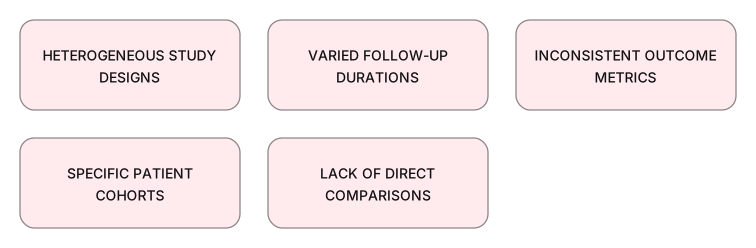
The evidence concerning the comparative effectiveness of percutaneous transluminal angioplasty (PTA) versus bypass surgery for peripheral artery disease (PAD) is varied, with some studies indicating superior outcomes for surgical revascularization in specific patient groups (e.g., CLTI with adequate saphenous vein [95]), while others suggest lower amputation rates post-PTA in diabetic CLI [153], and many finding comparable outcomes for amputation [3, 36]. This variability underscores the need for a personalized approach to revascularization, considering the specific patient and lesion characteristics. The most significant limitation affecting certainty is the Lack of Direct Comparisons, particularly well-designed, long-term randomized controlled trials. Clinicians should consider advanced endovascular techniques (e.g., drug-coated balloons) as a superior option to plain PTA where applicable, and tailor the overall strategy based on comprehensive patient assessment and available conduits.

References
SAIMSARA Session Index — session.json

Figure 1. Publication-year distribution of included originals

Figure 2. Study-design distribution of included originals
Figure 2. Study-design distribution

Figure 3. Study-type (directionality) distribution of included originals
Figure 3. Directionality distribution

Figure 4. Main extracted research topics
Figure 4. Main extracted research topics (Results)

Figure 5. Limitations of current studies (topics)

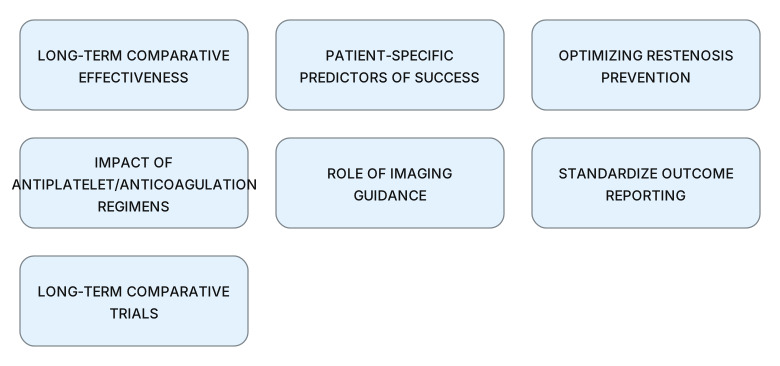
Figure 6. Future research directions (topics)