Carotid Disease Medication: Systematic Review with ☸️SAIMSARA.


saimsara.com Download PDF

Abstract: This paper aims to systematically review and synthesize the current evidence regarding medication use in carotid disease, focusing on treatment efficacy, adherence, and outcomes across various patient populations and clinical contexts. The review utilises 250 studies with 404013 total participants (naïve ΣN). Statin therapy is consistently associated with a median 41% (range: 25% to 51.8%) lower risk of adverse outcomes such as major adverse cardiac and cerebrovascular events (MACCE), death post-carotid endarterectomy (CEA), or restenosis. These findings are generally applicable across diverse patient populations with carotid disease, highlighting the critical role of statins in preventing progression and improving outcomes. However, the heterogeneous nature of study designs and outcome metrics represents the most significant limitation to synthesizing a comprehensive understanding of medication efficacy. A concrete next step is to conduct large-scale, prospective, randomized controlled trials with standardized outcome measures to compare the long-term effectiveness of different medication regimens in reducing carotid disease progression and clinical events.

Keywords: Carotid disease; Carotid stenosis; Carotid plaque; Antiplate

Review Stats
Identification of studies via Semantic Scholar (all fields) Identification Screening Included Records identified:n=291478Records excluded:n=290478 Records assessed for eligibilityn=1000Records excluded:n=750 Studies included in reviewn=250 PRISMA Diagram generated by ☸️ SAIMSARA
⛛OSMA Triangle Effect-of Predictor → Outcome medication  →  carotid disease Beneficial for patients ΣN=13125 (3%) Harmful for patients ΣN=14681 (4%) Neutral ΣN=376207 (93%) 0 ⛛OSMA Triangle generated by ☸️SAIMSARA
Show OSMA legend
Outcome-Sentiment Meta-Analysis (OSMA): (LLM-only)
Frame: Effect-of Predictor → Outcome • Source: Semantic Scholar
Outcome: carotid disease Typical timepoints: peri/post-op, 1-y. Reported metrics: %, CI, p.
Common endpoints: Common endpoints: complications, mortality, functional.
Predictor: medication — exposure/predictor. Routes seen: topical, oral, intravenous. Typical comparator: control, healthy controls, those without cognitive, metabolically healthy normal….

  • 1) Beneficial for patients — carotid disease with medication — [6], [12], [13], [17], [18], [20], [23], [44], [48], [56], [58], [72], [73], [105], [108], [113], [114], [117], [124], [131], [133], [137], [141], [145], [147], [178], [181], [186], [192], [200], [203], [212], [213], [225], [238], [245], [249] — ΣN=13125
  • 2) Harmful for patients — carotid disease with medication — [5], [7], [11], [19], [24], [50], [103], [109], [112], [115], [121], [143], [149], [177], [194], [196], [198] — ΣN=14681
  • 3) No clear effect — carotid disease with medication — [1], [2], [3], [4], [8], [9], [10], [14], [15], [16], [21], [22], [25], [26], [27], [28], [29], [30], [31], [32], [33], [34], [35], [36], [37], [38], [39], [40], [41], [42], [43], [45], [46], [47], [49], [51], [52], [53], [54], [55], [57], [59], [60], [61], [62], [63], [64], [65], [66], [67], [68], [69], [70], [71], [74], [75], [76], [77], [78], [79], [80], [81], [82], [83], [84], [85], [86], [87], [88], [89], [90], [91], [92], [93], [94], [95], [96], [97], [98], [99], [100], [101], [102], [104], [106], [107], [110], [111], [116], [118], [119], [120], [122], [123], [125], [126], [127], [128], [129], [130], [132], [134], [135], [136], [138], [139], [140], [142], [144], [146], [148], [150], [151], [152], [153], [154], [155], [156], [157], [158], [159], [160], [161], [162], [163], [164], [165], [166], [167], [168], [169], [170], [171], [172], [173], [174], [175], [176], [179], [180], [182], [183], [184], [185], [187], [188], [189], [190], [191], [193], [195], [197], [199], [201], [202], [204], [205], [206], [207], [208], [209], [210], [211], [214], [215], [216], [217], [218], [219], [220], [221], [222], [223], [224], [226], [227], [228], [229], [230], [231], [232], [233], [234], [235], [236], [237], [239], [240], [241], [242], [243], [244], [246], [247], [248], [250] — ΣN=376207
1) Introduction
Carotid artery disease, a significant contributor to cerebrovascular events, necessitates effective medical management to mitigate progression and prevent adverse outcomes. The landscape of carotid disease medication encompasses a broad spectrum of pharmacological agents, including antiplatelets, lipid-lowering therapies, and antihypertensive drugs, often complemented by lifestyle modifications. Understanding the efficacy, adherence patterns, and specific considerations for these medications across diverse patient populations is crucial for optimizing clinical practice. This paper synthesizes current research on carotid disease medication, drawing insights from a structured extraction of scientific literature.

2) Aim
This paper aims to systematically review and synthesize the current evidence regarding medication use in carotid disease, focusing on treatment efficacy, adherence, and outcomes across various patient populations and clinical contexts.

3) Methods
Systematic review with multilayer AI research agent: keyword normalization, retrieval & structuring, and paper synthesis (see SAIMSARA About section for details).


4) Results
4.1 Study characteristics: The review encompassed a diverse range of study designs, including numerous cohort studies (retrospective and prospective), randomized controlled trials (RCTs), cross-sectional studies, and case reports. Populations varied widely, from patients undergoing carotid intervention or with specific comorbidities like type 2 diabetes mellitus (T2DM) and HIV, to healthy community-dwelling individuals. Follow-up periods ranged from short-term (e.g., 24 hours postoperatively [162]) to long-term (e.g., 15.1 years [60], 18.8 years [52]), with many studies not specifying a follow-up duration.

4.2 Main numerical result aligned to the query: Statin therapy is consistently associated with a reduction in adverse cardiovascular events and disease progression in carotid disease patients. Specifically, statin use was linked to a median 41% (range: 25% to 51.8%) lower risk of adverse outcomes such as major adverse cardiac and cerebrovascular events (MACCE) [90], death post-carotid endarterectomy (CEA) [91], or restenosis [87].

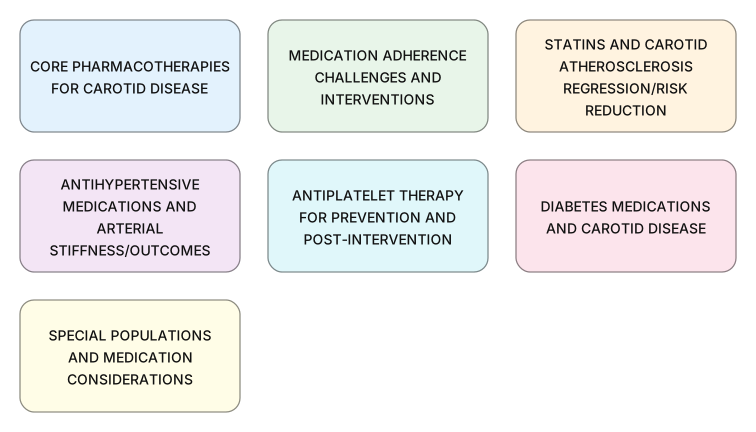
4.3 Topic synthesis:


5) Discussion
5.1 Principal finding: Statin therapy consistently demonstrates a significant protective effect, associated with a median 41% (range: 25% to 51.8%) lower risk of adverse cardiovascular outcomes, death, or restenosis in patients with carotid disease [87, 90, 91].

5.2 Clinical implications:


5.3 Research implications / key gaps:


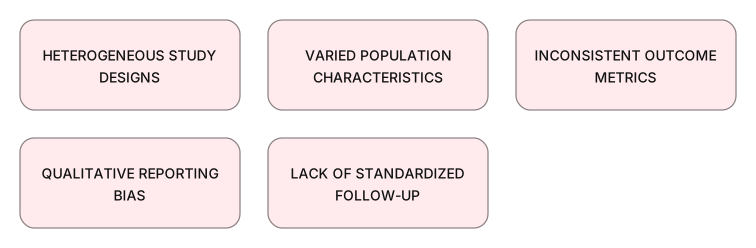
5.4 Limitations:


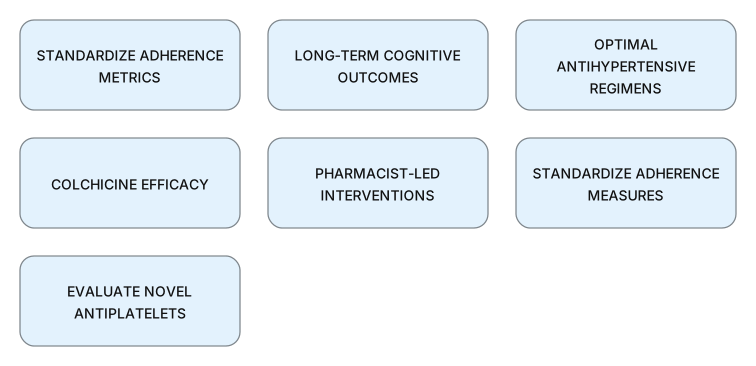
5.5 Future directions:


6) Conclusion
Statin therapy is consistently associated with a median 41% (range: 25% to 51.8%) lower risk of adverse outcomes such as major adverse cardiac and cerebrovascular events (MACCE), death post-carotid endarterectomy (CEA), or restenosis [87, 90, 91]. These findings are generally applicable across diverse patient populations with carotid disease, highlighting the critical role of statins in preventing progression and improving outcomes. However, the heterogeneous nature of study designs and outcome metrics represents the most significant limitation to synthesizing a comprehensive understanding of medication efficacy. A concrete next step is to conduct large-scale, prospective, randomized controlled trials with standardized outcome measures to compare the long-term effectiveness of different medication regimens in reducing carotid disease progression and clinical events.

References
SAIMSARA Session Index — session.json

Figure 1. Publication-year distribution of included originals

Figure 2. Study-design distribution of included originals
Figure 2. Study-design distribution

Figure 3. Study-type (directionality) distribution of included originals
Figure 3. Directionality distribution

Figure 4. Main extracted research topics
Figure 4. Main extracted research topics (Results)

Figure 5. Limitations of current studies (topics)

Figure 6. Future research directions (topics)