Carotid Disease and Stroke: Systematic Review with ☸️SAIMSARA.


saimsara.com Download PDF

Abstract: Systematic review with multilayer AI research agent: keyword normalization, retrieval & structuring, and paper synthesis (see SAIMSARA About section for details). The review utilises 180 studies with 304624 total participants (naïve ΣN). The median perioperative or 30-day stroke or death rate associated with carotid interventions or cardiac procedures where carotid disease is a factor was 2.1%, with a range of 0.6% to 4.3%. These findings are drawn from a wide array of study designs and patient populations, limiting the overall generalizability of the aggregated evidence. The most significant limitation affecting certainty is the variability in patient populations, which makes it difficult to draw universal conclusions. Clinicians should prioritize comprehensive carotid plaque characterization beyond stenosis alone to identify vulnerable plaques and individualize stroke prevention strategies.

Keywords: Carotid Disease; Stroke; Carotid Artery Stenosis; Carotid Plaque; Intima-Media Thickness; Ischemic Stroke; Stroke Risk Factors; Carotid Revascularization; Plaque Imaging; Transient Ischemic Attack

Review Stats
Identification of studies via Semantic Scholar (all fields) Identification Screening Included Records identified:n=13937Records excluded:n=12937 Records assessed for eligibilityn=1000Records excluded:n=820 Studies included in reviewn=180 PRISMA Diagram generated by ☸️ SAIMSARA
⛛OSMA Triangle Effect-of Predictor → Outcome carotid disease  →  stroke Beneficial for patients ΣN=13563 (4%) Harmful for patients ΣN=112186 (37%) Neutral ΣN=178875 (59%) 0 ⛛OSMA Triangle generated by ☸️SAIMSARA
Show OSMA legend
Outcome-Sentiment Meta-Analysis (OSMA): (LLM-only)
Frame: Effect-of Predictor → Outcome • Source: Semantic Scholar
Outcome: stroke Typical timepoints: peri/post-op, 1-y. Reported metrics: %, CI, p.
Common endpoints: Common endpoints: complications, mortality, functional.
Predictor: carotid disease — exposure/predictor. Routes seen: oral, iv. Typical comparator: cea, tf-cas, women, a population-based cohort….

  • 1) Beneficial for patients — stroke with carotid disease — [29], [32], [34], [44], [97], [99], [141], [145], [148] — ΣN=13563
  • 2) Harmful for patients — stroke with carotid disease — [2], [3], [4], [6], [10], [13], [14], [16], [17], [18], [19], [24], [25], [26], [27], [28], [35], [36], [38], [42], [47], [48], [49], [50], [77], [80], [83], [85], [88], [89], [93], [96], [103], [104], [105], [112], [121], [131], [132], [135], [137], [139], [143], [147], [151], [152], [153], [154], [158], [159], [160], [161], [164], [169], [174], [175], [176], [178] — ΣN=112186
  • 3) No clear effect — stroke with carotid disease — [1], [5], [7], [8], [9], [11], [12], [15], [20], [21], [22], [23], [30], [31], [33], [37], [39], [40], [41], [43], [45], [46], [51], [52], [53], [54], [55], [56], [57], [58], [59], [60], [61], [62], [63], [64], [65], [66], [67], [68], [69], [70], [71], [72], [73], [74], [75], [76], [78], [79], [81], [82], [84], [86], [87], [90], [91], [92], [94], [95], [98], [100], [101], [102], [106], [107], [108], [109], [110], [111], [113], [114], [115], [116], [117], [118], [119], [120], [122], [123], [124], [125], [126], [127], [128], [129], [130], [133], [134], [136], [138], [140], [142], [144], [146], [149], [150], [155], [156], [157], [162], [163], [165], [166], [167], [168], [170], [171], [172], [173], [177], [179], [180] — ΣN=178875
1) Introduction
Carotid artery disease, primarily atherosclerosis, is a major contributor to ischemic stroke, a leading cause of morbidity and mortality worldwide. The pathogenesis involves the development of plaques within the carotid arteries, which can lead to stroke through luminal stenosis, plaque rupture with subsequent embolization, or hemodynamic compromise. Understanding the intricate relationship between carotid disease characteristics—such as intima-media thickness (IMT), plaque burden, composition, and inflammation—and the risk of stroke is crucial for effective prevention, diagnosis, and management. This paper synthesizes current research on this critical association, exploring risk factors, diagnostic advancements, therapeutic interventions, and areas requiring further investigation.

2) Aim
Systematic review with multilayer AI research agent: keyword normalization, retrieval & structuring, and paper synthesis (see SAIMSARA About section for details).

3) Methods
Systematic review with multilayer AI research agent: keyword normalization, retrieval & structuring, and paper synthesis (see SAIMSARA About section for details).


4) Results
4.1 Study characteristics:
The included studies primarily comprised cohort (prospective and retrospective), cross-sectional, and mixed designs, with a smaller number of randomized controlled trials and case series. Populations ranged from general middle-aged and elderly adults to specific patient groups undergoing transcatheter aortic valve replacement (TAVR), coronary artery bypass grafting (CABG), or presenting with transient ischemic attack (TIA) and acute ischemic stroke. Follow-up periods varied widely, from immediate perioperative outcomes to long-term observations spanning up to 28 years.

4.2 Main numerical result aligned to the query:
The median perioperative or 30-day stroke or death rate associated with carotid interventions or cardiac procedures where carotid disease is a factor was 2.1%, with a range of 0.6% [21] to 4.3% [158].

4.3 Topic synthesis:


5) Discussion
5.1 Principal finding:
The median perioperative or 30-day stroke or death rate associated with carotid interventions or cardiac procedures where carotid disease is a factor was 2.1%, with a range of 0.6% [21] to 4.3% [158], highlighting the persistent risk of cerebrovascular events despite advancements in care.

5.2 Clinical implications:


5.3 Research implications / key gaps:


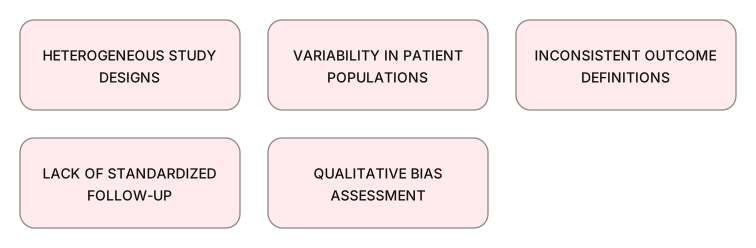
5.4 Limitations:


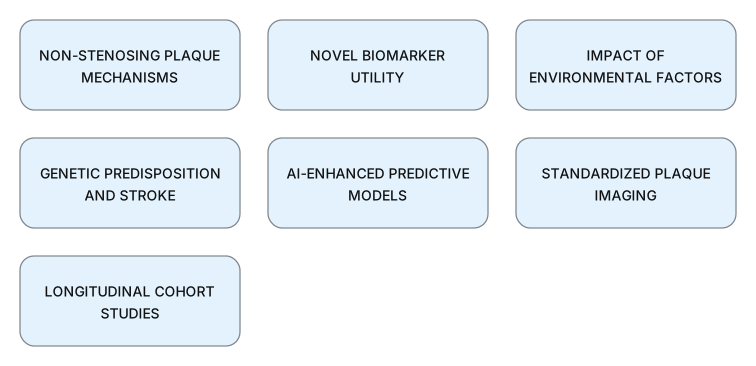
5.5 Future directions:


6) Conclusion
The median perioperative or 30-day stroke or death rate associated with carotid interventions or cardiac procedures where carotid disease is a factor was 2.1%, with a range of 0.6% [21] to 4.3% [158]. These findings are drawn from a wide array of study designs and patient populations, limiting the overall generalizability of the aggregated evidence. The most significant limitation affecting certainty is the variability in patient populations, which makes it difficult to draw universal conclusions. Clinicians should prioritize comprehensive carotid plaque characterization beyond stenosis alone to identify vulnerable plaques and individualize stroke prevention strategies.

References
SAIMSARA Session Index — session.json

Figure 1. Publication-year distribution of included originals

Figure 2. Study-design distribution of included originals
Figure 2. Study-design distribution

Figure 3. Study-type (directionality) distribution of included originals
Figure 3. Directionality distribution

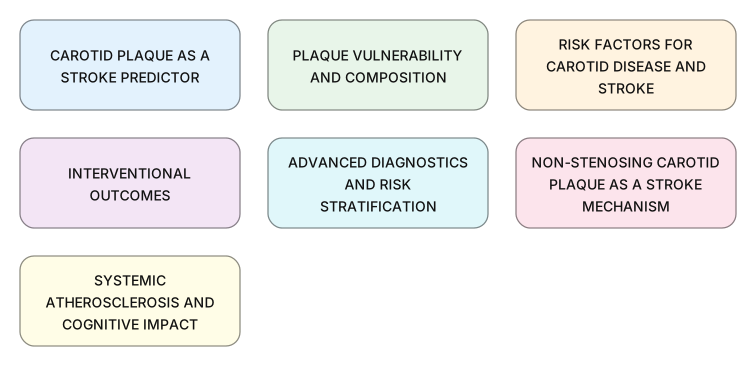
Figure 4. Main extracted research topics
Figure 4. Main extracted research topics (Results)

Figure 5. Limitations of current studies (topics)

Figure 6. Future research directions (topics)