Carotid Stenosis and Gender: Systematic Review with ☸️SAIMSARA.


saimsara.com Download PDF

Abstract: The aim of this paper is to systematically review and synthesize the current evidence regarding the influence of gender on carotid stenosis, its associated clinical manifestations, treatment outcomes, and underlying pathophysiological mechanisms. The review utilises 228 studies with 756419 total participants (naïve ΣN). A single central value for the association between carotid stenosis and gender cannot be computed due to the heterogeneity of metrics and populations across studies; however, males generally exhibit a higher prevalence and severity of carotid artery stenosis compared to females. This generalizability is limited by the heterogeneous metrics and study designs, with the most significant limitation being the Heterogeneous Metrics, which prevented a unified quantitative synthesis. Clinicians should recognize that gender plays a distinct role in carotid stenosis presentation and outcomes, particularly in treatment-related risks for females, necessitating personalized approaches to screening, management, and post-procedural care.

Keywords: Carotid Stenosis; Sex Differences; Gender; Atherosclerosis; Ischemic Stroke; Risk Factors

Review Stats
Identification of studies via Semantic Scholar (all fields) Identification Screening Included Records identified:n=866Records excluded:n=0 Records assessed for eligibilityn=866Records excluded:n=638 Studies included in reviewn=228 PRISMA Diagram generated by ☸️ SAIMSARA
⛛OSMA Triangle Effect-of Predictor → Outcome gender  →  carotid stenosis Beneficial for patients ΣN=45981 (6%) Harmful for patients ΣN=35750 (5%) Neutral ΣN=674688 (89%) 0 ⛛OSMA Triangle generated by ☸️SAIMSARA
Show OSMA legend
Outcome-Sentiment Meta-Analysis (OSMA): (LLM-only)
Frame: Effect-of Predictor → Outcome • Source: Semantic Scholar
Outcome: carotid stenosis Typical timepoints: peri/post-op, 10-y. Reported metrics: %, CI, p.
Common endpoints: Common endpoints: complications, mortality, functional.
Predictor: gender — exposure/predictor. Doses/units seen: 30 mg, 90 ml. Typical comparator: controls, male patients. female sex is, control, those without carotid artery….

  • 1) Beneficial for patients — carotid stenosis with gender — [21], [23], [131], [135], [142], [146], [172], [185], [186], [190], [213], [214], [219] — ΣN=45981
  • 2) Harmful for patients — carotid stenosis with gender — [4], [5], [8], [9], [14], [24], [34], [35], [50], [79], [84], [90], [99], [134], [139], [144], [145], [147], [152], [154], [155], [159], [161], [163], [165], [166], [169], [170], [180], [191], [203], [222], [226] — ΣN=35750
  • 3) No clear effect — carotid stenosis with gender — [1], [2], [3], [6], [7], [10], [11], [12], [13], [15], [16], [17], [18], [19], [20], [22], [25], [26], [27], [28], [29], [30], [31], [32], [33], [36], [37], [38], [39], [40], [41], [42], [43], [44], [45], [46], [47], [48], [49], [51], [52], [53], [54], [55], [56], [57], [58], [59], [60], [61], [62], [63], [64], [65], [66], [67], [68], [69], [70], [71], [72], [73], [74], [75], [76], [77], [78], [80], [81], [82], [83], [85], [86], [87], [88], [89], [91], [92], [93], [94], [95], [96], [97], [98], [100], [101], [102], [103], [104], [105], [106], [107], [108], [109], [110], [111], [112], [113], [114], [115], [116], [117], [118], [119], [120], [121], [122], [123], [124], [125], [126], [127], [128], [129], [130], [132], [133], [136], [137], [138], [140], [141], [143], [148], [149], [150], [151], [153], [156], [157], [158], [160], [162], [164], [167], [168], [171], [173], [174], [175], [176], [177], [178], [179], [181], [182], [183], [184], [187], [188], [189], [192], [193], [194], [195], [196], [197], [198], [199], [200], [201], [202], [204], [205], [206], [207], [208], [209], [210], [211], [212], [215], [216], [217], [218], [220], [221], [223], [224], [225], [227], [228] — ΣN=674688
1) Introduction
Carotid artery stenosis (CAS), a narrowing of the carotid arteries, is a significant risk factor for ischemic stroke and cognitive impairment. Its etiology is multifactorial, involving traditional cardiovascular risk factors such as age, hypertension, dyslipidemia, and smoking [12, 16, 48, 104]. The clinical presentation and prognosis of CAS can vary widely, from asymptomatic disease to acute ischemic stroke (AIS) [2, 5, 8]. Given the complex interplay of risk factors and outcomes, understanding the role of biological sex and gender-related factors in the development, progression, and management of CAS is crucial. This paper synthesizes current research on the relationship between carotid stenosis and gender, drawing insights from a comprehensive structured extraction.

2) Aim
The aim of this paper is to systematically review and synthesize the current evidence regarding the influence of gender on carotid stenosis, its associated clinical manifestations, treatment outcomes, and underlying pathophysiological mechanisms.

3) Methods
Systematic review with multilayer AI research agent: keyword normalization, retrieval & structuring, and paper synthesis (see SAIMSARA About section for details).


4) Results
4.1 Study characteristics:
The included studies span from 2000 to 2025, employing diverse designs such as cross-sectional, retrospective, prospective cohort, and mixed-design studies. Populations investigated include ischemic stroke patients, asymptomatic carotid stenosis (ACS) patients, individuals undergoing cardiac or carotid surgery, and community-dwelling subjects. Sample sizes range from small cohorts (e.g., N=5 [15], N=20 [2]) to large registries (e.g., N=2,635,595 [105], N=52,023 [107]). Follow-up periods vary from short-term (e.g., 30 days [4, 14]) to long-term (e.g., 23.4 years [15], 10 years [51, 154]).

4.2 Main numerical result aligned to the query:
A single central value for the association between carotid stenosis and gender cannot be computed due to the heterogeneity of metrics (e.g., average stenosis percentage, prevalence of specific stenosis grades, odds ratios for various outcomes) and populations across studies. However, a consistent trend indicates that males generally exhibit a higher prevalence and severity of carotid artery stenosis compared to females [6, 23, 90, 118, 120, 146, 152, 180, 185, 186, 195]. For instance, average carotid stenosis was reported as 20.84% in males versus 16.92% in females in one study [146], and the prevalence of 90-99% stenosis was 14.3% in men compared to 7.8% in women in another [118]. Furthermore, carotid atherosclerosis was found to be more severe in males (5.08% vs. 3.04% for stenosis, 1.49% vs. 0.69% for moderate to severe stenosis) in a large cohort [120]. Conversely, female gender was significantly associated with carotid atherosclerotic plaques in one prospective study (odds ratio = 3.23, P = .001) [190], and with lower extremity arterial disease (LEAD) in Chinese diabetic patients (male OR=2.54, 95% CI 1.30–5.00, P=0.007) [99].

4.3 Topic synthesis:


5) Discussion
5.1 Principal finding:
The principal finding of this review is that males consistently exhibit a higher prevalence and severity of carotid artery stenosis compared to females [6, 23, 90, 118, 120, 146, 152, 180, 185, 186, 195]. For instance, average stenosis was reported as 20.84% in males versus 16.92% in females in one study [146], highlighting a notable gender disparity in atherosclerotic burden.

5.2 Clinical implications:


5.3 Research implications / key gaps:


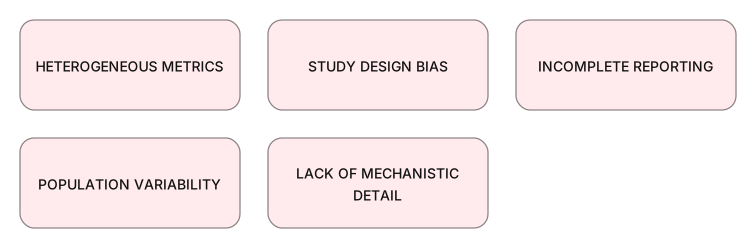
5.4 Limitations:


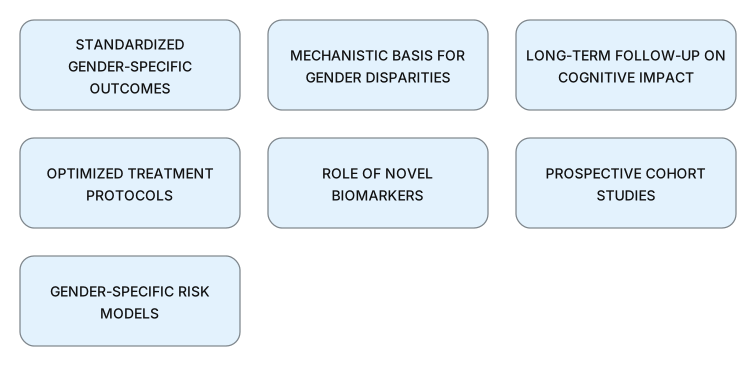
5.5 Future directions:


6) Conclusion
A single central value for the association between carotid stenosis and gender cannot be computed due to the heterogeneity of metrics and populations across studies; however, males generally exhibit a higher prevalence and severity of carotid artery stenosis compared to females [6, 23, 90, 118, 120, 146, 152, 180, 185, 186, 195]. This generalizability is limited by the heterogeneous metrics and study designs, with the most significant limitation being the Heterogeneous Metrics, which prevented a unified quantitative synthesis. Clinicians should recognize that gender plays a distinct role in carotid stenosis presentation and outcomes, particularly in treatment-related risks for females, necessitating personalized approaches to screening, management, and post-procedural care.

References
SAIMSARA Session Index — session.json

Figure 1. Publication-year distribution of included originals

Figure 2. Study-design distribution of included originals
Figure 2. Study-design distribution

Figure 3. Study-type (directionality) distribution of included originals
Figure 3. Directionality distribution

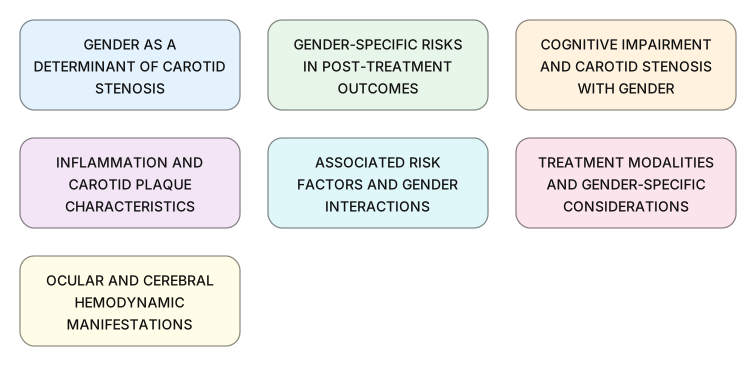
Figure 4. Main extracted research topics
Figure 4. Main extracted research topics (Results)

Figure 5. Limitations of current studies (topics)

Figure 6. Future research directions (topics)