Carotid Web: Systematic Review with ☸️SAIMSARA.


saimsara.com Download PDF

Abstract: This paper aims to synthesize the current understanding of carotid webs, their characteristics, diagnostic approaches, pathophysiological mechanisms, and treatment outcomes, to identify key research gaps and inform future clinical practice. The review utilises 134 studies with 148725 total participants (naïve ΣN). Carotid webs are associated with a high risk of recurrent ischemic events under medical management alone, with reported recurrence rates varying widely, for example, from 17% within 2 years to 71.4% in a prospective series and 56%, and cumulative rates reaching 27.3% at 5 years. This high recurrence risk is particularly relevant for younger patients with cryptogenic stroke. The substantial heterogeneity in study designs and follow-up periods across the current literature most affects the certainty of definitive conclusions regarding optimal management. Therefore, a critical next step is to conduct large-scale, prospective comparative effectiveness trials to establish the best treatment strategies for symptomatic carotid webs.

Keywords: Carotid web; Ischemic stroke; Stroke recurrence; Thrombus formation; Carotid artery stenting; Carotid endarterectomy; CT angiography; Ultrasound imaging; Risk stratification; Geometric parameters

Review Stats
Identification of studies via Semantic Scholar (all fields) Identification Screening Included Records identified:n=1988106Records excluded:n=1987106 Records assessed for eligibilityn=1000Records excluded:n=866 Studies included in reviewn=134 PRISMA Diagram generated by ☸️ SAIMSARA
⛛OSMA Triangle Effect-of Predictor → Outcome carotid web  →  Outcome Beneficial for patients ΣN=150 (0%) Harmful for patients ΣN=11958 (8%) Neutral ΣN=136617 (92%) 0 ⛛OSMA Triangle generated by ☸️SAIMSARA
Show OSMA legend
Outcome-Sentiment Meta-Analysis (OSMA): (LLM-only)
Frame: Effect-of Predictor → Outcome • Source: Semantic Scholar
Outcome: Outcome Typical timepoints: 1-y, 3-y. Reported metrics: %, CI, p.
Common endpoints: Common endpoints: complications, occlusion, recurrence.
Predictor: carotid web — exposure/predictor. Doses/units seen: 0.17 ml. Routes seen: oral. Typical comparator: asymptomatic caws, those without cw, stenting for carotid, conventional ultrasound….

  • 1) Beneficial for patients — Outcome with carotid web — [13], [14], [38], [45], [79], [80], [83] — ΣN=150
  • 2) Harmful for patients — Outcome with carotid web — [1], [2], [3], [4], [9], [11], [17], [19], [21], [24], [25], [27], [29], [32], [33], [43], [57], [60], [66], [74], [76], [78], [81], [90], [91], [100] — ΣN=11958
  • 3) No clear effect — Outcome with carotid web — [5], [6], [7], [8], [10], [12], [15], [16], [18], [20], [22], [23], [26], [28], [30], [31], [34], [35], [36], [37], [39], [40], [41], [42], [44], [46], [47], [48], [49], [50], [51], [52], [53], [54], [55], [56], [58], [59], [61], [62], [63], [64], [65], [67], [68], [69], [70], [71], [72], [73], [75], [77], [82], [84], [85], [86], [87], [88], [89], [92], [93], [94], [95], [96], [97], [98], [99], [101], [102], [103], [104], [105], [106], [107], [108], [109], [110], [111], [112], [113], [114], [115], [116], [117], [118], [119], [120], [121], [122], [123], [124], [125], [126], [127], [128], [129], [130], [131], [132], [133], [134] — ΣN=136617
1) Introduction
Carotid webs (CWs), also known as intimal fibromuscular dysplasia, are increasingly recognized as a significant, yet often underdiagnosed, cause of ischemic stroke, particularly in younger patients and those with cryptogenic stroke [20, 21, 48, 51, 52, 55, 76, 90, 102, 103, 118]. These non-atherosclerotic fibrous bands typically arise along the posterior margin of the carotid bulb, causing mild luminal narrowing [106, 116]. Their presence is associated with disturbed flow patterns and the potential for thrombus formation, leading to acute ischemic events [2, 5, 31, 74, 75, 105]. The clinical challenge lies in their identification, risk stratification, and optimal management, given the substantial risk of recurrent stroke under medical therapy alone [11, 17, 81, 118].

2) Aim
This paper aims to synthesize the current understanding of carotid webs, their characteristics, diagnostic approaches, pathophysiological mechanisms, and treatment outcomes, to identify key research gaps and inform future clinical practice.

3) Methods
Systematic review with multilayer AI research agent: keyword normalization, retrieval & structuring, and paper synthesis (see SAIMSARA About section for details).


4) Results
4.1 Study characteristics
The included studies predominantly employed mixed (retrospective and prospective components) or retrospective designs, alongside cohort studies, cross-sectional analyses, and numerous case series [1, 2, 3, 4, 5, 6, 7, 8, 9, 10, 11, 12, 13, 14, 16, 17, 18, 19, 20, 21, 22, 23, 24, 26, 27, 28, 29, 30, 31, 32, 33, 34, 35, 36, 37, 38, 40, 41, 42, 43, 44, 45, 46, 47, 49, 50, 52, 53, 54, 55, 56, 57, 58, 59, 60, 61, 62, 63, 64, 70, 74, 75, 76, 77, 78, 79, 80, 81, 82, 83, 84, 85, 92, 93, 94, 95, 96, 97, 98, 99, 100, 102, 103, 104, 105, 106, 107, 108, 109, 110, 111, 112, 113, 114, 115, 116, 117, 118, 119, 120, 121, 122, 123, 124, 125, 126, 127, 128, 129, 130, 131, 132, 133, 134]. Populations primarily consisted of patients with symptomatic and asymptomatic carotid webs, often presenting with acute ischemic stroke (AIS) or transient ischemic attack (TIA), with some studies focusing on younger cohorts or cryptogenic stroke [1, 2, 3, 4, 7, 9, 10, 11, 16, 17, 19, 20, 21, 22, 24, 29, 32, 33, 34, 37, 39, 41, 43, 44, 45, 52, 55, 57, 59, 60, 61, 62, 70, 76, 77, 78, 79, 80, 81, 84, 102, 103, 111, 112, 118]. Follow-up periods varied widely, from short-term (e.g., 30 days [77], median 154 days [59]) to intermediate (e.g., 1 year [13, 45, 114, 115, 117], 2 years [3, 11]) and longer durations (e.g., 5 years [17], 12 years [70]).

4.2 Main numerical result aligned to the query
Carotid webs are associated with a high risk of recurrent ischemic events under medical management alone, with reported recurrence rates varying widely depending on the study population and follow-up duration. For instance, a prospective series reported 71.4% recurrent stroke [81], while other studies indicated recurrence rates of 56% [118] and 17% within 2 years compared to 3% in patients without CW [11]. Cumulative recurrence rates under medical treatment alone have been observed to reach 27.3% at 5 years [17].

4.3 Topic synthesis


5) Discussion
5.1 Principal finding
The principal finding is that carotid webs are associated with a high risk of recurrent ischemic events under medical management alone, with reported recurrence rates varying widely, for example, from 17% within 2 years [11] to 71.4% in a prospective series [81] and 56% [118], and cumulative rates reaching 27.3% at 5 years [17]. This underscores the inadequacy of conservative approaches for symptomatic patients.

5.2 Clinical implications


5.3 Research implications / key gaps


5.4 Limitations


5.5 Future directions


6) Conclusion
Carotid webs are associated with a high risk of recurrent ischemic events under medical management alone, with reported recurrence rates varying widely, for example, from 17% within 2 years [11] to 71.4% in a prospective series [81] and 56% [118], and cumulative rates reaching 27.3% at 5 years [17]. This high recurrence risk is particularly relevant for younger patients with cryptogenic stroke. The substantial heterogeneity in study designs and follow-up periods across the current literature most affects the certainty of definitive conclusions regarding optimal management. Therefore, a critical next step is to conduct large-scale, prospective comparative effectiveness trials to establish the best treatment strategies for symptomatic carotid webs.

References
SAIMSARA Session Index — session.json

Figure 1. Publication-year distribution of included originals

Figure 2. Study-design distribution of included originals
Figure 2. Study-design distribution

Figure 3. Study-type (directionality) distribution of included originals
Figure 3. Directionality distribution

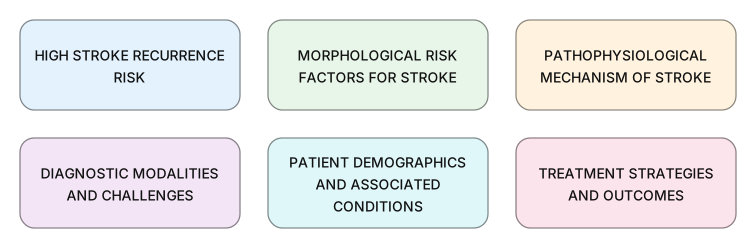
Figure 4. Main extracted research topics
Figure 4. Main extracted research topics (Results)

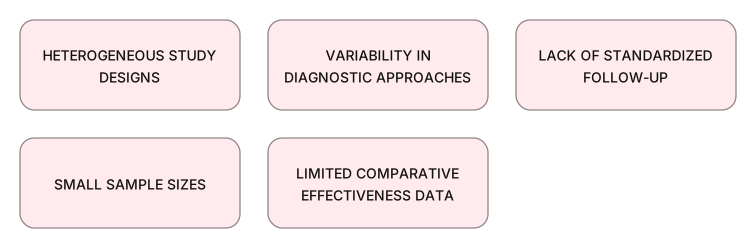
Figure 5. Limitations of current studies (topics)

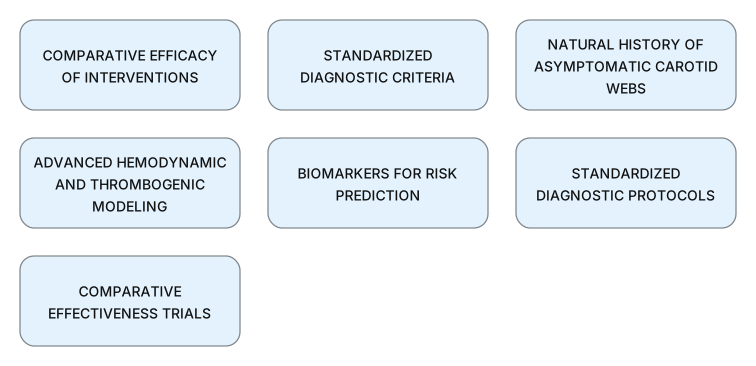
Figure 6. Future research directions (topics)