Coated CVC and Complications: Systematic Review with ☸️SAIMSARA.


saimsara.com

Review Stats
Identification of studies via EPMC (all fields) Identification Screening Included Records identified:n=596Records excluded:n=0 Records assessed for eligibilityn=596Records excluded:n=568 Studies included in reviewn=28 PRISMA Diagram generated by ☸️ SAIMSARA
⛛OSMA Triangle Effect-of Predictor → Outcome coated CVC  →  complications Beneficial for patients ΣN=726 (19%) Harmful for patients ΣN=101 (3%) Neutral ΣN=3024 (79%) 0 ⛛OSMA Triangle generated by ☸️SAIMSARA
Outcome-Sentiment Meta-Analysis (OSMA): (LLM-only)
Frame: Effect-of Predictor → Outcome • Source: Europe PMC
Outcome: complications Reported metrics: %, CI, p.
Common endpoints: Common endpoints: complications, los.
Predictor: coated CVC — exposure/predictor. Typical comparator: uncoated catheters, the control group, control, noncoated cvcs….


1) Introduction
Central venous catheters (CVCs) are indispensable medical devices for patient management across various clinical settings, enabling drug administration, fluid resuscitation, and hemodynamic monitoring. Despite their utility, CVCs are associated with significant complications, primarily catheter-related bloodstream infections (CRBSIs) and thrombosis. These complications contribute to increased morbidity, mortality, and healthcare costs. The development of CVCs with specialized coatings represents a promising strategy to mitigate these adverse events by conferring antimicrobial, antithrombotic, or dual-action properties to the catheter surface. This paper synthesizes current evidence on the efficacy and implications of coated CVCs in reducing complications.

2) Aim
This paper aims to systematically review and synthesize the available evidence on the effectiveness of coated central venous catheters in reducing complications, specifically focusing on infection and thrombosis, as well as to identify relevant research gaps and clinical implications.

3) Methods
This rapid systematic review was conducted using an autonomous multilayer AI research agent (SAIMSARA) for keyword normalization, retrieval & structuring, and paper synthesis.

3.1 Eligibility criteria: Original studies investigating coated CVCs and their associated complications were included. Reviews, editorials, and conference papers were excluded. Studies were selected based on their relevance to the "coated CVC and complications" query.

3.2 Study selection: Study selection was performed by applying a strict keyword gate during the initial retrieval phase, as managed by the SAIMSARA agent. The structured summary provided contains the filtered Original Studies.

3.3 Risk of bias: The risk of bias was qualitatively inferred from the available study design fields. Randomized controlled trials (RCTs) [1, 11, 19, 23, 26] were considered to offer the highest level of evidence, while cross-sectional [2], experimental [6], synthetic/simulation [15, 25], and mixed-design studies [7, 8, 10, 12, 13, 14, 16, 17, 18, 20, 21, 22, 24, 27, 28] were noted for their varying methodological strengths and limitations. Studies not specifying a design [3, 4, 5, 9] or population [3, 4, 5, 9] were generally considered to have a higher potential for bias or limited generalizability.

3.4 Synthesis: The synthesis of findings was performed by an autonomous multilayer AI research agent, which conducted keyword normalization, retrieval & structuring, and subsequent paper synthesis (see SAIMSARA About section for details).

4) Results

4.1 Study characteristics: The included studies comprised a diverse range of designs, including prospective randomized controlled trials [1, 19, 23], cross-sectional studies [2], experimental designs [6], synthetic/simulation studies [15, 25], and various mixed-design or unspecified studies [3, 4, 5, 7, 8, 9, 10, 12, 13, 14, 16, 17, 18, 20, 21, 22, 24, 27, 28]. Populations varied widely, encompassing cancer patients [1, 28], ICU nurses [2], pediatric surgical patients [14], hemodialysis patients [11, 13], patients undergoing major surgery [23], critically ill patients [19, 26], individuals with hematological malignancy [10], and animal models (rats, rabbits, hamsters) [18, 20, 17, 22]. Follow-up periods, when specified, ranged from 3 months [11] to 120 hours in simulation [15, 25] or 9-12 days in clinical trials [23].

4.2 Main numerical result aligned to the query:
Regarding infection-related complications, a non-leaching antibacterial coating on CVCs significantly reduced the incidence of bloodstream infections (BSI) from 6.5% to 2.0% (P=0.0081) in intensive care patients [19]. For catheter tip bacterial colonization, PHMB-coated CVCs showed a colonization rate of 2.5% compared to 4.2% for standard CVCs (p=0.10) in cancer patients [1]. Another study reported catheter colonization rates of 17.4% for non-leaching antibacterial coated CVCs versus 18.7% for standard CVCs (P=0.7477) [19]. Across these two studies, the median colonization rate for coated CVCs was 9.95% (range: 2.5–17.4%) compared to 11.45% (range: 4.2–18.7%) for standard CVCs [1, 19]. In terms of broader adverse events, a noble metal coated CVC (BIP CVC) demonstrated 0 adverse events compared to 5 adverse events in 4 patients in the standard CVC group (p=0.011) in patients undergoing major surgery [23].

4.3 Topic synthesis:


5) Discussion

5.1 Principal finding:
A non-leaching antibacterial coating on central venous catheters significantly reduced the incidence of bloodstream infections from 6.5% to 2.0% (P=0.0081) in intensive care patients [19], indicating a substantial clinical benefit in preventing severe infectious complications.

5.2 Clinical implications:


5.3 Research implications / key gaps:


5.4 Limitations:


5.5 Future directions:


6) Conclusion
A non-leaching antibacterial coating on central venous catheters significantly reduced the incidence of bloodstream infections from 6.5% to 2.0% (P=0.0081) in intensive care patients [19]. While various coatings show promise in reducing infection and thrombosis across diverse populations and settings, the heterogeneity of coating types, study designs, and outcome measures limits broad generalizability. The variability in study designs, particularly the reliance on preclinical and small-scale human studies, most affects the certainty of widespread clinical efficacy. Clinicians should consider the evidence for specific coated CVCs in their patient populations, while researchers should prioritize large-scale, comparative RCTs with standardized outcomes to solidify the evidence base.

References
SAIMSARA Session Index — session.json

Figure 1. Publication-year distribution of included originals

Figure 2. Study-design distribution of included originals
Figure 2. Study-design distribution

Figure 3. Study-type (directionality) distribution of included originals
Figure 3. Directionality distribution

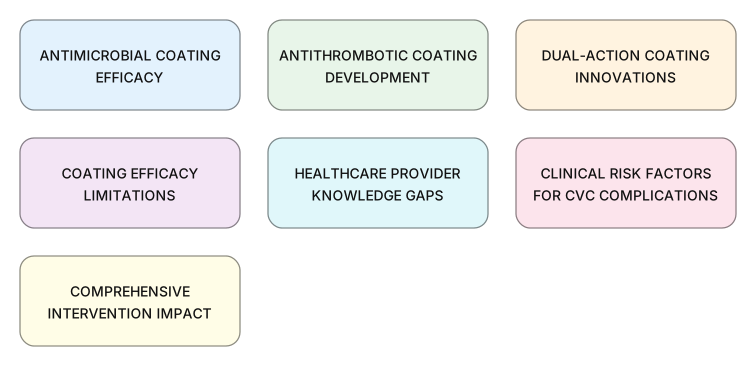
Figure 4. Main extracted research topics
Figure 4. Main extracted research topics (Results)

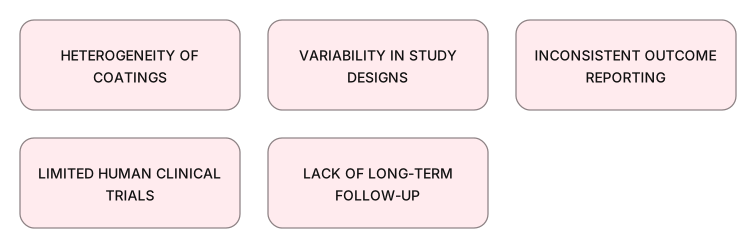
Figure 5. Limitations of current studies (topics)

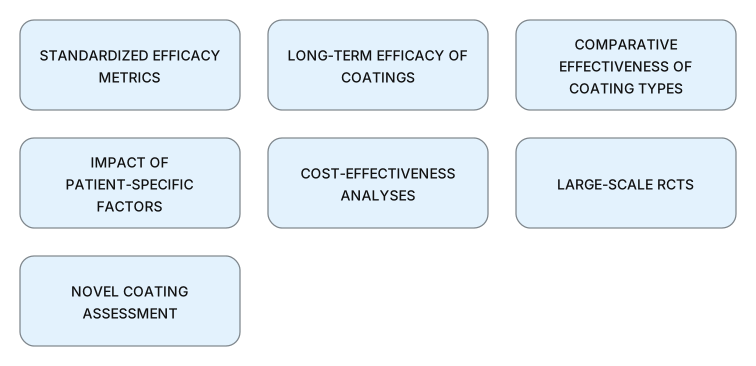
Figure 6. Future research directions (topics)