Coffee and Longevity: Systematic Review with ☸️SAIMSARA.


saimsara.com

Review Stats
Identification of studies via EPMC (all fields) Identification Screening Included Records identified:n=3692Records excluded:n=0 Records assessed for eligibilityn=3692Records excluded:n=3495 Studies included in reviewn=197 PRISMA Diagram generated by ☸️ SAIMSARA
OSMA Triangle Effect-of Predictor → Outcome coffee  →  longevity Beneficial for patients ΣN=470588 (48%) Harmful for patients ΣN=44195 (4%) Neutral ΣN=470483 (48%) 0 OSMA Triangle generated by ☸️SAIMSARA
Outcome-Sentiment Meta-Analysis (OSMA): (LLM-only)
Frame: Effect-of Predictor → Outcome • Source: Europe PMC
Outcome: longevity Typical timepoints: 5-y, 55-y. Reported metrics: %, CI, p.
Common endpoints: Common endpoints: mortality, survival, healing.
Predictor: coffee — exposure/predictor. Doses/units seen: 130 mg, 1000 g. Routes seen: topical. Typical comparator: controls, the control, control, the ormocer-based nanohybrid….


1) Introduction
Coffee, one of the most widely consumed beverages globally, is a complex mixture of bioactive compounds, including caffeine, polyphenols, and diterpenes, which have garnered significant scientific interest for their potential health benefits. As global populations age, understanding the factors that influence healthy aging and longevity has become a critical public health objective. Research into dietary patterns and specific food items, such as coffee, offers insights into lifestyle modifications that may extend healthspan and lifespan. This paper aims to systematically review the current scientific evidence on the relationship between coffee consumption and longevity, synthesizing findings from diverse study designs and populations to provide a comprehensive overview of its multifaceted impact.

2) Aim
The aim of this paper is to systematically review and synthesize the current evidence regarding the association between coffee consumption and longevity, leveraging the Autonomous Multilayer AI Research Agent (SAIMSARA) framework for keyword normalization, retrieval, structuring, and paper synthesis.

3) Methods
3.1 Eligibility criteria
Original studies were included in this review. Editorials, conference papers, and reviews were excluded. The primary focus was on studies directly investigating coffee consumption or its components in relation to longevity, aging biomarkers, or health outcomes relevant to lifespan.

3.2 Study selection
Studies were selected based on a strict keyword gate applied upstream by the SAIMSARA system, ensuring relevance to "Coffee and Longevity." This process filtered a broad range of scientific literature to identify pertinent articles.

3.3 Risk of bias
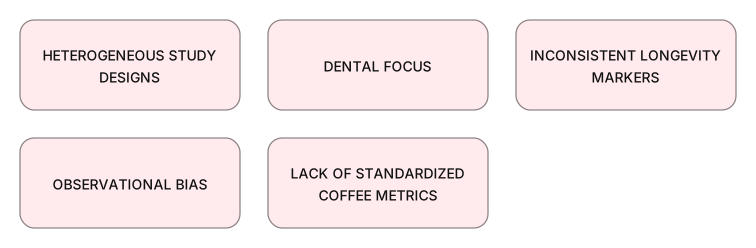
The included studies exhibit considerable heterogeneity in design, ranging from observational cohort studies and randomized controlled trials (RCTs) to numerous in vitro and animal experimental studies. Many studies were classified as "Mixed" design, often indicating a combination of laboratory-based experiments (e.g., dental material testing) or animal models. For many studies, specific details regarding study type directionality, statistics, and follow-up periods were not explicitly provided in the structured summary, limiting a comprehensive assessment of internal validity. A significant portion of the extracted literature focused on the effects of coffee on dental materials, which, while scientific, is not directly relevant to human biological longevity, introducing a thematic bias in the overall dataset. Cohort studies, while offering insights into human populations, are inherently susceptible to confounding factors.

3.4 Synthesis
Autonomous multilayer AI research agent: keyword normalization, retrieval & structuring, and paper synthesis (see SAIMSARA About section for details).

4) Results
4.1 Study characteristics
The included studies comprise a diverse array of designs, including cohort studies, randomized controlled trials, cross-sectional analyses, and numerous experimental or mixed-design investigations. Populations ranged from human adults (including centenarians, individuals with diabetes mellitus, and older women) to various model organisms such as Caenorhabditis elegans, Drosophila melanogaster, yeast, and insects, as well as in vitro dental materials. Sample sizes varied widely, from small experimental groups of 12 [39] to large cohorts of up to 449,563 participants [49]. Follow-up periods also showed significant variation, from short-term observations of hours or days in experimental settings [21, 23, 25] to long-term prospective cohorts spanning up to 26 years [48, 172].

4.2 Main numerical result aligned to the query
Coffee consumption is frequently associated with a reduced risk of all-cause and cardiovascular mortality, with reported Hazard Ratios (HR) and Relative Risks (RR) for all-cause mortality ranging from 0.21 [188] to 0.94 [176] in various populations and consumption levels. For instance, the highest coffee consumption was associated with lower risks of all-cause mortality (HR 0.82, 95%CI 0.73, 0.91) in individuals with diabetes mellitus [19]. Habitual coffee intake of up to 5 cups/day was associated with significant reductions in the risk of all-cause mortality (HR 0.86, CI [0.83-0.89]) and cardiovascular mortality (HR 0.82, CI [0.74-0.90]) [49]. However, some studies indicate an increased risk, with HRs up to 2.13 (95% CI, 1.26-3.59) for high consumption (>28 cups/week) in women younger than 55 years [164]. A U-shaped nonlinear association has also been observed with all-cause and cardiovascular disease mortality, suggesting both beneficial and detrimental effects depending on intake levels [46].

4.3 Topic synthesis


5) Discussion
5.1 Principal finding
The central finding indicates a complex, often U-shaped, association between coffee consumption and human longevity, with moderate intake generally linked to a reduced risk of all-cause and cardiovascular mortality, exemplified by Hazard Ratios for all-cause mortality as low as 0.21 [188] and 0.86 [49], but with high intake potentially increasing mortality risk in certain populations [164].

5.2 Clinical implications


5.3 Research implications / key gaps


5.4 Limitations


5.5 Future directions


6) Conclusion
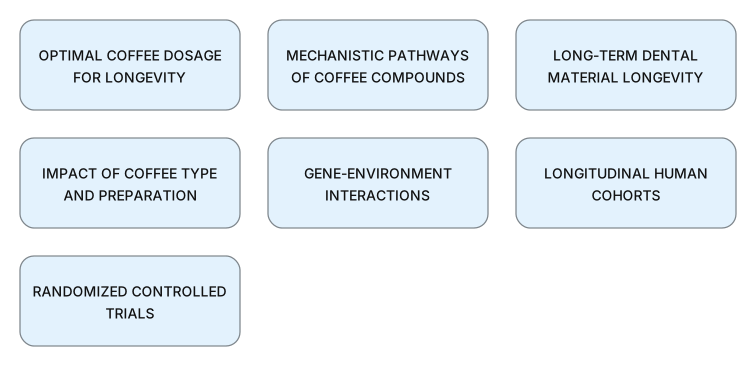
Coffee consumption is frequently associated with a reduced risk of all-cause and cardiovascular mortality, with reported Hazard Ratios (HR) and Relative Risks (RR) for all-cause mortality ranging from 0.21 [188] to 0.94 [176] in various populations and consumption levels, though high intake may increase mortality risk in certain groups. These findings suggest that moderate coffee consumption may contribute to healthy aging and extended lifespan in diverse human populations. However, the heterogeneous nature of study designs and longevity markers, particularly the prevalence of in vitro dental material studies, most significantly affects the certainty and generalizability of the findings. Future research should focus on large-scale, longitudinal human cohort studies with standardized coffee intake assessments to establish definitive dose-response relationships and mechanistic insights into coffee's role in human longevity.

References
SAIMSARA Session Index — session.json

Figure 1. Publication-year distribution of included originals

Figure 2. Study-design distribution of included originals
Figure 2. Study-design distribution

Figure 3. Study-type (directionality) distribution of included originals
Figure 3. Directionality distribution

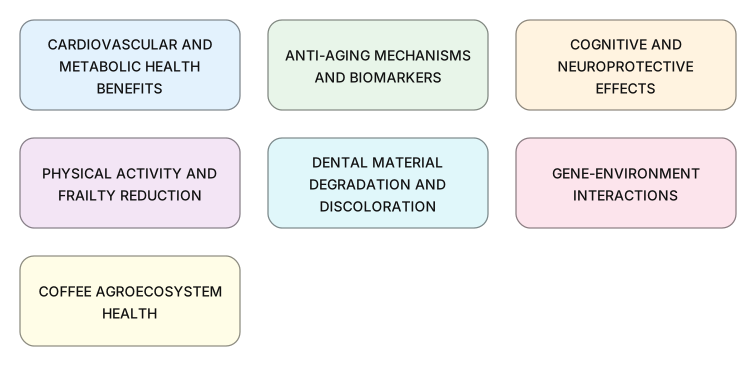
Figure 4. Main extracted research topics
Figure 4. Main extracted research topics (Results)

Figure 5. Limitations of current studies (topics)

Figure 6. Future research directions (topics)