Crawford Classification Aneurysm: Systematic Review with ☸️SAIMSARA.


saimsara.com Download PDF

Abstract: This paper aims to synthesize current research themes related to aneurysm classification, with a particular focus on the Crawford classification for thoracoabdominal aortic aneurysms, and to identify associated clinical outcomes, emerging diagnostic tools, and therapeutic advancements. The review utilises 118 studies with 126287 total participants (naïve ΣN). For thoracoabdominal aortic aneurysm (TAAA) repair, the median 30-day or operative mortality rate across various studies was 9.6%, with a range from 0% to 64.7%. Spinal cord ischemia (SCI) or paraplegia rates in TAAA repair showed a median of 4.2%, ranging from 0% to 16.2%. These outcomes, assessed across diverse patient cohorts and treatment modalities, highlight the significant morbidity and mortality associated with TAAA, particularly influenced by the Crawford classification. The broad scope of aneurysm types and varied reporting of outcomes across studies represent the most significant limitation to certainty. Clinicians should integrate the Crawford classification with patient-specific risk factors to optimize treatment selection and implement robust spinal cord protection strategies in TAAA repair.

Keywords: Crawford classification; Thoracoabdominal aortic aneurysm; Aortic aneurysm; Aneurysm repair; Endovascular repair; Open surgical repair; Spinal cord ischemia; Postoperative mortality; Paraplegia; Aortic surgery

Review Stats
Identification of studies via Semantic Scholar (all fields) Identification Screening Included Records identified:n=5122Records excluded:n=4122 Records assessed for eligibilityn=1000Records excluded:n=882 Studies included in reviewn=118 PRISMA Diagram generated by ☸️ SAIMSARA
⛛OSMA Triangle Effect-of Predictor → Outcome crawford classification aneurysm  →  Outcome Beneficial for patients ΣN=0 (0%) Harmful for patients ΣN=0 (0%) Neutral ΣN=126287 (100%) 0 ⛛OSMA Triangle generated by ☸️SAIMSARA
Show OSMA legend
Outcome-Sentiment Meta-Analysis (OSMA): (LLM-only)
Frame: Effect-of Predictor → Outcome • Source: Semantic Scholar
Outcome: Outcome Typical timepoints: 30-day, peri/post-op. Reported metrics: %, CI, p.
Common endpoints: Common endpoints: occlusion, mortality, complications.
Predictor: crawford classification aneurysm — exposure/predictor. Routes seen: iv. Typical comparator: clinical factors and, younger patients, flow diverter stent treatment, types iii-v….

  • 1) Beneficial for patients — Outcome with crawford classification aneurysm — — — ΣN=0
  • 2) Harmful for patients — Outcome with crawford classification aneurysm — — — ΣN=0
  • 3) No clear effect — Outcome with crawford classification aneurysm — [1], [2], [3], [4], [5], [6], [7], [8], [9], [10], [11], [12], [13], [14], [15], [16], [17], [18], [19], [20], [21], [22], [23], [24], [25], [26], [27], [28], [29], [30], [31], [32], [33], [34], [35], [36], [37], [38], [39], [40], [41], [42], [43], [44], [45], [46], [47], [48], [49], [50], [51], [52], [53], [54], [55], [56], [57], [58], [59], [60], [61], [62], [63], [64], [65], [66], [67], [68], [69], [70], [71], [72], [73], [74], [75], [76], [77], [78], [79], [80], [81], [82], [83], [84], [85], [86], [87], [88], [89], [90], [91], [92], [93], [94], [95], [96], [97], [98], [99], [100], [101], [102], [103], [104], [105], [106], [107], [108], [109], [110], [111], [112], [113], [114], [115], [116], [117], [118] — ΣN=126287
1) Introduction
Aneurysms represent localized dilations of blood vessels, posing significant risks of rupture, hemorrhage, and end-organ ischemia. Accurate classification of aneurysms is crucial for guiding treatment strategies, predicting outcomes, and facilitating research. Among these, the Crawford classification system for thoracoabdominal aortic aneurysms (TAAAs) is a foundational anatomical scheme, categorizing aneurysms based on their longitudinal extent and involvement of visceral and renal arteries. This classification significantly impacts the complexity of surgical repair and associated morbidity and mortality. Beyond TAAAs, various other aneurysm types, particularly intracranial aneurysms, also rely on diverse classification systems to inform management and assess treatment efficacy.

2) Aim
This paper aims to synthesize current research themes related to aneurysm classification, with a particular focus on the Crawford classification for thoracoabdominal aortic aneurysms, and to identify associated clinical outcomes, emerging diagnostic tools, and therapeutic advancements.

3) Methods
Systematic review with multilayer AI research agent: keyword normalization, retrieval & structuring, and paper synthesis (see SAIMSARA About section for details).


4) Results
4.1 Study characteristics:
The studies primarily consisted of retrospective and prospective cohort designs, with several mixed-design studies and a few case series or experimental designs. Populations frequently included patients with thoracoabdominal aortic aneurysms (TAAA), but also encompassed various intracranial, cerebral, abdominal, and other peripheral aneurysms. Follow-up periods ranged from 30 days to 10 years, with many studies not specifying long-term follow-up.

4.2 Main numerical result aligned to the query:
For thoracoabdominal aortic aneurysm (TAAA) repair, the median 30-day or operative mortality rate across various studies was 9.6%, with a range from 0% [8] to 64.7% [44]. Spinal cord ischemia (SCI) or paraplegia rates in TAAA repair showed a median of 4.2%, ranging from 0% [1] to 16.2% [3]. These outcomes reflect diverse patient cohorts and treatment modalities, including open and endovascular approaches.

4.3 Topic synthesis:


5) Discussion
5.1 Principal finding:
The Crawford classification for thoracoabdominal aortic aneurysms (TAAAs) is fundamental for guiding treatment and risk assessment, with median 30-day or operative mortality rates ranging from 0% [8] to 64.7% [44] and spinal cord ischemia/paraplegia rates from 0% [1] to 16.2% [3] across various repair modalities.

5.2 Clinical implications:


5.3 Research implications / key gaps:


5.4 Limitations:


5.5 Future directions:


6) Conclusion
For thoracoabdominal aortic aneurysm (TAAA) repair, the median 30-day or operative mortality rate across various studies was 9.6%, with a range from 0% [8] to 64.7% [44]. Spinal cord ischemia (SCI) or paraplegia rates in TAAA repair showed a median of 4.2%, ranging from 0% [1] to 16.2% [3]. These outcomes, assessed across diverse patient cohorts and treatment modalities, highlight the significant morbidity and mortality associated with TAAA, particularly influenced by the Crawford classification. The broad scope of aneurysm types and varied reporting of outcomes across studies represent the most significant limitation to certainty. Clinicians should integrate the Crawford classification with patient-specific risk factors to optimize treatment selection and implement robust spinal cord protection strategies in TAAA repair.

References
SAIMSARA Session Index — session.json

Figure 1. Publication-year distribution of included originals

Figure 2. Study-design distribution of included originals
Figure 2. Study-design distribution

Figure 3. Study-type (directionality) distribution of included originals
Figure 3. Directionality distribution

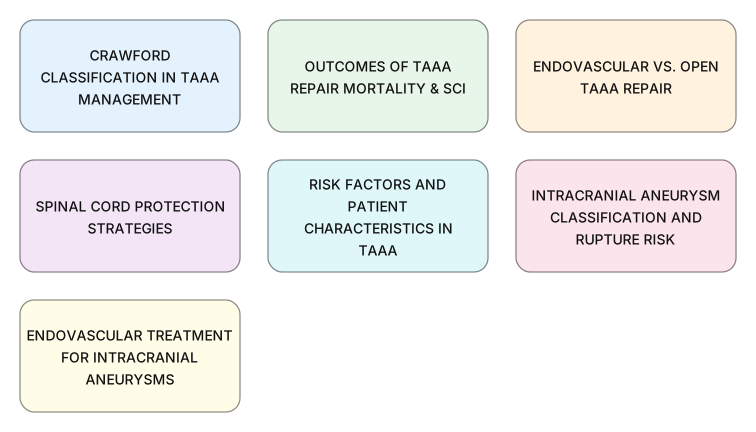
Figure 4. Main extracted research topics
Figure 4. Main extracted research topics (Results)

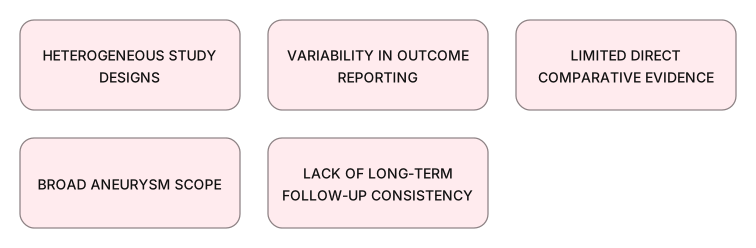
Figure 5. Limitations of current studies (topics)

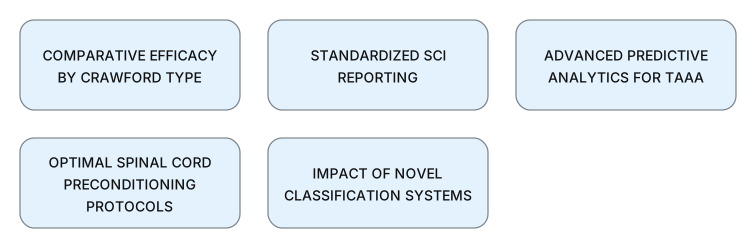
Figure 6. Future research directions (topics)