CT Angiography in Carotid Disease: Systematic Review with ☸️SAIMSARA.


saimsara.com Download PDF

Abstract: Systematic review with multilayer AI research agent: keyword normalization, retrieval & structuring, and paper synthesis (see SAIMSARA About section for details). The review utilises 225 studies with 54037 total participants (naïve ΣN). The diagnostic accuracy of CT angiography for carotid artery disease, particularly stenosis, demonstrated a median of 90% (range: 85.7–94%) across several studies. This high accuracy underscores its critical role in the assessment of carotid pathologies, from common atherosclerotic stenosis to complex conditions like Moyamoya disease and vasculitis. However, the diverse study designs and heterogeneity in reporting metrics represent a significant limitation, impacting the certainty of broad generalizations. To advance clinical practice, future research should focus on standardizing CTA protocols for plaque characterization and conducting large-scale validation of AI-powered diagnostic tools to enhance efficiency and reduce variability.

Keywords: Computed Tomography Angiography; Carotid Artery Disease; Carotid Stenosis; Atherosclerosis; Carotid Plaque; Diagnostic Imaging; Cerebrovascular Disease; Machine Learning; Vascular Imaging

Review Stats
Identification of studies via Semantic Scholar (all fields) Identification Screening Included Records identified:n=1676Records excluded:n=676 Records assessed for eligibilityn=1000Records excluded:n=775 Studies included in reviewn=225 PRISMA Diagram generated by ☸️ SAIMSARA
⛛OSMA Triangle Effect-of Predictor → Outcome ct angiography  →  carotid disease Beneficial for patients ΣN=358 (1%) Harmful for patients ΣN=2358 (4%) Neutral ΣN=51321 (95%) 0 ⛛OSMA Triangle generated by ☸️SAIMSARA
Show OSMA legend
Outcome-Sentiment Meta-Analysis (OSMA): (LLM-only)
Frame: Effect-of Predictor → Outcome • Source: Semantic Scholar
Outcome: carotid disease Typical timepoints: 3-day, peri/post-op. Reported metrics: %, CI, p.
Common endpoints: Common endpoints: complications, occlusion, healing.
Predictor: ct angiography — exposure/predictor. Doses/units seen: 8 ml. Routes seen: oral. Typical comparator: risk score alone, real ct angiography, carotid calcification alone, conventional angiography in….

  • 1) Beneficial for patients — carotid disease with ct angiography — [17], [38], [47], [143] — ΣN=358
  • 2) Harmful for patients — carotid disease with ct angiography — [3], [6], [9], [11], [21], [45] — ΣN=2358
  • 3) No clear effect — carotid disease with ct angiography — [1], [2], [4], [5], [7], [8], [10], [12], [13], [14], [15], [16], [18], [19], [20], [22], [23], [24], [25], [26], [27], [28], [29], [30], [31], [32], [33], [34], [35], [36], [37], [39], [40], [41], [42], [43], [44], [46], [48], [49], [50], [51], [52], [53], [54], [55], [56], [57], [58], [59], [60], [61], [62], [63], [64], [65], [66], [67], [68], [69], [70], [71], [72], [73], [74], [75], [76], [77], [78], [79], [80], [81], [82], [83], [84], [85], [86], [87], [88], [89], [90], [91], [92], [93], [94], [95], [96], [97], [98], [99], [100], [101], [102], [103], [104], [105], [106], [107], [108], [109], [110], [111], [112], [113], [114], [115], [116], [117], [118], [119], [120], [121], [122], [123], [124], [125], [126], [127], [128], [129], [130], [131], [132], [133], [134], [135], [136], [137], [138], [139], [140], [141], [142], [144], [145], [146], [147], [148], [149], [150], [151], [152], [153], [154], [155], [156], [157], [158], [159], [160], [161], [162], [163], [164], [165], [166], [167], [168], [169], [170], [171], [172], [173], [174], [175], [176], [177], [178], [179], [180], [181], [182], [183], [184], [185], [186], [187], [188], [189], [190], [191], [192], [193], [194], [195], [196], [197], [198], [199], [200], [201], [202], [203], [204], [205], [206], [207], [208], [209], [210], [211], [212], [213], [214], [215], [216], [217], [218], [219], [220], [221], [222], [223], [224], [225] — ΣN=51321
1) Introduction
Carotid artery disease encompasses a spectrum of conditions, including stenosis, aneurysm, and dissection, which are significant contributors to cerebrovascular events such as stroke and transient ischemic attacks (TIAs). Accurate and timely diagnosis is crucial for effective patient management and risk stratification. Computed tomography angiography (CTA) has emerged as a cornerstone imaging modality, offering detailed anatomical and pathological insights into the carotid vasculature. This paper synthesizes current research on the utility of CTA in the diagnosis, characterization, and management of carotid artery disease, drawing upon a diverse body of evidence ranging from diagnostic accuracy studies to investigations into plaque vulnerability and associations with systemic conditions.

2) Aim
Systematic review with multilayer AI research agent: keyword normalization, retrieval & structuring, and paper synthesis (see SAIMSARA About section for details).

3) Methods
Systematic review with multilayer AI research agent: keyword normalization, retrieval & structuring, and paper synthesis (see SAIMSARA About section for details).


4) Results
4.1 Study characteristics:
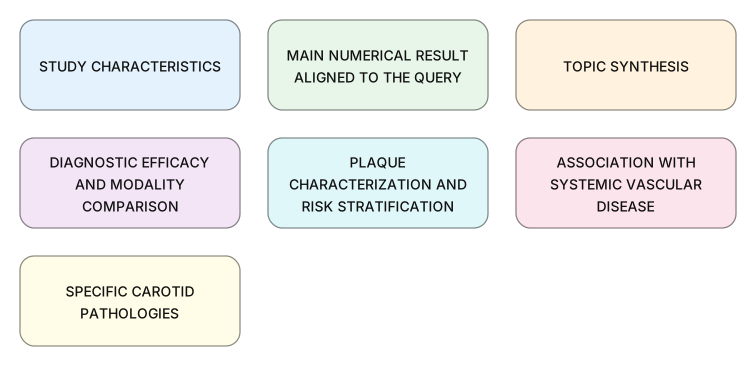
The included studies primarily consisted of mixed-design investigations (retrospective and prospective components), cohort studies, and case series, often focusing on specific patient populations such as those with carotid artery stenosis, acute ischemic stroke, transient ischemic attack, or conditions like Moyamoya disease and Takayasu arteritis. Sample sizes varied widely, from single case reports to large cohorts of over 1700 patients, with follow-up periods ranging from immediate post-procedure assessment to several years, though many studies did not specify follow-up duration.

4.2 Main numerical result aligned to the query:
The diagnostic accuracy of CT angiography for carotid artery disease, particularly stenosis, demonstrated a median of 90% (range: 85.7–94%) across several studies [1, 4, 146, 147]. For example, one machine learning approach leveraging craniocervical CTA achieved 90% accuracy in diagnosing carotid artery diseases [1], while a generative adversarial network-based model synthesizing CTA-like images showed 94% accuracy in an internal test set and 86% in an external validation set for aortic and carotid artery disease [4]. CTA also showed high accuracy in predicting the degree of stenosis in symptomatic carotid artery disease, reaching 91.4% [146] and 88.5% sensitivity with 85.7% specificity for severe stenosis [147].

4.3 Topic synthesis:


5) Discussion
5.1 Principal finding:
The central finding of this review is that CT angiography demonstrates a high diagnostic accuracy, with a median of 90% (range: 85.7–94%), in assessing carotid artery disease, particularly stenosis [1, 4, 146, 147]. This indicates its robust capability in identifying and characterizing various carotid pathologies.

5.2 Clinical implications:


5.3 Research implications / key gaps:


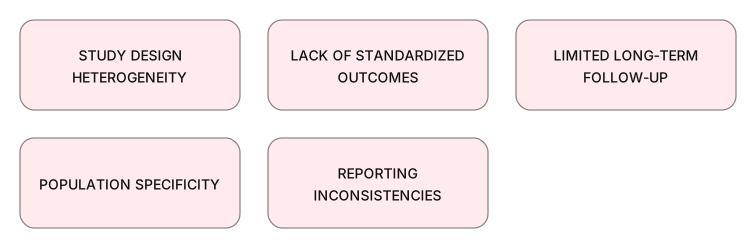
5.4 Limitations:


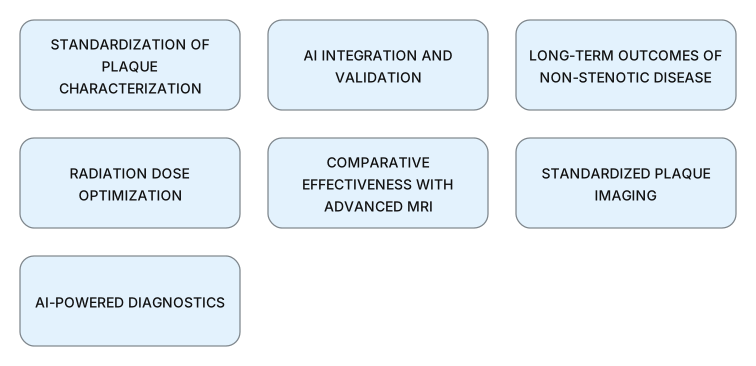
5.5 Future directions:


6) Conclusion
The diagnostic accuracy of CT angiography for carotid artery disease, particularly stenosis, demonstrated a median of 90% (range: 85.7–94%) across several studies [1, 4, 146, 147]. This high accuracy underscores its critical role in the assessment of carotid pathologies, from common atherosclerotic stenosis to complex conditions like Moyamoya disease and vasculitis. However, the diverse study designs and heterogeneity in reporting metrics represent a significant limitation, impacting the certainty of broad generalizations. To advance clinical practice, future research should focus on standardizing CTA protocols for plaque characterization and conducting large-scale validation of AI-powered diagnostic tools to enhance efficiency and reduce variability.

References
SAIMSARA Session Index — session.json

Figure 1. Publication-year distribution of included originals

Figure 2. Study-design distribution of included originals
Figure 2. Study-design distribution

Figure 3. Study-type (directionality) distribution of included originals
Figure 3. Directionality distribution

Figure 4. Main extracted research topics
Figure 4. Main extracted research topics (Results)

Figure 5. Limitations of current studies (topics)

Figure 6. Future research directions (topics)