DCB and Mortality: Systematic Review with ☸️SAIMSARA.


saimsara.com

Review Stats
Identification of studies via EPMC (all fields) Identification Screening Included Records identified:n=1764Records excluded:n=0 Records assessed for eligibilityn=1764Records excluded:n=1518 Studies included in reviewn=246 PRISMA Diagram generated by ☸️ SAIMSARA
⛛OSMA Triangle Effect-of Predictor → Outcome dcb  →  mortality Beneficial for patients ΣN=139744 (41%) Harmful for patients ΣN=26168 (8%) Neutral ΣN=172188 (51%) 0 ⛛OSMA Triangle generated by ☸️SAIMSARA
Outcome-Sentiment Meta-Analysis (OSMA): (LLM-only)
Frame: Effect-of Predictor → Outcome • Source: Europe PMC
Outcome: mortality Typical timepoints: 12-mo, 2-y. Reported metrics: %, CI, p.
Common endpoints: Common endpoints: mortality, patency, survival.
Predictor: dcb — exposure/predictor. Doses/units seen: 6 μg. Routes seen: oral. Typical comparator: percutaneous transluminal, plain balloons, des in high-risk patients, dcb angioplasty alone….


1) Introduction
Drug-coated balloons (DCBs) represent a significant advancement in interventional cardiology and peripheral vascular disease treatment, designed to deliver antiproliferative agents directly to the vessel wall to prevent restenosis. While their efficacy in reducing target lesion revascularization has been widely explored, concerns regarding their long-term safety, particularly their association with all-cause mortality, have prompted extensive research. This paper synthesizes the current evidence on the relationship between DCB use and mortality outcomes across various vascular beds and patient populations.

2) Aim
The aim of this paper is to systematically review and synthesize the available evidence from recent scientific literature regarding the association between drug-coated balloon interventions and mortality, identifying key findings, clinical implications, and future research directions.

3) Methods
3.1 Eligibility criteria: This review included original studies investigating drug-coated balloon interventions and their association with mortality outcomes. Editorials, conference papers, and reviews were excluded.
3.2 Study selection: Studies were identified and filtered based on a strict keyword gate for "dcb and mortality" using an autonomous multilayer AI research agent. Only studies directly pertaining to drug-coated balloons in vascular interventions and reporting mortality data were considered for synthesis.
3.3 Risk of bias: The included studies comprised a mix of designs, including randomized controlled trials (RCTs), cohort studies (both prospective and retrospective), and mixed-design studies. RCTs generally offer the highest level of evidence, while retrospective cohort studies and mixed designs may be susceptible to confounding and selection bias. Sample sizes varied widely, from small case series to large registries and meta-analyses, impacting the statistical power to detect mortality differences. Follow-up periods also varied, ranging from short-term (e.g., 6 months) to long-term (up to 5 years or more), influencing the capture of late mortality events.
3.4 Synthesis: Autonomous multilayer AI research agent: keyword normalization, retrieval & structuring, and paper synthesis (see SAIMSARA About section for details).

4) Results
4.1 Study characteristics: The included studies predominantly featured cohort designs (both retrospective and prospective) and mixed methodologies, with a notable number of randomized controlled trials (RCTs). Populations frequently included patients with femoropopliteal artery disease, coronary artery disease, infrapopliteal lesions, and dysfunctional arteriovenous fistulas. Sample sizes ranged from as few as 8 [8] to over 9000 patients [3], with follow-up periods typically spanning 12 months to 5 years.
4.2 Main numerical result aligned to the query: Across studies reporting 12-month all-cause mortality rates following drug-coated balloon interventions, the median rate was 6.5% [206], with a range from 1.17% [159] to 12.1% [70]. While some studies indicated no significant differences in mortality between DCB and comparator groups (e.g., PTA, DES, BMS) [1, 3, 4, 13, 14, 30, 33, 34, 41, 44, 50, 54, 55, 60, 65, 67, 76, 77, 78, 81, 82, 83, 86, 87, 88, 89, 95, 96, 97, 101, 104, 112, 117, 128, 129, 131, 135, 151, 152, 153, 155, 158, 159, 162, 163, 166, 170, 172, 176, 179, 181, 183, 185, 186, 194, 196, 201, 203, 208], a few studies reported conflicting results, with one early study showing higher 24-month mortality in the DCB group (8.1% vs 0.9%, p=0.008) [210], and others suggesting a survival benefit for DCBs [9, 17, 123, 136, 151, 156, 202].
4.3 Topic synthesis:


5) Discussion
5.1 Principal finding: The principal finding of this review is that, across numerous studies, drug-coated balloon interventions are generally not associated with a significantly increased risk of all-cause mortality compared to other revascularization strategies, with a median 12-month all-cause mortality rate of 6.5% [206] (range 1.17% [159] to 12.1% [70]) when specific rates were reported.
5.2 Clinical implications:

5.3 Research implications / key gaps:

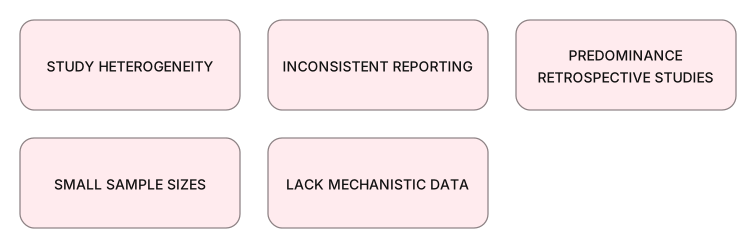
5.4 Limitations:

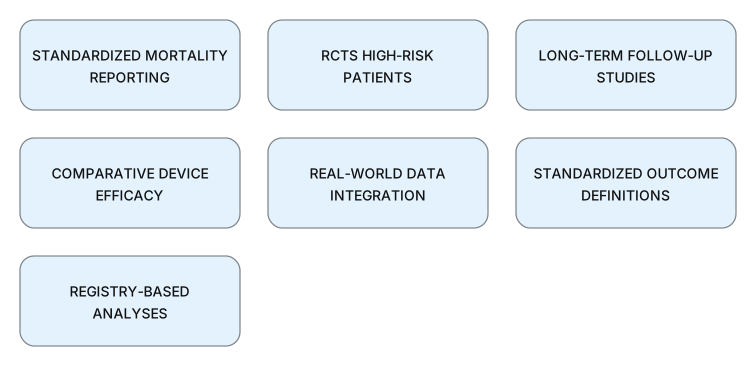
5.5 Future directions:


6) Conclusion
Across numerous studies, the median 12-month all-cause mortality rate following drug-coated balloon interventions was 6.5% [206], with a range from 1.17% [159] to 12.1% [70]. DCBs are generally considered safe with respect to mortality in various vascular interventions, often showing no significant difference compared to other revascularization strategies, although one early study reported higher DCB mortality. The greatest limitation affecting certainty is the heterogeneity of study designs and inconsistent reporting of mortality metrics. A crucial next step is to conduct larger, well-designed randomized controlled trials focusing on long-term mortality in high-risk patient populations to further solidify the safety profile of DCBs.

References
SAIMSARA Session Index — session.json

Figure 1. Publication-year distribution of included originals

Figure 2. Study-design distribution of included originals
Figure 2. Study-design distribution

Figure 3. Study-type (directionality) distribution of included originals
Figure 3. Directionality distribution

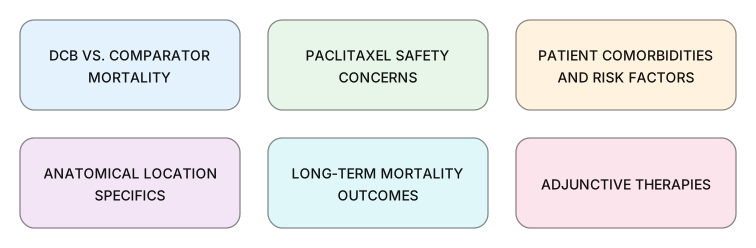
Figure 4. Main extracted research topics
Figure 4. Main extracted research topics (Results)

Figure 5. Limitations of current studies (topics)

Figure 6. Future research directions (topics)