Diagnostic of Carotid Stenosis: Systematic Review with ☸️SAIMSARA.


saimsara.com Download PDF

Abstract: The aim of this paper is to systematically review and synthesize the diagnostic methodologies for carotid stenosis based on a structured extraction summary. The review utilises 187 studies with 62117 total participants (naïve ΣN). Duplex ultrasound (DUS) exhibits a median diagnostic accuracy of 83% (ranging from 66% to 94%) for carotid artery stenosis. This broad range in reported accuracy highlights the need for continued refinement and standardization in diagnostic practices. The heterogeneity of study designs and inconsistent reporting of diagnostic metrics represent the most significant limitation to synthesizing a unified understanding. Future efforts should focus on establishing standardized DUS protocols and rigorously validating novel biomarkers and advanced imaging techniques in large, prospective studies to improve diagnostic precision and patient outcomes.

Keywords: Carotid Stenosis; Diagnosis; Diagnostic Imaging; Biomarkers; Carotid Ultrasound; Magnetic Resonance Imaging

Review Stats
Identification of studies via Semantic Scholar (all fields) Identification Screening Included Records identified:n=2547Records excluded:n=1547 Records assessed for eligibilityn=1000Records excluded:n=813 Studies included in reviewn=187 PRISMA Diagram generated by ☸️ SAIMSARA
⛛OSMA Triangle Effect-of Predictor → Outcome carotid stenosis  →  diagnostic Beneficial for patients ΣN=5213 (8%) Harmful for patients ΣN=26132 (42%) Neutral ΣN=30772 (50%) 0 ⛛OSMA Triangle generated by ☸️SAIMSARA
Show OSMA legend
Outcome-Sentiment Meta-Analysis (OSMA): (LLM-only)
Frame: Effect-of Predictor → Outcome • Source: Semantic Scholar
Outcome: diagnostic Typical timepoints: 3-day, 2-day. Reported metrics: %, CI, p.
Common endpoints: Common endpoints: complications, occlusion, functional.
Predictor: carotid stenosis — exposure/predictor. Doses/units seen: 81 mg, 1.2 mg. Typical comparator: controls, the control group and can, control, angiography….

  • 1) Beneficial for patients — diagnostic with carotid stenosis — [127], [128], [129], [130], [131], [132], [133], [134], [135], [138], [139], [140], [141], [142], [143], [145], [146], [148], [149], [150], [154], [158], [160], [161], [163], [169], [171], [173], [175] — ΣN=5213
  • 2) Harmful for patients — diagnostic with carotid stenosis — [165], [166], [179], [184], [185] — ΣN=26132
  • 3) No clear effect — diagnostic with carotid stenosis — [1], [2], [3], [4], [5], [6], [7], [8], [9], [10], [11], [12], [13], [14], [15], [16], [17], [18], [19], [20], [21], [22], [23], [24], [25], [26], [27], [28], [29], [30], [31], [32], [33], [34], [35], [36], [37], [38], [39], [40], [41], [42], [43], [44], [45], [46], [47], [48], [49], [50], [51], [52], [53], [54], [55], [56], [57], [58], [59], [60], [61], [62], [63], [64], [65], [66], [67], [68], [69], [70], [71], [72], [73], [74], [75], [76], [77], [78], [79], [80], [81], [82], [83], [84], [85], [86], [87], [88], [89], [90], [91], [92], [93], [94], [95], [96], [97], [98], [99], [100], [101], [102], [103], [104], [105], [106], [107], [108], [109], [110], [111], [112], [113], [114], [115], [116], [117], [118], [119], [120], [121], [122], [123], [124], [125], [126], [136], [137], [144], [147], [151], [152], [153], [155], [156], [157], [159], [162], [164], [167], [168], [170], [172], [174], [176], [177], [178], [180], [181], [182], [183], [186], [187] — ΣN=30772
1) Introduction
Carotid artery stenosis (CAS) is a significant contributor to cerebrovascular events, including acute ischemic stroke (AIS) and transient ischemic attacks (TIAs) [18, 45, 80, 161, 168]. Accurate and timely diagnosis of CAS is crucial for risk stratification and guiding therapeutic interventions to prevent severe neurological sequelae [119]. The diagnostic landscape for CAS is diverse, encompassing a range of imaging modalities, novel biochemical biomarkers, and advanced computational methods. This paper synthesizes current research on diagnostic approaches for carotid stenosis, highlighting their performance, emerging trends, and areas for future investigation.

2) Aim
The aim of this paper is to systematically review and synthesize the diagnostic methodologies for carotid stenosis based on a structured extraction summary.

3) Methods
Systematic review with multilayer AI research agent: keyword normalization, retrieval & structuring, and paper synthesis (see SAIMSARA About section for details).


4) Results
4.1 Study characteristics:
The reviewed literature comprises a variety of study designs, predominantly mixed (combining retrospective and prospective elements or different methodologies), cohort, and cross-sectional studies. Populations investigated include patients with symptomatic or asymptomatic carotid artery stenosis (CAS), healthy controls, individuals with acute ischemic stroke (AIS) or TIA, and those with specific risk factors such as diabetes or hypercholesterolemia. Follow-up periods, when specified, ranged from 90 days to 7 years, though many studies did not report follow-up.

4.2 Main numerical result aligned to the query:
Diagnostic accuracy for duplex ultrasound (DUS) in detecting carotid artery stenosis varied across studies, with a median accuracy of 83% [8, 83] and a range from 66% [83] to 94% [108]. For specific stenosis ranges, DUS showed an accuracy of 69% for 50-94% stenosis and 84% for 70-94% stenosis of the internal carotid artery (ICA) [14]. Other reported DUS accuracies included 74.5% for peak systolic velocity (PSV) ≥ 125 cm/sec, 85.2% for PSV ≥ 180 cm/sec, and 87.4% for ICA/CCA PSV ratio ≥ 2.0 for ≥50% ICA stenosis [8].

4.3 Topic synthesis:


5) Discussion
5.1 Principal finding:
The central finding of this review is that duplex ultrasound (DUS) exhibits a median diagnostic accuracy of 83% (ranging from 66% to 94%) for carotid artery stenosis [8, 83, 108], positioning it as a widely utilized, albeit variable, diagnostic tool.

5.2 Clinical implications:


5.3 Research implications / key gaps:


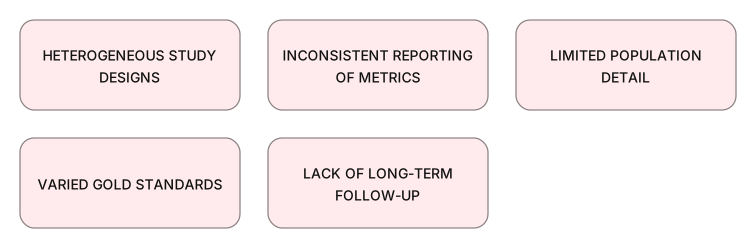
5.4 Limitations:


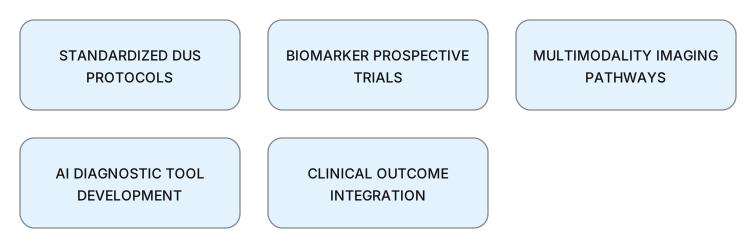
5.5 Future directions:


6) Conclusion
Duplex ultrasound (DUS) exhibits a median diagnostic accuracy of 83% (ranging from 66% to 94%) for carotid artery stenosis [8, 83, 108]. This broad range in reported accuracy highlights the need for continued refinement and standardization in diagnostic practices. The heterogeneity of study designs and inconsistent reporting of diagnostic metrics represent the most significant limitation to synthesizing a unified understanding. Future efforts should focus on establishing standardized DUS protocols and rigorously validating novel biomarkers and advanced imaging techniques in large, prospective studies to improve diagnostic precision and patient outcomes.

References
SAIMSARA Session Index — session.json

Figure 1. Publication-year distribution of included originals

Figure 2. Study-design distribution of included originals
Figure 2. Study-design distribution

Figure 3. Study-type (directionality) distribution of included originals
Figure 3. Directionality distribution

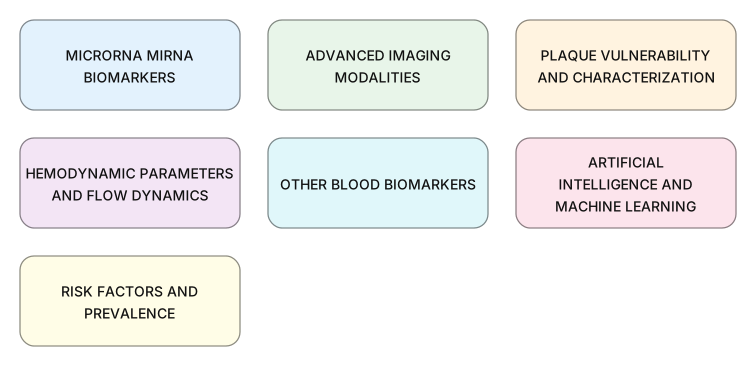
Figure 4. Main extracted research topics
Figure 4. Main extracted research topics (Results)

Figure 5. Limitations of current studies (topics)

Figure 6. Future research directions (topics)