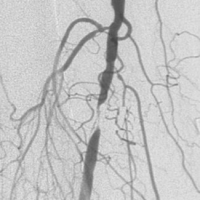
This review shows that AAA diagnosis is no longer just about measuring diameter: the strongest evidence now points to a multimodal pathway where ultrasound and CTA remain the clinical backbone, while CEUS, biomechanical modeling, and emerging biomarker panels begin to refine who truly carries higher rupture or surveillance risk. The full paper maps where these newer tools already add real diagnostic value, where they remain premature, and how AAA detection is shifting from simple imaging toward biologically and mechanically informed precision assessment.
Abstract: The aim of this review is to synthesize contemporary evidence regarding the diagnostic modalities for AAA, including the efficacy of screening programs, the accuracy of advanced imaging techniques, and the emergence of novel circulating biomarkers for diagnosis and risk stratification. The review utilises 303 original studies with 443878 total participants (topic deduplicated ΣN). The mapped evidence suggests that abdominal aortic aneurysm diagnosis is now anchored by high-performing imaging, with ultrasonography remaining the principal screening modality and reported sensitivity and specificity reaching 98.9% and 99.9% in screening settings, while computed tomography angiography remains central for anatomic definition and acute rupture assessment, with sensitivity of 98.3% and specificity of 94.9% in suspected rupture. A prominent signal across the evidence map is the shift beyond diameter alone toward multimodal assessment, including biomechanical indices that showed better rupture discrimination than maximal diameter in some studies (area under the curve 0.878 versus 0.789) and biomarker strategies such as D-dimer- and myeloperoxidase-based models with area under the curve values around 0.80 to 0.95. For post-endovascular aneurysm repair surveillance, contrast-enhanced ultrasound repeatedly showed high diagnostic performance and supports a practical radiation-sparing alternative to repeated computed tomography angiography in appropriate patients. At the same time, the evidence base remains heterogeneous, particularly for biomarkers, artificial intelligence tools, and individualized diagnostic thresholds, so these approaches should currently be viewed as promising adjuncts rather than replacements for established imaging pathways. Future research should prioritize externally validated multimodal diagnostic models that combine standardized imaging measurements, clinically usable biomarker thresholds, and prospective testing across screening, emergency, and surveillance populations.
Final search date and database lock: 2026-04-12 13:16:47 CEST
Plan: Pro (expanded craft tokens; source: PubMed)
Source: PubMed
Total Abstracts/Papers: 1138
Downloaded Abstracts/Papers: 1138
Included original and non-original Abstracts/Papers (all): 326
Included original Abstracts/Papers (Vote counting by direction of effect): 303
Reference Index (links used in paper): 127
Total participants (topic deduplicated ΣN): 443878
Get access to the full paper
Unlock the full evidence map
The full evidence review, including the Introduction, Methods, Results, Discussion, Conclusion, figures, and complete reference index, opens after purchase or sign-in.
[7] Improved identification of abdominal aortic aneurysm using the Kernelized Expectation Maximization algorithm. — https://doi.org/10.1098/rsta.2020.0201
[32] Hemoglobin homeostasis in abdominal aortic aneurysm: diagnostic and prognostic potential of hemoglobin/heme and scavenger molecules. — https://doi.org/10.1186/s12872-024-04131-3
[33] MicroRNA-15a-5p mediates abdominal aortic aneurysm progression and serves as a potential diagnostic and prognostic circulating biomarker. — https://doi.org/10.1038/s43856-025-00892-w
[44] Prospective Comparison of Reduced-Iodine-Dose Virtual Monochromatic Imaging Dataset From Dual-Energy CT Angiography With Standard-Iodine-Dose Single-Energy CT Angiography for Abdominal Aortic Aneurysm. — https://doi.org/10.2214/ajr.15.15814
[46] Enhancing clinical outcomes: Point of care ultrasound in the precision diagnosis and Management of Abdominal Aortic Aneurysms in emergency medicine: A systematic review and meta-analysis. — https://doi.org/10.1002/jcu.23850
[48] Diagnostic Accuracy of AI for Opportunistic Screening of Abdominal Aortic Aneurysm in CT: A Systematic Review and Narrative Synthesis. — https://doi.org/10.3390/diagnostics12123197
[50] The Evaluation of Longitudinal Strain of Large and Small Abdominal Aortic Aneurysm by Two-Dimensional Speckle-Tracking Ultrasound. — https://doi.org/10.1002/jum.15792
[51] Diagnostic and predictive values of circulating tetrahydrobiopterin levels as a novel biomarker in patients with thoracic and abdominal aortic aneurysms. — https://doi.org/10.1016/j.redox.2022.102444
[53] Diagnostic Utility of a Combined MPO/D-Dimer Score to Distinguish Abdominal Aortic Aneurysm from Peripheral Artery Disease. — https://doi.org/10.3390/jcm12247558
[56] Comprehensive transcriptomic analysis unveils macrophage-associated genes for establishing an abdominal aortic aneurysm diagnostic model and molecular therapeutic framework. — https://doi.org/10.1186/s40001-024-01900-w
[57] Regulation of CD163 Receptor in Patients with Abdominal Aortic Aneurysm and Associations with Antioxidant Enzymes HO-1 and NQO1. — https://doi.org/10.3390/antiox12040947
[62] Circulating monocyte populations as biomarker for abdominal aortic aneurysms: a single-center retrospective cohort study. — https://doi.org/10.3389/fimmu.2024.1418625
[63] The potential role of plasma fibroblast growth factor 21 as a diagnostic biomarker for abdominal aortic aneurysm presence and development. — https://doi.org/10.1016/j.lfs.2021.119346
[66] Serum matrix metalloproteinase-9 is a valuable biomarker for identification of abdominal and thoracic aortic aneurysm: a case-control study. — https://doi.org/10.1186/s12872-018-0931-0
[79] Circulating Extracellular Vesicles: Their Role in Patients with Abdominal Aortic Aneurysm (AAA) Undergoing EndoVascular Aortic Repair (EVAR). — https://doi.org/10.3390/ijms232416015
[83] Point-of-care ultrasound for FAST and AAA in rural New Zealand: quality and impact on patient care. — https://doi.org/10.22605/rrh5027
[84] EVAR Follow-Up with Ultrasound Superb Microvascular Imaging (SMI) Compared to CEUS and CT Angiography for Detection of Type II Endoleak. — https://doi.org/10.3390/diagnostics12020526
[85] In vivo feasibility case study for evaluating abdominal aortic aneurysm tissue properties and rupture potential using acoustic radiation force impulse imaging. — https://doi.org/10.1016/j.jmbbm.2010.12.017
[86] [Validity of the abdominal ecography in primary care for detection of aorta abdominal aneurism in male between 65 and 75 years]. — https://doi.org/10.1016/j.aprim.2017.10.005
[88] Contrast Enhanced Ultrasound can Replace Computed Tomography Angiography for Surveillance After Endovascular Aortic Aneurysm Repair. — https://doi.org/10.1016/j.ejvs.2016.07.007
[96] Evaluation of low-dose CT angiography with model-based iterative reconstruction after endovascular aneurysm repair of a thoracic or abdominal aortic aneurysm. — https://doi.org/10.2214/ajr.13.11286
[105] D-Dimers and MPO Are No Suitable Biomarkers for Application in Abdominal Aortic Aneurysm (AAA) Surveillance in a Real-World Setting of Vascular Surgery Patients. — https://doi.org/10.3390/biom14121525
[110] Artificial neural network-based analysis of ferroptosis-associated molecular subtypes and immunological profiles in abdominal aortic aneurysm. — https://doi.org/10.3389/fimmu.2026.1721069
[113] Measuring abdominal aortic diameters in routine abdominal computed tomography scans and implications for abdominal aortic aneurysm screening. — https://doi.org/10.1016/j.jvs.2016.11.044
[114] A meta-analysis of the diagnostic accuracy of dual-energy computed tomography for endoleak detection after endovascular aneurysm repair. — https://doi.org/10.1007/s00330-025-11717-8
[121] Combining Volumetric and Wall Shear Stress Analysis from CT to Assess Risk of Abdominal Aortic Aneurysm Progression. — https://doi.org/10.1148/radiol.2020192112
[122] Identification of a biomarker and immune infiltration in perivascular adipose tissue of abdominal aortic aneurysm. — https://doi.org/10.3389/fphys.2022.977910
[126] Multicenter investigations of the prevalence of abdominal aortic aneurysm in elderly Japanese patients with hypertension. — https://doi.org/10.1253/circj.cj-14-0972
[139] Observations from the IMPROVE trial concerning the clinical care of patients with ruptured abdominal aortic aneurysm. — https://doi.org/10.1002/bjs.9410
[140] Quantitative mass spectrometry analysis using PAcIFIC for the identification of plasma diagnostic biomarkers for abdominal aortic aneurysm. — https://doi.org/10.1371/journal.pone.0028698
[150] The Association Between Serum HMGB2 Levels and Abdominal Aortic Aneurysm in Males: Insights Into the HMGB2-TREM Pathway. — https://doi.org/10.31083/rcm33511
[151] Magnetic resonance imaging is more sensitive than computed tomography angiography for the detection of endoleaks after endovascular abdominal aortic aneurysm repair: a systematic review. — https://doi.org/10.1016/j.ejvs.2012.12.014
[157] Combining detection of Notch1 and tumor necrosis factor-α converting enzyme is a reliable biomarker for the diagnosis of abdominal aortic aneurysms. — https://doi.org/10.1016/j.lfs.2015.02.009
[158] CEUS versus CT Angiography in the follow-up of abdominal aortic endoprostheses: diagnostic accuracy and activity-based cost analysis. — https://doi.org/10.1007/s11547-018-0926-z
[159] Computed Tomography-Aortography Versus Color-Duplex Ultrasound for Surveillance of Endovascular Abdominal Aortic Aneurysm Repair: A Prospective Multicenter Diagnostic-Accuracy Study (the ESSEA Trial). — https://doi.org/10.1161/circimaging.119.009886
[173] Feasibility of Diffusion-weighted MRI for Detecting Abdominal Aortic Endoleaks after Endovascular Aneurysm Repair. — https://doi.org/10.1148/radiol.243466
[174] Dynamic Radial MR Imaging for Endoleak Surveillance after Endovascular Repair of Abdominal Aortic Aneurysms with Inconclusive CT Angiography: A Prospective Study. — https://doi.org/10.3390/jcm13102913
[176] Plasma levels of matrix metalloproteinase-9: a possible diagnostic marker of successful endovascular aneurysm repair. — https://doi.org/10.1016/j.ejvs.2011.10.014
[177] Diagnostic accuracy of non-radiologist performed ultrasound for abdominal aortic aneurysm: systematic review and meta-analysis. — https://doi.org/10.1111/ijcp.12453
[178] Interleukin 2 receptor subunit beta as a novel hub gene plays a potential role in the immune microenvironment of abdominal aortic aneurysms. — https://doi.org/10.1016/j.gene.2022.146472
[179] A significant correlation between body surface area and infrarenal aortic diameter is detected in a large screening population with possibly clinical implications. — https://doi.org/10.23736/s0392-9590.19.04071-9
[182] Golden-angle radial sparse parallel (GRASP) magnetic resonance angiography (MRA) for endoleak evaluation after endovascular repair of the aorta: a prospective comparison to conventional time-resolved MRA. — https://doi.org/10.21037/qims-24-1130
[187] Identification of Macrophage-Related Biomarkers for Abdominal Aortic Aneurysm Through Combined Single-Cell Sequencing and Machine Learning. — https://doi.org/10.2147/jir.s499593
[195] Three-Dimensional Ultrasound for Abdominal Aortic Aneurysm Surveillance: Diagnostic Accuracy, Reproducibility, and Agreement With Computed Tomography. A Systematic Review and Meta-Analysis. — https://doi.org/10.1016/j.avsg.2026.01.040
[196] Detection of Endoleaks Following Thoracic and Abdominal Aortic Endovascular Aortic Repair-: A Comparison of Standard and Dynamic 4D-Computed Tomography Angiography. — https://doi.org/10.1177/15266028221095390
[203] A Novel Diagnostic and Prognostic Score for Abdominal Aortic Aneurysms Based on D-Dimer and a Comprehensive Analysis of Myeloid Cell Parameters. — https://doi.org/10.1055/s-0039-1679939
[218] Contrast-enhanced ultrasound versus color duplex ultrasound imaging in the follow-up of patients after endovascular abdominal aortic aneurysm repair. — https://doi.org/10.1016/j.jvs.2008.10.008
[219] A novel strategy to translate the biomechanical rupture risk of abdominal aortic aneurysms to their equivalent diameter risk: method and retrospective validation. — https://doi.org/10.1016/j.ejvs.2013.12.018
[222] Identification of key monocytes/macrophages related gene set of the early-stage abdominal aortic aneurysm by integrated bioinformatics analysis and experimental validation. — https://doi.org/10.3389/fcvm.2022.950961
[223] Increased 18F-fluorodeoxyglucose uptake in abdominal aortic aneurysms in positron emission/computed tomography is associated with inflammation, aortic wall instability, and acute symptoms. — https://doi.org/10.1016/j.jvs.2008.03.059
[230] Biomechanical indices are more sensitive than diameter in predicting rupture of asymptomatic abdominal aortic aneurysms. — https://doi.org/10.1016/j.jvs.2019.03.051
[261] Multidetector-row computed tomography angiography in abdominal aortic aneurysm treated with endovascular repair: evaluation of optimal timing of delayed phase imaging for the detection of low-flow endoleaks. — https://doi.org/10.1097/rct.0b013e31814b271d
[262] Use of Artificial Intelligence With Deep Learning Approaches for the Follow-up of Infrarenal Endovascular Aortic Repair. — https://doi.org/10.1177/15266028241252097
[265] Imaging characteristics and diagnostic accuracy of FDG-PET/CT, contrast enhanced CT and combined imaging in patients with suspected mycotic or inflammatory abdominal aortic aneurysms. — https://doi.org/10.1371/journal.pone.0272772
[275] [Comparison of contrast-enhanced MR angiography of the aortoiliac vessels using a 1.0 molar contrast agent at 1.0 T with intra-arterial digital subtraction angiography]. — https://doi.org/10.1055/s-2004-813267
[314] Systematic review and meta-analysis of the growth and rupture rates of small abdominal aortic aneurysms: implications for surveillance intervals and their cost-effectiveness. — https://doi.org/10.3310/hta17410