EVAR Follow Up: Systematic Review with ☸️SAIMSARA.


saimsara.com Download PDF

Abstract: This paper aims to systematically review and synthesize the current evidence regarding the follow-up of patients after Endovascular Aneurysm Repair (EVAR), focusing on long-term outcomes, diagnostic strategies, and emerging technologies, to identify key clinical implications and future research directions. The review utilises 96 studies with 485520 total participants (naïve ΣN). Reintervention rates following EVAR show considerable variability across studies and devices, with reported percentages ranging from 10% at mean follow-up to 27.0% at 5-year follow-up for specific devices. This high rate of reintervention, coupled with other potential complications, necessitates rigorous and often lifelong follow-up. The heterogeneity in study designs and outcome reporting across the literature remains the single limitation that most affects certainty regarding optimal surveillance strategies. Clinicians should prioritize the use of less invasive and radiation-free imaging modalities like ultrasound as a primary surveillance tool, especially given its comparable accuracy to CTA for endoleak detection.

Keywords: Endovascular Aneurysm Repair; EVAR Surveillance; Abdominal Aortic Aneurysm; Endoleak; Computed Tomography Angiography; Ultrasound Imaging; Post-EVAR Complications; Reintervention; Long-term Outcomes; Radiation Exposure

Review Stats
Identification of studies via Semantic Scholar (all fields) Identification Screening Included Records identified:n=7584Records excluded:n=6584 Records assessed for eligibilityn=1000Records excluded:n=904 Studies included in reviewn=96 PRISMA Diagram generated by ☸️ SAIMSARA
⛛OSMA Triangle Effect-of Predictor → Outcome EVAR  →  follow up Beneficial for patients ΣN=66609 (14%) Harmful for patients ΣN=18882 (4%) Neutral ΣN=400029 (82%) 0 ⛛OSMA Triangle generated by ☸️SAIMSARA
Show OSMA legend
Outcome-Sentiment Meta-Analysis (OSMA): (LLM-only)
Frame: Effect-of Predictor → Outcome • Source: Semantic Scholar
Outcome: follow up Typical timepoints: 30-day, peri/post-op. Reported metrics: %, CI, p.
Common endpoints: Common endpoints: mortality, complications, survival.
Predictor: EVAR — procedure/intervention. Routes seen: subcutaneous. Typical comparator: open repair of abdominal, open repair, computerized tomography, evar without this intervention….

  • 1) Beneficial for patients — follow up with EVAR — [22], [39] — ΣN=66609
  • 2) Harmful for patients — follow up with EVAR — [44], [45] — ΣN=18882
  • 3) No clear effect — follow up with EVAR — [1], [2], [3], [4], [5], [6], [7], [8], [9], [10], [11], [12], [13], [14], [15], [16], [17], [18], [19], [20], [21], [23], [24], [25], [26], [27], [28], [29], [30], [31], [32], [33], [34], [35], [36], [37], [38], [40], [41], [42], [43], [46], [47], [48], [49], [50], [51], [52], [53], [54], [55], [56], [57], [58], [59], [60], [61], [62], [63], [64], [65], [66], [67], [68], [69], [70], [71], [72], [73], [74], [75], [76], [77], [78], [79], [80], [81], [82], [83], [84], [85], [86], [87], [88], [89], [90], [91], [92], [93], [94], [95], [96] — ΣN=400029
1) Introduction
Endovascular Aneurysm Repair (EVAR) has revolutionized the treatment of abdominal aortic aneurysms (AAAs), offering a less invasive alternative to open surgical repair (OSR). While EVAR provides clear early operative benefits, its long-term durability necessitates diligent and often lifelong postoperative surveillance to detect and manage potential complications such as endoleaks, device migration, and aneurysm sac changes. The effectiveness and optimal strategies for this follow-up remain areas of active research, balancing diagnostic accuracy, patient burden, and healthcare costs. This paper synthesizes current evidence on EVAR follow-up, exploring its long-term outcomes, surveillance modalities, and associated challenges.

2) Aim
This paper aims to systematically review and synthesize the current evidence regarding the follow-up of patients after Endovascular Aneurysm Repair (EVAR), focusing on long-term outcomes, diagnostic strategies, and emerging technologies, to identify key clinical implications and future research directions.

3) Methods
Systematic review with multilayer AI research agent: keyword normalization, retrieval & structuring, and paper synthesis (see SAIMSARA About section for details).


4) Results
4.1 Study characteristics:
The included studies comprise a mix of randomized controlled trials (RCTs), cohort studies, and mixed-design studies, with both prospective and retrospective approaches. Populations generally consist of patients undergoing EVAR for abdominal aortic aneurysms (AAAs), including those unfit for open repair, and some studies specifically address complex aneurysms (e.g., pararenal, thoracoabdominal, juxtarenal) or specific patient subgroups (e.g., octogenarians, young patients, those with sarcopenia). Follow-up durations vary widely, ranging from 30 days [49, 67, 79, 80] to very long-term, including 15 years [1] and mean follow-ups of 12.7 years [3].

4.2 Main numerical result aligned to the query:
Reintervention rates following EVAR show considerable variability across studies and devices, with reported percentages ranging from 10% at mean follow-up [85] to 27.0% at 5-year follow-up for specific devices [28]. The median of reported percentage reintervention rates is approximately 17.35% (derived from 10% [85], 14.9% [28], 15.4% [94], 16.7% [28], 18% [39], 19.5% [28], 22% [75], 27% [28]). This is notably higher than rates for open repair, with one study reporting 4.1 vs 1.7 per 100 person-years for EVAR vs open repair (p<0.001) [3].

4.3 Topic synthesis:


5) Discussion
5.1 Principal finding:
The principal finding of this synthesis is that reintervention rates following EVAR are substantial and variable, with reported percentages ranging from 10% to 27.0% across different follow-up durations and device types, and a median of approximately 17.35% [28, 85]. This highlights the critical need for continuous and effective post-EVAR surveillance.

5.2 Clinical implications:


5.3 Research implications / key gaps:


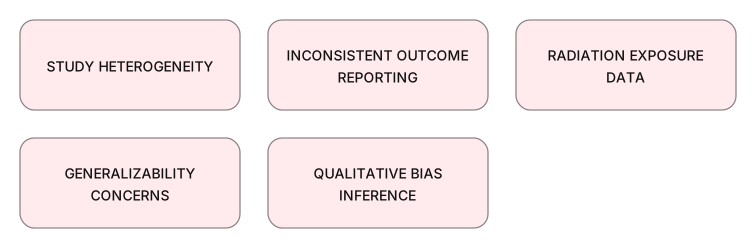
5.4 Limitations:


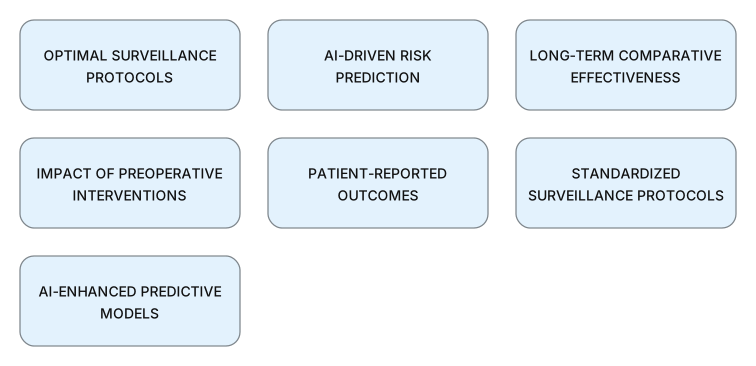
5.5 Future directions:


6) Conclusion
Reintervention rates following EVAR show considerable variability across studies and devices, with reported percentages ranging from 10% at mean follow-up [85] to 27.0% at 5-year follow-up for specific devices [28]. This high rate of reintervention, coupled with other potential complications, necessitates rigorous and often lifelong follow-up. The heterogeneity in study designs and outcome reporting across the literature remains the single limitation that most affects certainty regarding optimal surveillance strategies. Clinicians should prioritize the use of less invasive and radiation-free imaging modalities like ultrasound as a primary surveillance tool, especially given its comparable accuracy to CTA for endoleak detection.

References
SAIMSARA Session Index — session.json

Figure 1. Publication-year distribution of included originals

Figure 2. Study-design distribution of included originals
Figure 2. Study-design distribution

Figure 3. Study-type (directionality) distribution of included originals
Figure 3. Directionality distribution

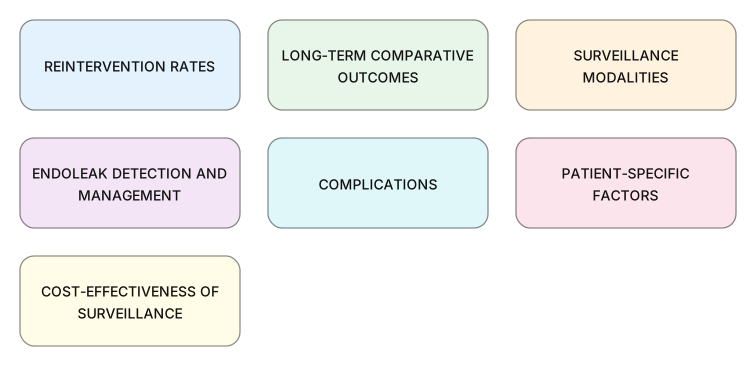
Figure 4. Main extracted research topics
Figure 4. Main extracted research topics (Results)

Figure 5. Limitations of current studies (topics)

Figure 6. Future research directions (topics)