EVAR vs Open Repair for Aortic Aneurysm: Systematic Review with ☸️SAIMSARA.


saimsara.com Download PDF

Abstract: To compare EVAR versus OSR for aortic aneurysm repair regarding mortality, reinterventions, complications, and durability, synthesizing key themes from extracted studies. The review utilises 227 studies with 607960 total participants (naïve ΣN). EVAR demonstrates lower short-term 30-day mortality (median 1.9%, range 0-7.3%) compared to OSR (median 5.9%, range 2.3-17%) in elective AAA repair. Findings generalize to high-volume centers treating infrarenal/ruptured AAA but less to complex anatomies or low-resource settings. Retrospective dominance most affects certainty. Clinicians should prioritize EVAR for ruptured cases while ensuring rigorous long-term surveillance.

Keywords: EVAR; open repair; abdominal aortic aneurysm; perioperative mortality; reintervention rates; long-term survival; randomized controlled trial; ruptured AAA; cost-effectiveness; acute kidney injury

Review Stats
Identification of studies via Semantic Scholar (all fields) Identification Screening Included Records identified:n=2075Records excluded:n=1075 Records assessed for eligibilityn=1000Records excluded:n=773 Studies included in reviewn=227 PRISMA Diagram generated by ☸️ SAIMSARA
⛛OSMA Triangle Head-to-Head (A vs B) EVAR vs open repair — aortic aneurysm Legend: “Favours EVAR” = left edge, “Favours open repair” = right edge; “Neutral” = vertical. Favours EVAR ΣN=136952 (23%) Favours open repair ΣN=23464 (4%) Neutral ΣN=447544 (74%) 0 ⛛OSMA Triangle generated by ☸️SAIMSARA
Show OSMA legend
Outcome-Sentiment Meta-Analysis (OSMA): (LLM-only)
Frame: Head-to-Head (A vs B) • Source: Semantic Scholar
Comparators: A = EVAR; B = open repair
Outcome: aortic aneurysm Typical timepoints: 30-day, peri/post-op. Reported metrics: %, CI, p.
Common endpoints: Common endpoints: mortality, complications, survival.
Predictor: EVAR vs open repair — exposure/predictor.

  • 1) A favored (EVAR) — aortic aneurysm with EVAR vs open repair — [7], [10], [16], [19], [21], [22], [23], [24], [34], [36], [37], [47], [48], [71], [74], [75], [111], [118], [119], [120], [121], [122], [138], [142], [145], [147], [151], [153], [159], [160], [161], [169], [174], [179], [180], [193], [208], [209], [212], [213], [223], [225], [226], [227] — ΣN=136952
  • 2) B favored (open repair) — aortic aneurysm with EVAR vs open repair — [28], [29], [33], [35], [43], [123], [141], [170], [175] — ΣN=23464
  • 3) Neutral (no difference) — aortic aneurysm with EVAR vs open repair — [1], [2], [3], [4], [5], [6], [8], [9], [11], [12], [13], [14], [15], [17], [18], [20], [25], [26], [27], [30], [31], [32], [38], [39], [40], [41], [42], [44], [45], [46], [49], [50], [51], [52], [53], [54], [55], [56], [57], [58], [59], [60], [61], [62], [63], [64], [65], [66], [67], [68], [69], [70], [72], [73], [76], [77], [78], [79], [80], [81], [82], [83], [84], [85], [86], [87], [88], [89], [90], [91], [92], [93], [94], [95], [96], [97], [98], [99], [100], [101], [102], [103], [104], [105], [106], [107], [108], [109], [110], [112], [113], [114], [115], [116], [117], [124], [125], [126], [127], [128], [129], [130], [131], [132], [133], [134], [135], [136], [137], [139], [140], [143], [144], [146], [148], [149], [150], [152], [154], [155], [156], [157], [158], [162], [163], [164], [165], [166], [167], [168], [171], [172], [173], [176], [177], [178], [181], [182], [183], [184], [185], [186], [187], [188], [189], [190], [191], [192], [194], [195], [196], [197], [198], [199], [200], [201], [202], [203], [204], [205], [206], [207], [210], [211], [214], [215], [216], [217], [218], [219], [220], [221], [222], [224] — ΣN=447544
1) Introduction
Abdominal aortic aneurysm (AAA) repair aims to prevent rupture, with endovascular aneurysm repair (EVAR) emerging as a minimally invasive alternative to open surgical repair (OSR). Early randomized controlled trials (RCTs) like EVAR Trial 1 demonstrated short-term survival advantages for EVAR, but long-term data raised concerns over durability, reinterventions, and aneurysm-related mortality [1,2,6]. This review synthesizes evidence from diverse studies comparing EVAR and OSR across elective, ruptured, and complex anatomies, addressing evolving outcomes, complications, and patient subgroups.

2) Aim
To compare EVAR versus OSR for aortic aneurysm repair regarding mortality, reinterventions, complications, and durability, synthesizing key themes from extracted studies.

3) Methods
Systematic review with multilayer AI research agent: keyword normalization, retrieval & structuring, and paper synthesis (see SAIMSARA About section for details).
Bias: Qualitatively inferred from study design fields.

4) Results
4.1 Study characteristics
Studies predominantly involved patients with infrarenal or juxtarenal abdominal aortic aneurysms (AAA), including elective intact, ruptured, and high-risk cases; designs spanned RCTs (e.g., EVAR Trial 1 [1,2,6,8]), retrospective cohorts, and mixed methods. Follow-up ranged from 30 days to 15 years, with short-term (perioperative/30-day) and midterm (1-5 years) outcomes most common.

4.2 Main numerical result aligned to the query
Comparable 30-day/operative mortality rates for elective/intact AAA showed lower values for EVAR versus OSR, with median EVAR 1.9% (range 0-7.3%) [4,10,29] versus median OSR 5.9% (range 2.3-17%) [4,10,29]; p-values ranged from <0.001 to 0.140, indicating consistent short-term benefit with some heterogeneity. For ruptured AAA, EVAR 30-day mortality median was 25% (range 5.9-50%) versus OSR median 50% (range 35-63.3%) [19,23,24]. No uniform long-term all-cause mortality metric existed due to varying follow-up and adjustments, but multiple reports noted equivalence after 3-5 years [10,15,20].

4.3 Topic synthesis


5) Discussion
5.1 Principal finding
EVAR demonstrates lower short-term 30-day mortality (median 1.9%, range 0-7.3%) compared to OSR (median 5.9%, range 2.3-17%) in elective AAA repair [4,10,29], with similar patterns in ruptured cases. Long-term survival converges, but EVAR incurs higher reintervention rates [10,150].

5.2 Clinical implications


5.3 Research implications / key gaps


5.4 Limitations


5.5 Future directions


6) Conclusion
EVAR demonstrates lower short-term 30-day mortality (median 1.9%, range 0-7.3%) compared to OSR (median 5.9%, range 2.3-17%) in elective AAA repair [4,10,29]. Findings generalize to high-volume centers treating infrarenal/ruptured AAA but less to complex anatomies or low-resource settings. Retrospective dominance most affects certainty. Clinicians should prioritize EVAR for ruptured cases while ensuring rigorous long-term surveillance.

References
SAIMSARA Session Index — session.json

Figure 1. Publication-year distribution of included originals

Figure 2. Study-design distribution of included originals
Figure 2. Study-design distribution

Figure 3. Study-type (directionality) distribution of included originals
Figure 3. Directionality distribution

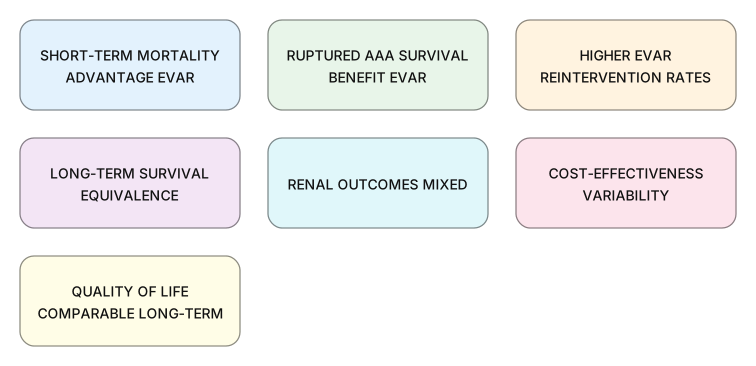
Figure 4. Main extracted research topics
Figure 4. Main extracted research topics (Results)

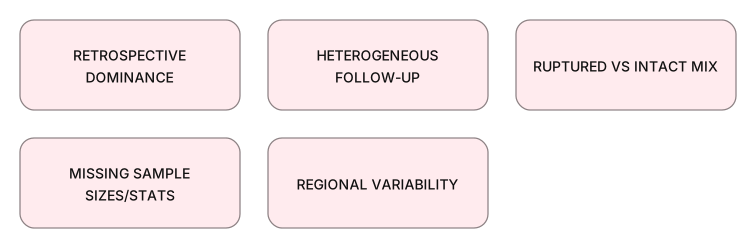
Figure 5. Limitations of current studies (topics)

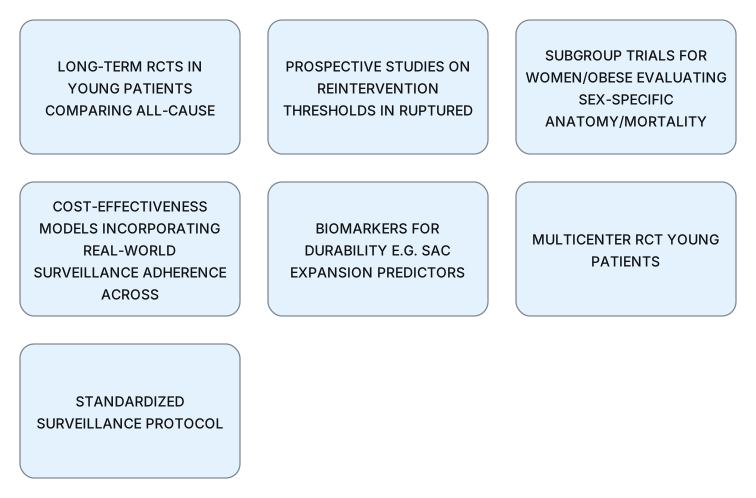
Figure 6. Future research directions (topics)