Femoral Thromboendarterectomy: Systematic Review with ☸️SAIMSARA.


saimsara.com Download PDF

Abstract: This paper aims to systematically review and synthesize current evidence regarding femoral thromboendarterectomy, focusing on its efficacy, safety, physiological impact, and associated clinical considerations, as extracted and structured by a multilayer AI research agent. The review utilises 7 studies with 273 total participants (naïve ΣN). Thromboendarterectomy (TEA) for common femoral artery (CFA) occlusive disease demonstrated a 1-year primary patency rate of 92.8%, significantly higher compared to stenting (84.6%, p=0.006). This suggests that femoral TEA is an effective revascularization strategy, particularly for CFA disease, with promising outcomes extending to complex aortoiliac lesions with minimally invasive approaches. However, the reliance on retrospective designs and small sample sizes in much of the current literature represents a significant limitation to the certainty and generalizability of these findings. Clinicians should prioritize femoral TEA for CFA occlusive disease, while future prospective comparative trials are needed to solidify long-term outcomes and optimize patient management strategies.

Keywords: Femoral thromboendarterectomy; Common femoral artery; Peripheral arterial disease

Review Stats
Identification of studies via Semantic Scholar (all fields) Identification Screening Included Records identified:n=267518Records excluded:n=266518 Records assessed for eligibilityn=1000Records excluded:n=993 Studies included in reviewn=7 PRISMA Diagram generated by ☸️ SAIMSARA
⛛OSMA Triangle Effect-of Predictor → Outcome femoral thromboendarterectomy  →  Outcome Beneficial for patients ΣN=0 (0%) Harmful for patients ΣN=0 (0%) Neutral ΣN=273 (100%) 0 ⛛OSMA Triangle generated by ☸️SAIMSARA
Show OSMA legend
Outcome-Sentiment Meta-Analysis (OSMA): (LLM-only)
Frame: Effect-of Predictor → Outcome • Source: Semantic Scholar
Outcome: Outcome Typical timepoints: 1-y, peri/post-op. Reported metrics: %, p.
Common endpoints: Common endpoints: complications, patency, mortality.
Predictor: femoral thromboendarterectomy — exposure/predictor.

  • 1) Beneficial for patients — Outcome with femoral thromboendarterectomy — — — ΣN=0
  • 2) Harmful for patients — Outcome with femoral thromboendarterectomy — — — ΣN=0
  • 3) No clear effect — Outcome with femoral thromboendarterectomy — [1], [2], [3], [4], [5], [6], [7] — ΣN=273
1) Introduction
Femoral thromboendarterectomy (TEA) is a foundational surgical technique for revascularizing occlusive disease in the common femoral artery (CFA) and associated segments, crucial for managing peripheral arterial disease (PAD). This procedure aims to remove atherosclerotic plaque, thereby restoring arterial patency and improving limb perfusion. Its application spans patients with intermittent claudication (IC) to those suffering from chronic limb-threatening ischemia (CLTI). The efficacy and safety of femoral TEA, alongside considerations for patient selection, perioperative monitoring, and adjunctive therapies, remain key areas of investigation in vascular surgery.

2) Aim
This paper aims to systematically review and synthesize current evidence regarding femoral thromboendarterectomy, focusing on its efficacy, safety, physiological impact, and associated clinical considerations, as extracted and structured by a multilayer AI research agent.

3) Methods
Systematic review with multilayer AI research agent: keyword normalization, retrieval & structuring, and paper synthesis (see SAIMSARA About section for details).


4) Results
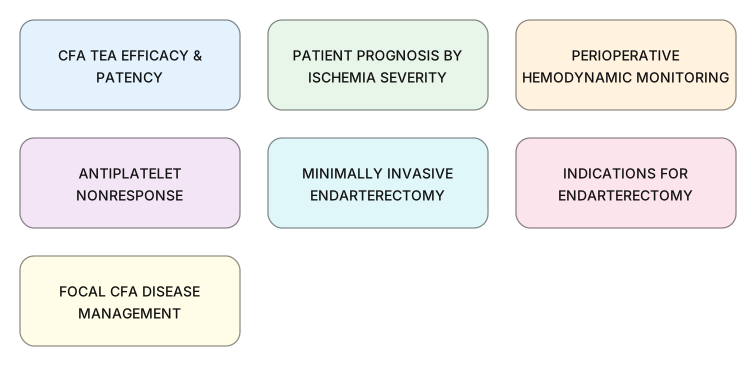
4.1 Study characteristics: The included literature comprises mixed-design studies [1, 2, 6], cohort studies [3, 4], and a case series [5], with one entry providing general procedural information without specific study design [7]. Retrospective analyses were common [1, 3, 6], alongside prospective investigations [2, 4]. Patient populations varied, encompassing Japanese cohorts with CLTI and IC [1], patients with peripheral arterial disease undergoing revascularization [2], individuals with atherosclerotic CFA occlusive disease [3], and those undergoing various vascular surgeries including femoral TEA [4]. One study focused on aortoiliac occlusive disease [5], while others addressed focal CFA disease [6] or general indications for plaque removal [7]. Follow-up durations were often not specified [1, 2, 4, 6, 7], though some studies reported outcomes at 1 year [3] or up to 6 years [5].

4.2 Main numerical result aligned to the query:
Thromboendarterectomy (TEA) for common femoral artery (CFA) occlusive disease demonstrated a 1-year primary patency rate of 92.8%, which was significantly higher compared to stenting (84.6%, p=0.006) [3]. This superiority extended to freedom from reintervention, with TEA achieving a 94.0% rate versus 89.9% for stenting (p=0.030) over the same period [3]. For more extensive aortobiiliofemoral endarterectomy, a 6-year patency rate of 100% was reported [5].

4.3 Topic synthesis:


5) Discussion
5.1 Principal finding: Thromboendarterectomy (TEA) for common femoral artery (CFA) occlusive disease demonstrated a 1-year primary patency rate of 92.8%, significantly higher compared to stenting (84.6%, p=0.006) [3]. This highlights TEA's robust efficacy in maintaining arterial patency for a critical vascular segment.

5.2 Clinical implications:


5.3 Research implications / key gaps:


5.4 Limitations:


5.5 Future directions:


6) Conclusion
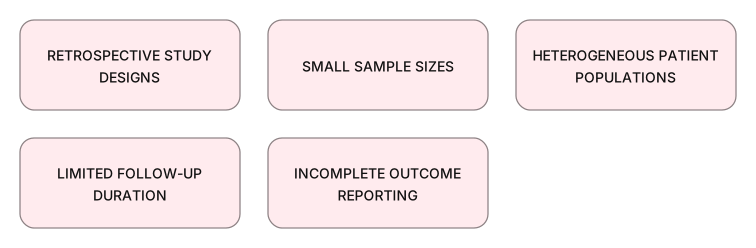
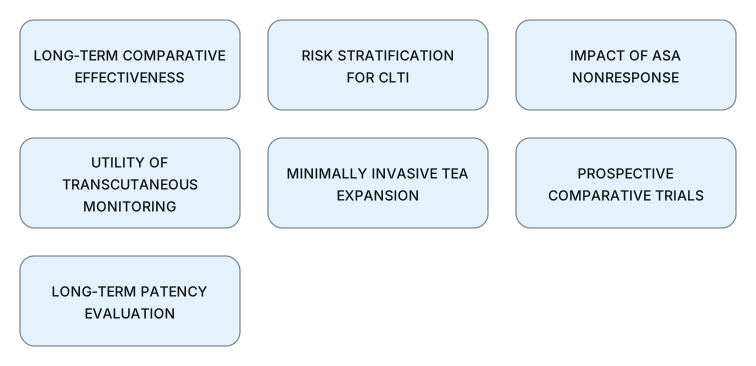
Thromboendarterectomy (TEA) for common femoral artery (CFA) occlusive disease demonstrated a 1-year primary patency rate of 92.8%, significantly higher compared to stenting (84.6%, p=0.006) [3]. This suggests that femoral TEA is an effective revascularization strategy, particularly for CFA disease, with promising outcomes extending to complex aortoiliac lesions with minimally invasive approaches. However, the reliance on retrospective designs and small sample sizes in much of the current literature represents a significant limitation to the certainty and generalizability of these findings. Clinicians should prioritize femoral TEA for CFA occlusive disease, while future prospective comparative trials are needed to solidify long-term outcomes and optimize patient management strategies.

References
SAIMSARA Session Index — session.json

Figure 1. Publication-year distribution of included originals

Figure 2. Study-design distribution of included originals
Figure 2. Study-design distribution

Figure 3. Study-type (directionality) distribution of included originals
Figure 3. Directionality distribution

Figure 4. Main extracted research topics
Figure 4. Main extracted research topics (Results)

Figure 5. Limitations of current studies (topics)

Figure 6. Future research directions (topics)