Guarana: Systematic Review with ☸️SAIMSARA.


saimsara.com

Review Stats
Identification of studies via PubMed (titles/abstracts) Identification Screening Included Records identified:n=336Records excluded:n=2 Records assessed for eligibilityn=334Records excluded:n=135 Studies included in reviewn=199 PRISMA Diagram generated by ☸️ SAIMSARA
⛛OSMA Triangle Effect-of Predictor → Outcome guarana  →  Outcome Beneficial for patients ΣN=2164 (17%) Harmful for patients ΣN=1880 (15%) Neutral ΣN=8448 (68%) 0 ⛛OSMA Triangle generated by ☸️SAIMSARA
Outcome-Sentiment Meta-Analysis (OSMA): (LLM-only)
Frame: Effect-of Predictor → Outcome • Source: PubMed
Outcome: Outcome Typical timepoints: 11-day, 24-y. Reported metrics: %, CI, p.
Common endpoints: Common endpoints: complications, seizure, qol.
Predictor: guarana — exposure/predictor. Doses/units seen: 1000 μg, 50 mg, 300 mg. Routes seen: topical, oral. Typical comparator: placebo, a low dose of caffeine or, placebo groups, control….


1) Introduction
Guarana (Paullinia cupana) is a plant native to the Amazon basin, historically recognized for its stimulant properties and rich content of methylxanthines and polyphenols [35, 48, 146]. Recent research has expanded our understanding of guarana beyond its traditional use, revealing diverse applications across agriculture, industrial processes, and human health. Studies explore its potential in enhancing plant growth, developing sustainable materials, and modulating various physiological processes in biological systems. This paper synthesizes findings on guarana's multifaceted roles, from its rhizosphere microbiome interactions to its impact on cognitive function, metabolism, and therapeutic potential, alongside considerations for its safety and industrial applications.

2) Aim
The aim of this paper is to systematically review and synthesize the current scientific literature on guarana, extracting key findings related to its biological activities, health effects, and industrial applications, and to identify critical research gaps.

3) Methods
Systematic review with multilayer AI research agent: keyword normalization, retrieval & structuring, and paper synthesis (see SAIMSARA About section for details).


4) Results
4.1 Study characteristics
The review encompassed a broad spectrum of study designs, including randomized controlled trials (RCTs), cohort studies, mixed-design investigations, and experimental studies. Populations ranged from human volunteers (e.g., students, athletes, cancer patients) to various animal models (e.g., Drosophila melanogaster, Wistar rats, mice, Caenorhabditis elegans, earthworms), and in vitro cellular systems (e.g., Caco-2 cells, human mesenchymal stem cells, neuronal cells). Agricultural settings included sugarcane, soybean, and guarana plants themselves. Follow-up periods varied widely, from acute observations over minutes or hours to longer durations of days, weeks, months, and in one case, up to 2 years for nanoparticle stability [8].

4.2 Main numerical result aligned to the query
Guarana-associated microbes demonstrate significant plant growth-promoting capabilities. Specifically, studies show that Bacillus paramycoides RZ3MS14 improved sugarcane growth by increases ranging from 225.92% to 520.89% [1], while rhizobacteria isolated from guarana promoted corn root dry weight increases of 136.9% and 247.8% [103]. Across these comparable metrics, the median increase in plant growth and root dry weight attributed to guarana-associated microbes was 242.25% (range: 136.9% to 520.89%) [1, 103].

4.3 Topic synthesis


5) Discussion
5.1 Principal finding
The most striking and consistently quantifiable positive effect of guarana, as evidenced by this review, is its role in agriculture: plant growth promotion by guarana-associated microbes showed a median increase of 242.25% (range: 136.9% to 520.89%) in plant growth and root dry weight [1, 103].

5.2 Clinical implications


5.3 Research implications / key gaps


5.4 Limitations


5.5 Future directions


6) Conclusion
Plant growth promotion by guarana-associated microbes showed a median increase of 242.25% (range: 136.9% to 520.89%) in plant growth and root dry weight [1, 103]. This remarkable agricultural potential contrasts with the more varied and sometimes contradictory findings in human health, where guarana demonstrates promise in cognitive enhancement and metabolic regulation but also carries risks of adverse events, particularly when consumed in high doses or in combination with other stimulants. The high variability in guarana preparations and study designs across human and animal models significantly limits the generalizability of its direct physiological effects. Future research should focus on standardized guarana extracts and rigorous human clinical trials to clarify its efficacy and safety for specific health applications.

References
SAIMSARA Session Index — session.json

Figure 1. Publication-year distribution of included originals

Figure 2. Study-design distribution of included originals
Figure 2. Study-design distribution

Figure 3. Study-type (directionality) distribution of included originals
Figure 3. Directionality distribution

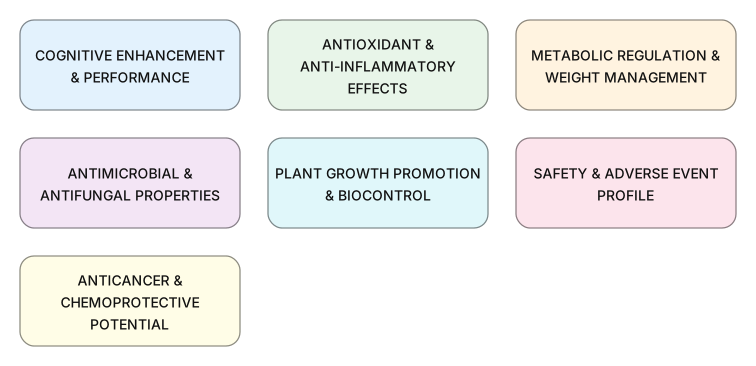
Figure 4. Main extracted research topics
Figure 4. Main extracted research topics (Results)

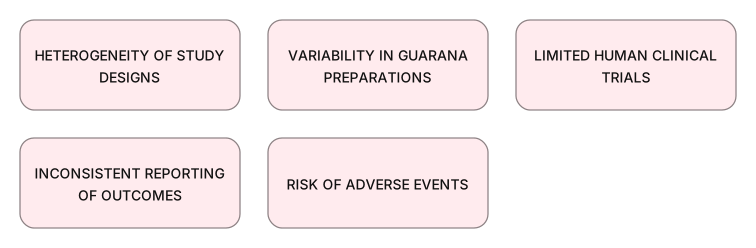
Figure 5. Limitations of current studies (topics)

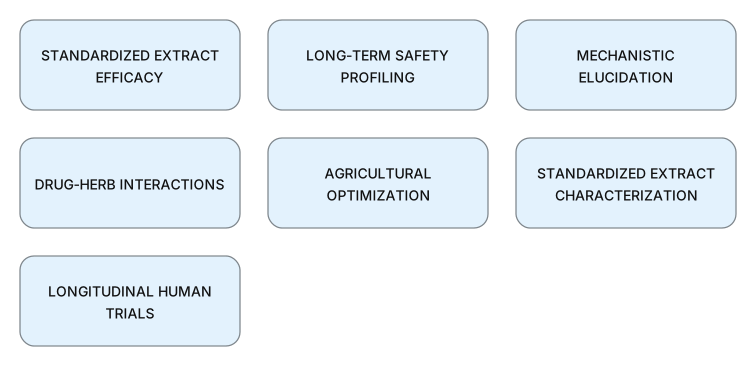
Figure 6. Future research directions (topics)