Guarana and Health: Systematic Review with ☸️SAIMSARA.


saimsara.com

Review Stats
Identification of studies via EPMC (titles/abstracts) Identification Screening Included Records identified:n=70Records excluded:n=0 Records assessed for eligibilityn=70Records excluded:n=39 Studies included in reviewn=31 PRISMA Diagram generated by ☸️ SAIMSARA
⛛OSMA Triangle Effect-of Predictor → Outcome guarana and health  →  Outcome Beneficial for patients ΣN=126 (2%) Harmful for patients ΣN=4871 (81%) Neutral ΣN=980 (16%) 0 ⛛OSMA Triangle generated by ☸️SAIMSARA
Outcome-Sentiment Meta-Analysis (OSMA): (LLM-only)
Frame: Effect-of Predictor → Outcome • Source: Europe PMC
Outcome: Outcome Typical timepoints: 6-y, 25-y. Reported metrics: %, p.
Common endpoints: Common endpoints: functional, seizure.
Predictor: guarana and health — exposure/predictor. Routes seen: sc. Typical comparator: soluble polyphenols.


1) Introduction
Guarana (Paullinia cupana) is a plant native to the Amazon basin, traditionally recognized for its stimulant properties and diverse health applications. Its seeds are rich in bioactive compounds, including caffeine, catechins, and other polyphenols, which contribute to its purported physiological effects. Recent scientific inquiry has explored guarana's potential benefits across various health domains, ranging from cognitive enhancement and metabolic regulation to antioxidant and antimicrobial activities. However, alongside these potential advantages, concerns regarding its safety profile, particularly in high concentrations or in combination with other stimulants, necessitate a comprehensive evaluation. This paper synthesizes current research on guarana and health, drawing insights from a structured extraction of scientific literature.

2) Aim
The aim of this paper is to systematically review the current evidence on the health effects of guarana, encompassing both its potential benefits and reported adverse outcomes, to identify key findings, research gaps, and implications for clinical practice and future research.

3) Methods
Systematic review with multilayer AI research agent: keyword normalization, retrieval & structuring, and paper synthesis (see SAIMSARA About section for details).


4) Results
4.1 Study characteristics
The included studies comprised a mixed array of designs, including in vitro analyses, animal models (Wistar rats, C. elegans, LDLr-/- mice, B6C3F1 mice, ICR mice, Chinese hamster ovary cells), and human investigations (students, healthy adults, truck drivers, overweight professionals, case reports, poison data system analyses). Follow-up periods varied significantly, from immediate observations to 2 years, with many studies not specifying a follow-up duration.

4.2 Main numerical result aligned to the query
Preventive treatment with guarana powder significantly mitigated paracetamol-induced liver damage in rats, resulting in a median reduction of 29% in elevated liver enzymes (ALT, AST, ALP), with a range of 24% to 44% [2].

4.3 Topic synthesis


5) Discussion
5.1 Principal finding
The central finding indicates that preventive treatment with guarana powder significantly mitigated paracetamol-induced liver damage in rats, resulting in a median reduction of 29% in elevated liver enzymes (ALT, AST, ALP) [2].

5.2 Clinical implications


5.3 Research implications / key gaps


5.4 Limitations


5.5 Future directions


6) Conclusion
Preventive treatment with guarana powder significantly mitigated paracetamol-induced liver damage in rats, resulting in a median reduction of 29% in elevated liver enzymes (ALT, AST, ALP), with a range of 24% to 44% [2]. While these findings suggest promising therapeutic potential, particularly in antioxidant and protective capacities, the generalizability to human populations is limited by the prevalence of animal studies and small sample sizes in human trials. The most significant limitation affecting certainty is the reliance on animal models and small, often unblinded, human studies, alongside the confounding presence of co-ingredients in many tested formulations. Therefore, clinicians should advise caution regarding guarana consumption, especially in individuals with pre-existing conditions, pending further robust human clinical trials.

References
SAIMSARA Session Index — session.json

Figure 1. Publication-year distribution of included originals

Figure 2. Study-design distribution of included originals
Figure 2. Study-design distribution

Figure 3. Study-type (directionality) distribution of included originals
Figure 3. Directionality distribution

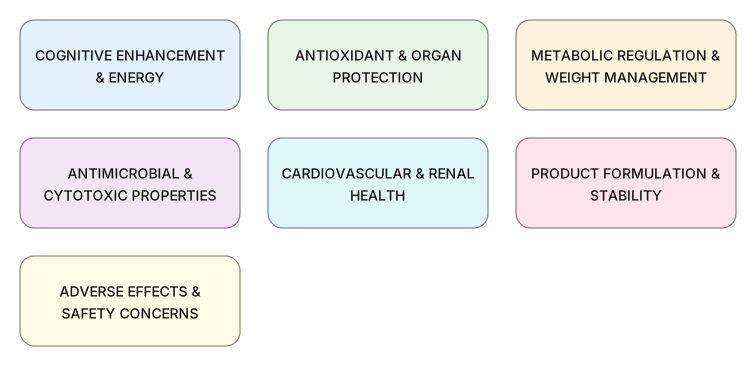
Figure 4. Main extracted research topics
Figure 4. Main extracted research topics (Results)

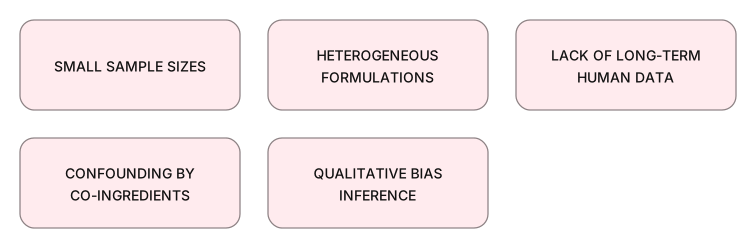
Figure 5. Limitations of current studies (topics)

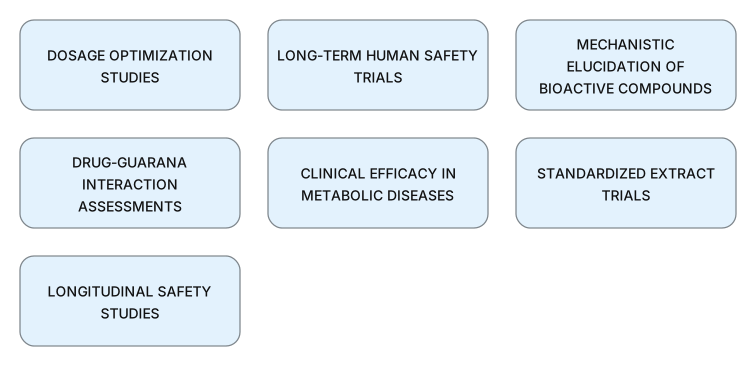
Figure 6. Future research directions (topics)