Life Quality in Peripheral Artery Disease: Systematic Review with ☸️SAIMSARA.


saimsara.com Download PDF

Abstract: This systematic review aims to comprehensively assess the current understanding of life quality in patients with peripheral artery disease, identifying its determinants, methods of assessment, and the impact of various interventions on patient-reported quality of life outcomes. The review utilises 277 studies with 231946 total participants (naïve ΣN). Peripheral artery disease significantly impairs patients' quality of life, with various interventions demonstrating improvements in functional capacity, notably a median increase of 35.2 meters (range: 21.3 to 85 meters) in 6-minute walking distance. These findings are generally applicable across symptomatic PAD populations, emphasizing the importance of functional improvements for overall well-being. However, the variability in QoL assessment tools across studies represents a significant limitation, hindering comprehensive cross-study comparisons. Future research should prioritize the standardization of quality of life measures to enable more robust comparative effectiveness studies and better inform clinical practice.

Keywords: Peripheral Artery Disease; Health-Related Quality of Life; Intermittent Claudication

Review Stats
Identification of studies via Semantic Scholar (all fields) Identification Screening Included Records identified:n=20137Records excluded:n=19137 Records assessed for eligibilityn=1000Records excluded:n=723 Studies included in reviewn=277 PRISMA Diagram generated by ☸️ SAIMSARA
⛛OSMA Triangle Effect-of Predictor → Outcome peripheral artery disease  →  life quality Beneficial for patients ΣN=19041 (8%) Harmful for patients ΣN=27535 (12%) Neutral ΣN=185370 (80%) 0 ⛛OSMA Triangle generated by ☸️SAIMSARA
Show OSMA legend
Outcome-Sentiment Meta-Analysis (OSMA): (LLM-only)
Frame: Effect-of Predictor → Outcome • Source: Semantic Scholar
Outcome: life quality Typical timepoints: 1-y, 12-mo. Reported metrics: %, CI, p.
Common endpoints: Common endpoints: qol, functional, mortality.
Predictor: peripheral artery disease — exposure/predictor. Doses/units seen: 100 mg, 2.5 mg. Routes seen: iv, oral. Typical comparator: hf or stroke patients, 6-minute walking distance, control, lbet….

  • 1) Beneficial for patients — life quality with peripheral artery disease — [4], [5], [7], [9], [12], [13], [14], [17], [21], [25], [26], [27], [29], [31], [33], [35], [36], [37], [40], [45], [49], [50], [51], [52], [53], [54], [56], [57], [61], [63], [64], [67], [69], [75], [91], [95], [108], [109], [110], [112], [114], [115], [117], [118], [122], [124], [125], [152], [153], [155], [156], [157], [163], [164], [165], [167], [168], [169], [170], [171], [172], [173], [175], [177], [178], [180], [183], [187], [189], [190], [193], [197], [201], [212], [214], [215], [217], [218], [221], [225], [257], [263], [269], [271], [272], [273], [277] — ΣN=19041
  • 2) Harmful for patients — life quality with peripheral artery disease — [3], [11], [15], [16], [20], [22], [23], [30], [32], [42], [43], [46], [55], [58], [66], [68], [71], [72], [73], [74], [76], [77], [81], [82], [85], [93], [97], [98], [99], [151], [158], [159], [160], [161], [166], [182], [194], [195], [196], [198], [200], [202], [207], [208], [210], [213], [216], [219], [220], [222], [223], [224], [255], [265], [275], [276] — ΣN=27535
  • 3) No clear effect — life quality with peripheral artery disease — [1], [2], [6], [8], [10], [18], [19], [24], [28], [34], [38], [39], [41], [44], [47], [48], [59], [60], [62], [65], [70], [78], [79], [80], [83], [84], [86], [87], [88], [89], [90], [92], [94], [96], [100], [101], [102], [103], [104], [105], [106], [107], [111], [113], [116], [119], [120], [121], [123], [126], [127], [128], [129], [130], [131], [132], [133], [134], [135], [136], [137], [138], [139], [140], [141], [142], [143], [144], [145], [146], [147], [148], [149], [150], [154], [162], [174], [176], [179], [181], [184], [185], [186], [188], [191], [192], [199], [203], [204], [205], [206], [209], [211], [226], [227], [228], [229], [230], [231], [232], [233], [234], [235], [236], [237], [238], [239], [240], [241], [242], [243], [244], [245], [246], [247], [248], [249], [250], [251], [252], [253], [254], [256], [258], [259], [260], [261], [262], [264], [266], [267], [268], [270], [274] — ΣN=185370
1) Introduction
Peripheral Artery Disease (PAD) is a chronic condition affecting millions of adults globally, characterized by reduced blood flow to the limbs [20, 73, 159]. This arterial insufficiency often leads to symptoms such as intermittent claudication (IC), rest pain, non-healing wounds, and in severe cases, critical limb ischemia (CLI) and limb loss [66, 73, 133, 151]. These physical manifestations profoundly impair patients' functional capacity, mobility, and overall health-related quality of life (HRQoL) [16, 72, 77, 82, 96, 97, 150, 154, 255]. The burden of PAD extends beyond physical limitations, encompassing psychosocial and emotional distress, reduced life satisfaction, and increased depressive symptoms [30, 58, 71, 159]. Given its widespread impact, improving quality of life (QoL) is a primary treatment objective for patients with PAD [102, 117, 156, 177]. This systematic review synthesizes recent findings on the multifaceted aspects of life quality in PAD patients, identifying key determinants and therapeutic strategies.

2) Aim
This systematic review aims to comprehensively assess the current understanding of life quality in patients with peripheral artery disease, identifying its determinants, methods of assessment, and the impact of various interventions on patient-reported quality of life outcomes.

3) Methods
Systematic review with multilayer AI research agent: keyword normalization, retrieval & structuring, and paper synthesis (see SAIMSARA About section for details).


4) Results
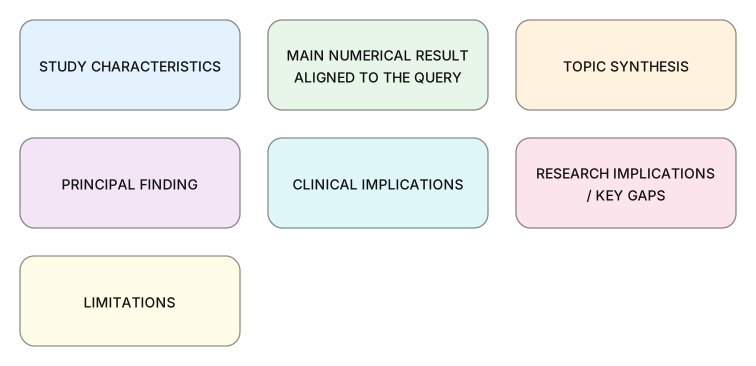
4.1 Study characteristics:
The review encompassed a broad range of study designs, including numerous cohort studies [1, 3, 5, 6, 9, 11, 13, 14, 16, 36, 37, 40, 43, 45, 46, 54, 55, 58, 61, 63, 116, 118, 119, 130, 137, 154, 161, 162, 174, 177, 190, 193, 194, 195, 196, 197, 198, 202, 208, 213, 214, 216, 217, 226, 231, 239, 242, 243, 245, 247, 271, 275], cross-sectional studies [2, 7, 10, 15, 22, 48, 57, 62, 68, 70, 120, 123, 147, 149, 162, 206, 207, 210, 213, 215, 236, 238], and randomized controlled trials (RCTs) [4, 8, 12, 17, 21, 28, 35, 44, 50, 52, 53, 56, 60, 65, 80, 108, 109, 110, 112, 126, 144, 163, 165, 167, 168, 171, 173, 175, 178, 181, 184, 185, 186, 191, 199, 203, 205, 211, 218, 234, 235, 250, 251, 256, 258, 261, 264, 270, 274]. Populations primarily included adults with symptomatic PAD, often with intermittent claudication or critical limb ischemia. Follow-up periods varied widely, from short-term (e.g., 4 weeks [41], 6 weeks [56], 8 weeks [50, 126, 167], 12 weeks [8, 21, 65, 112, 171, 181, 185, 205], 3 months [9, 43, 45, 108, 117, 190, 203, 218]) to intermediate (e.g., 6 months [36, 37, 44, 56, 116, 186, 212], 12 months [5, 43, 55, 63, 118, 119, 175, 191, 193, 217, 219, 248, 251, 264, 266], 18 months [189], 24 months [116, 245]) and long-term (e.g., 3 years [54, 190, 226], 4.5 years [257], 5 years [43], 11 years [137]).

4.2 Main numerical result aligned to the query:
Improvements in 6-minute walking distance (6MWD), a key indicator of functional capacity and quality of life, were frequently reported across various interventions. The median absolute improvement in 6MWD was 35.2 meters, with a range from 21.3 meters to 85 meters [31, 33, 50, 114, 172]. For instance, supervised exercise training (SET) led to an average improvement of 32.1 ± 6.6 meters [31] and 53.5 ± 4.5 meters [33]. Home-based leg heat therapy showed a median improvement of 21.3 meters compared to a control group's -0.91 meters [50], while high-pressure intermittent limb compression (HPILC) resulted in a 35.2 ± 38.7 meters improvement [172]. Another study reported an increase from 137 ± 12 meters to 222 ± 10 meters, representing an 85-meter gain [114]. These improvements consistently correlated with enhanced quality of life metrics [9, 53, 114].

4.3 Topic synthesis:


5) Discussion
5.1 Principal finding:
The review consistently highlights that peripheral artery disease significantly impairs patients' quality of life, with various interventions demonstrating improvements in functional capacity, notably a median increase of 35.2 meters (range: 21.3 to 85 meters) in 6-minute walking distance [31, 33, 50, 114, 172]. This underscores the critical link between physical function and perceived well-being in this patient population.

5.2 Clinical implications:


5.3 Research implications / key gaps:


5.4 Limitations:


5.5 Future directions:


6) Conclusion
Peripheral artery disease significantly impairs patients' quality of life, with various interventions demonstrating improvements in functional capacity, notably a median increase of 35.2 meters (range: 21.3 to 85 meters) in 6-minute walking distance [31, 33, 50, 114, 172]. These findings are generally applicable across symptomatic PAD populations, emphasizing the importance of functional improvements for overall well-being. However, the variability in QoL assessment tools across studies represents a significant limitation, hindering comprehensive cross-study comparisons. Future research should prioritize the standardization of quality of life measures to enable more robust comparative effectiveness studies and better inform clinical practice.

References
SAIMSARA Session Index — session.json

Figure 1. Publication-year distribution of included originals

Figure 2. Study-design distribution of included originals
Figure 2. Study-design distribution

Figure 3. Study-type (directionality) distribution of included originals
Figure 3. Directionality distribution

Figure 4. Main extracted research topics
Figure 4. Main extracted research topics (Results)

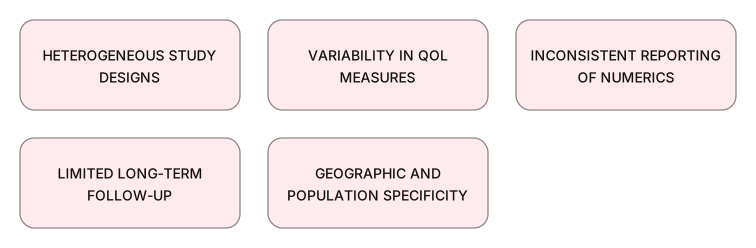
Figure 5. Limitations of current studies (topics)

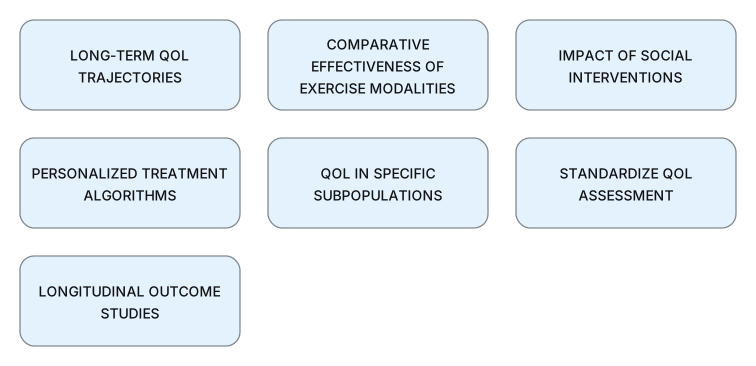
Figure 6. Future research directions (topics)