Osteopathy and Health: Systematic Review with ☸️SAIMSARA.


saimsara.com

Review Stats
Identification of studies via PubMed (titles/abstracts) Identification Screening Included Records identified:n=389Records excluded:n=2 Records assessed for eligibilityn=387Records excluded:n=246 Studies included in reviewn=141 PRISMA Diagram generated by ☸️ SAIMSARA
⛛OSMA Triangle Effect-of Predictor → Outcome osteopathy and health  →  Outcome Beneficial for patients ΣN=57530 (57%) Harmful for patients ΣN=12820 (13%) Neutral ΣN=31417 (31%) 0 ⛛OSMA Triangle generated by ☸️SAIMSARA
Outcome-Sentiment Meta-Analysis (OSMA): (LLM-only)
Frame: Effect-of Predictor → Outcome • Source: PubMed
Outcome: Outcome Typical timepoints: 5-y, 3-y. Reported metrics: %, CI, p.
Common endpoints: Common endpoints: qol, complications, seizure.
Predictor: osteopathy and health — exposure/predictor. Typical comparator: those with less experience, males in rural northern, untreated infants, sham….


1) Introduction
Osteopathy, a distinct system of medicine, emphasizes the interconnectedness of the body's systems and the body's innate ability to heal. Practitioners, known as osteopaths or Doctors of Osteopathy (DOs), utilize a holistic, patient-centered approach, often employing manual techniques to diagnose and treat a wide range of health conditions. The scope of osteopathic practice extends beyond musculoskeletal complaints to encompass various systemic and chronic health issues, often integrating with conventional medical care. This paper synthesizes recent research to elucidate the current landscape of osteopathic practice, its perceived effectiveness, professional development, and integration within broader healthcare systems, highlighting its evolving role in promoting health.

2) Aim
Systematic review with multilayer AI research agent: keyword normalization, retrieval & structuring, and paper synthesis (see SAIMSARA About section for details).

3) Methods
Systematic review with multilayer AI research agent: keyword normalization, retrieval & structuring, and paper synthesis (see SAIMSARA About section for details).


4) Results
4.1 Study characteristics
The included studies comprise a wide array of designs, predominantly cross-sectional surveys and mixed-methods studies investigating professional practices, patient perceptions, and educational aspects. Cohort studies and case series explored specific health conditions and occupational exposures, while a few randomized controlled trials and protocols aimed to assess the efficacy of osteopathic manipulative treatment (OMT) for conditions like chronic low back pain (CLBP), depressive symptoms, and infant sucking difficulties. Follow-up periods, when specified, ranged from 5 weeks to 5 years, with many cross-sectional studies having no follow-up.

4.2 Main numerical result aligned to the query
A significant proportion of patients seeking osteopathic care do so for musculoskeletal (MSK) conditions. The use of osteopathy for MSK problems was reported to be a median of 73% (range: 61.9% to 81.1%) across various populations and settings, including patients in Quebec [110], England [76], and the UK [33, 136]. While other specific conditions showed promising results, such as a mean effectiveness of 7.3 for pain reduction in endometriosis [9] and a mean reduction of 1.20 hours in infant crying time [125], these metrics were not directly comparable across multiple studies to derive a central value.

4.3 Topic synthesis


5) Discussion
5.1 Principal finding
The central finding indicates that osteopathy is predominantly utilized for musculoskeletal conditions, with a median of 73% of patients seeking care for such complaints across various international settings [33, 76, 110, 136]. This underscores its established role in addressing physical pain and dysfunction.

5.2 Clinical implications


5.3 Research implications / key gaps


5.4 Limitations


5.5 Future directions


6) Conclusion
Osteopathy is predominantly utilized for musculoskeletal conditions, with a median of 73% of patients seeking care for such complaints across various international settings [33, 76, 110, 136]. This highlights its established role in addressing physical pain, although its application extends to a broad spectrum of non-musculoskeletal conditions, from infant crying to palliative care. The methodological heterogeneity of current research, encompassing diverse study designs, remains the single limitation that most affects certainty in drawing broad conclusions. Clinicians should recognize osteopathy's potential as an effective adjunctive therapy for chronic pain and specific pediatric conditions, while future research should prioritize large-scale, high-quality randomized controlled trials to further validate its efficacy across a wider range of health issues and standardize diagnostic approaches.

References
SAIMSARA Session Index — session.json

Figure 1. Publication-year distribution of included originals

Figure 2. Study-design distribution of included originals
Figure 2. Study-design distribution

Figure 3. Study-type (directionality) distribution of included originals
Figure 3. Directionality distribution

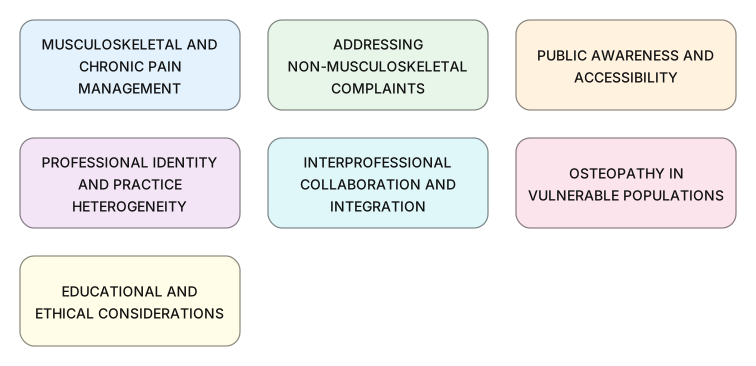
Figure 4. Main extracted research topics
Figure 4. Main extracted research topics (Results)

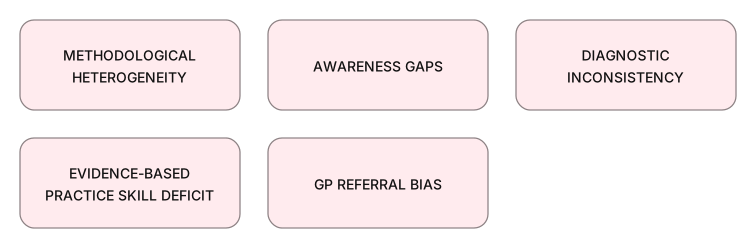
Figure 5. Limitations of current studies (topics)

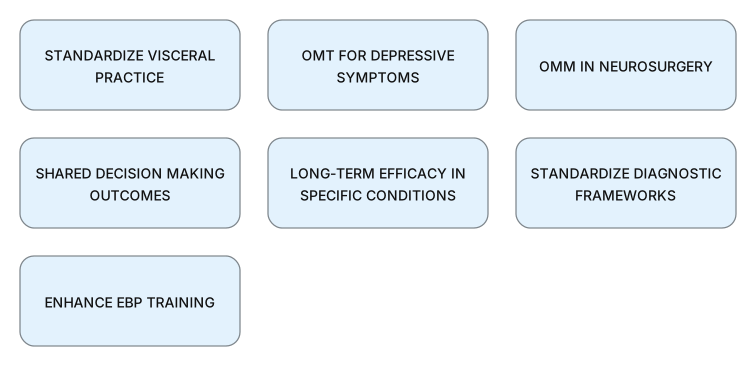
Figure 6. Future research directions (topics)