PAD Bypass: Systematic Review with ☸️SAIMSARA.


saimsara.com Download PDF

Abstract: This paper aims to systematically review the current evidence on PAD bypass surgery, synthesizing findings related to its efficacy, safety, patient-specific outcomes, and comparative performance against alternative revascularization strategies, as well as identifying key biological insights and areas for future research. The review utilises 177 studies with 265898 total participants (naïve ΣN). Amputation-free survival was significantly better in the bypass surgery group (43.4 months) compared to the angioplasty and stenting group (39.8 months) for patients with ulcers or toe gangrenes. This suggests that for specific presentations of peripheral arterial disease, bypass surgery offers superior limb salvage outcomes. However, the heterogeneity of studies, particularly the prevalence of retrospective designs, represents the single limitation that most affects the certainty of these findings. Clinicians should consider bypass surgery as a primary revascularization strategy for critical limb ischemia, especially when a usable saphenous vein is available, while actively managing patient-specific risk factors like glycemic control and pre-operative cardiac status.

Keywords: Peripheral Arterial Disease; Bypass Surgery; Lower Extremity Revascularization; Graft Patency; Infrainguinal

Review Stats
Identification of studies via Semantic Scholar (all fields) Identification Screening Included Records identified:n=512382Records excluded:n=511382 Records assessed for eligibilityn=1000Records excluded:n=823 Studies included in reviewn=177 PRISMA Diagram generated by ☸️ SAIMSARA
⛛OSMA Triangle Effect-of Predictor → Outcome bypass  →  PAD Beneficial for patients ΣN=123364 (46%) Harmful for patients ΣN=60237 (23%) Neutral ΣN=82297 (31%) 0 ⛛OSMA Triangle generated by ☸️SAIMSARA
Show OSMA legend
Outcome-Sentiment Meta-Analysis (OSMA): (LLM-only)
Frame: Effect-of Predictor → Outcome • Source: Semantic Scholar
Outcome: PAD Typical timepoints: peri/post-op, 1-y. Reported metrics: %, CI, p.
Common endpoints: Common endpoints: mortality, complications, patency.
Predictor: bypass — procedure/intervention. Routes seen: oral, topical. Typical comparator: saphenous vein grafts in both, non-diabetic patients, single antiplatelet therapy, best medical treatment….

  • 1) Beneficial for patients — PAD with bypass — [1], [9], [10], [12], [14], [15], [18], [24], [25], [27], [29], [31], [38], [39], [42], [44], [46], [47], [49], [51], [52], [60], [62], [67], [119], [122], [151], [164], [166], [172], [173], [175] — ΣN=123364
  • 2) Harmful for patients — PAD with bypass — [2], [3], [4], [7], [8], [16], [20], [21], [23], [28], [30], [32], [41], [48], [55], [61], [69], [118], [120], [125], [153], [157], [165], [176] — ΣN=60237
  • 3) No clear effect — PAD with bypass — [5], [6], [11], [13], [17], [19], [22], [26], [33], [34], [35], [36], [37], [40], [43], [45], [50], [53], [54], [56], [57], [58], [59], [63], [64], [65], [66], [68], [70], [71], [72], [73], [74], [75], [76], [77], [78], [79], [80], [81], [82], [83], [84], [85], [86], [87], [88], [89], [90], [91], [92], [93], [94], [95], [96], [97], [98], [99], [100], [101], [102], [103], [104], [105], [106], [107], [108], [109], [110], [111], [112], [113], [114], [115], [116], [117], [121], [123], [124], [126], [127], [128], [129], [130], [131], [132], [133], [134], [135], [136], [137], [138], [139], [140], [141], [142], [143], [144], [145], [146], [147], [148], [149], [150], [152], [154], [155], [156], [158], [159], [160], [161], [162], [163], [167], [168], [169], [170], [171], [174], [177] — ΣN=82297
Introduction
Peripheral arterial disease (PAD) represents a significant global health burden, characterized by stenoses or occlusions in arteries supplying the limbs, most commonly the lower extremities. Surgical bypass remains a cornerstone of revascularization strategies for PAD, particularly in cases of critical limb ischemia (CLTI) where limb salvage is paramount. This procedure aims to restore blood flow to ischemic tissues, thereby alleviating symptoms, promoting wound healing, and preventing amputation. Beyond the immediate technical success, the long-term efficacy, patient-specific outcomes, and comparative effectiveness against evolving endovascular therapies are subjects of ongoing research. Understanding the multifaceted aspects of PAD bypass, including its biological benefits, patient risk factors, and the influence of systemic conditions, is crucial for optimizing patient management and improving clinical outcomes.

Aim
This paper aims to systematically review the current evidence on PAD bypass surgery, synthesizing findings related to its efficacy, safety, patient-specific outcomes, and comparative performance against alternative revascularization strategies, as well as identifying key biological insights and areas for future research.

Methods
Systematic review with multilayer AI research agent: keyword normalization, retrieval & structuring, and paper synthesis (see SAIMSARA About section for details).


Results
4.1 Study characteristics:
The extracted literature comprises a diverse range of study designs, including numerous retrospective cohort studies, mixed-design investigations, and several prospective randomized controlled trials or cohort studies. Populations frequently include patients with peripheral arterial disease (PAD) undergoing various bypass procedures (e.g., infra-inguinal, femoropopliteal, aortoiliac), as well as those undergoing coronary artery bypass grafting (CABG) with concomitant PAD. Typical follow-up periods range from 30 days to 10 years, with several studies reporting 1-year, 3-year, or 5-year outcomes.

4.2 Main numerical result aligned to the query:
Amputation-free survival (AFS) was reported to be significantly better in the bypass surgery group (median 43.4 months, range 43.4 to 39.8 months) compared to the angioplasty and stenting group (median 39.8 months, range 43.4 to 39.8 months) for patients with ulcers or toe gangrenes [119].

4.3 Topic synthesis:


Discussion
5.1 Principal finding:
For patients presenting with ulcers or toe gangrenes, bypass surgery was associated with a significantly better amputation-free survival of 43.4 months compared to 39.8 months for angioplasty and stenting [119].

5.2 Clinical implications:


5.3 Research implications / key gaps:


5.4 Limitations:


5.5 Future directions:


Conclusion
Amputation-free survival was significantly better in the bypass surgery group (43.4 months) compared to the angioplasty and stenting group (39.8 months) for patients with ulcers or toe gangrenes [119]. This suggests that for specific presentations of peripheral arterial disease, bypass surgery offers superior limb salvage outcomes. However, the heterogeneity of studies, particularly the prevalence of retrospective designs, represents the single limitation that most affects the certainty of these findings. Clinicians should consider bypass surgery as a primary revascularization strategy for critical limb ischemia, especially when a usable saphenous vein is available, while actively managing patient-specific risk factors like glycemic control and pre-operative cardiac status.

References
SAIMSARA Session Index — session.json

Figure 1. Publication-year distribution of included originals

Figure 2. Study-design distribution of included originals
Figure 2. Study-design distribution

Figure 3. Study-type (directionality) distribution of included originals
Figure 3. Directionality distribution

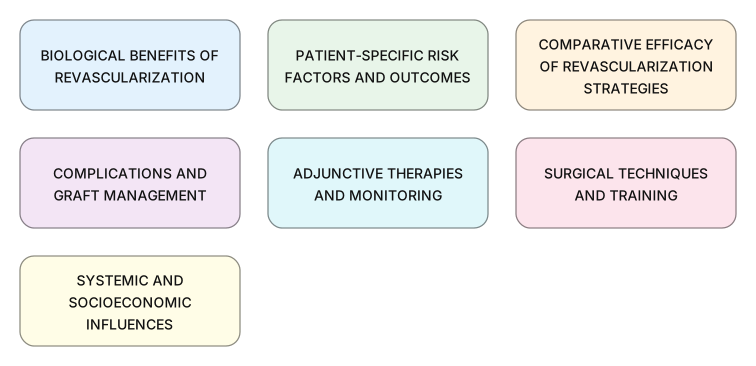
Figure 4. Main extracted research topics
Figure 4. Main extracted research topics (Results)

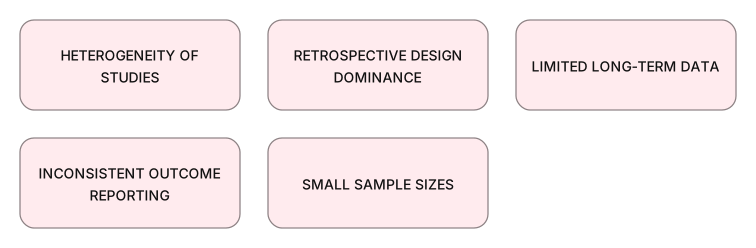
Figure 5. Limitations of current studies (topics)

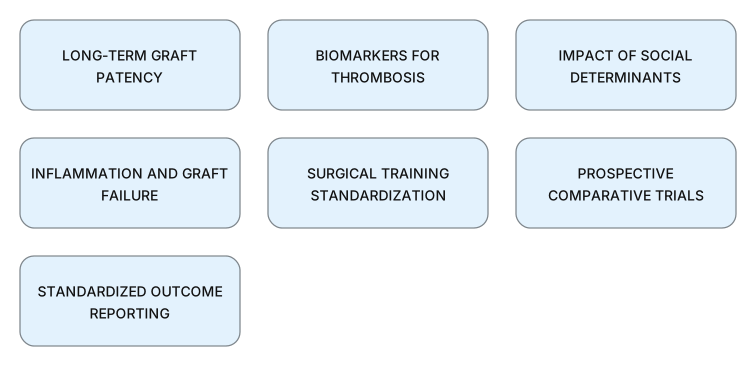
Figure 6. Future research directions (topics)