PAD Fontaine Classification: Systematic Review with ☸️SAIMSARA.


saimsara.com Download PDF

Abstract: The aim of this paper is to systematically review the current scientific literature, leveraging a multilayer AI research agent, to synthesize findings related to the Fontaine classification in the context of PAD, encompassing its utility in diagnosis, prognosis, and treatment evaluation. The review utilises 139 studies with 683465 total participants (naïve ΣN). The Fontaine classification is consistently used across studies as a primary metric for assessing PAD severity and evaluating treatment efficacy, though no single comparable numerical outcome (e.g., a pooled success rate or odds ratio) is reported across multiple studies to allow for a central value calculation. This classification remains indispensable for guiding clinical decisions, stratifying patient risk, and assessing the impact of various interventions on disease progression and patient quality of life. The heterogeneity of study designs and outcome reporting across the literature most significantly affects the certainty of synthesized findings. To advance PAD management, future research should prioritize standardized outcome reporting and the development of AI-driven predictive models that integrate Fontaine stages with comprehensive patient data.

Keywords: Peripheral Artery Disease; Fontaine Classification; Disease Staging

Review Stats
Identification of studies via Semantic Scholar (all fields) Identification Screening Included Records identified:n=3049Records excluded:n=2049 Records assessed for eligibilityn=1000Records excluded:n=861 Studies included in reviewn=139 PRISMA Diagram generated by ☸️ SAIMSARA
⛛OSMA Triangle Effect-of Predictor → Outcome Predictor  →  Outcome Beneficial for patients ΣN=594032 (87%) Harmful for patients ΣN=22576 (3%) Neutral ΣN=66857 (10%) 0 ⛛OSMA Triangle generated by ☸️SAIMSARA
Show OSMA legend
Outcome-Sentiment Meta-Analysis (OSMA): (LLM-only)
Frame: Effect-of Predictor → Outcome • Source: Semantic Scholar
Outcome: Outcome Typical timepoints: peri/post-op, 2-y. Reported metrics: %, CI, p.
Common endpoints: Common endpoints: mortality, admission, qol.
Predictor: Predictor — exposure/predictor. Routes seen: iv, intramuscular, oral. Typical comparator: control, severe pad, class iv and non-pad patients, those without wound occurrence….

  • 1) Beneficial for patients — Outcome with Predictor — [31], [42], [43], [45], [48], [49], [59], [65], [67], [70], [72], [73], [74], [76], [86], [90], [91], [92], [93], [95], [99], [100], [128], [132], [135], [136], [139] — ΣN=594032
  • 2) Harmful for patients — Outcome with Predictor — [33], [36], [38], [39], [40], [47], [50], [52], [54], [55], [56], [57], [58], [60], [61], [62], [63], [64], [69], [71], [75], [78], [81], [82], [87], [88], [96], [98], [131], [134], [138] — ΣN=22576
  • 3) No clear effect — Outcome with Predictor — [1], [2], [3], [4], [5], [6], [7], [8], [9], [10], [11], [12], [13], [14], [15], [16], [17], [18], [19], [20], [21], [22], [23], [24], [25], [26], [27], [28], [29], [30], [32], [34], [35], [37], [41], [44], [46], [51], [53], [66], [68], [77], [79], [80], [83], [84], [85], [89], [94], [97], [101], [102], [103], [104], [105], [106], [107], [108], [109], [110], [111], [112], [113], [114], [115], [116], [117], [118], [119], [120], [121], [122], [123], [124], [125], [126], [127], [129], [130], [133], [137] — ΣN=66857
1) Introduction
Peripheral artery disease (PAD) is a prevalent circulatory condition characterized by narrowed arteries that reduce blood flow to the limbs, most commonly the legs. The Fontaine classification, originally developed by René Fontaine, provides a standardized system for categorizing the severity of PAD based on clinical symptoms, ranging from asymptomatic disease to critical limb ischemia (CLI) with tissue loss [130, 32]. This classification is widely utilized in clinical practice for diagnosis, guiding treatment decisions, and assessing prognosis across various patient populations, including those with comorbidities like diabetes mellitus and hypertension. Its application spans from evaluating novel therapeutic interventions to identifying risk factors and predicting adverse outcomes.

2) Aim
The aim of this paper is to systematically review the current scientific literature, leveraging a multilayer AI research agent, to synthesize findings related to the Fontaine classification in the context of PAD, encompassing its utility in diagnosis, prognosis, and treatment evaluation.

3) Methods
Systematic review with multilayer AI research agent: keyword normalization, retrieval & structuring, and paper synthesis (see SAIMSARA About section for details).


4) Results
4.1 Study characteristics:
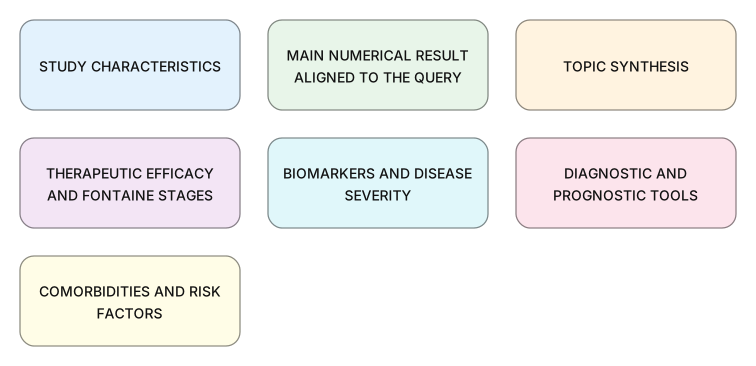
The extracted literature comprises a diverse range of study designs, including mixed-method studies, cohort studies (both retrospective and prospective), randomized controlled trials (RCTs), and cross-sectional analyses. Populations predominantly include patients with lower extremity peripheral artery disease (PAD), often stratified by specific Fontaine classification stages, and frequently coexisting with conditions such as diabetes mellitus (T2DM), hypertension (HTN), and coronary artery disease (CAD). Follow-up periods varied significantly, from short-term (1 month [3], 3 weeks [34], 6 months [1, 2, 11, 17, 19, 59]) to intermediate (1 year [20, 42, 73], 2 years [4, 36, 93, 121]) and long-term (5 years [89], 7 years [119], 18.8 years [38], 17.4 years [52]).

4.2 Main numerical result aligned to the query:
The Fontaine classification is consistently used across studies as a primary metric for assessing PAD severity and evaluating treatment efficacy, though no single comparable numerical outcome (e.g., a pooled success rate or odds ratio) is reported across multiple studies to allow for a central value calculation. Instead, various interventions demonstrate significant improvements in Fontaine stages or related clinical parameters. For instance, Lumbar sympathetic blockade (LSB) led to regressed Fontaine Classification Stages [1], and rotational atherothrombectomy significantly improved postoperative Rutherford and Fontaine classifications (p<0.001) [42]. Cilostazol treatment significantly improved PAD symptoms classified by Fontaine classification [43], and iliac artery stenting improved Fontaine classifications from stages IIa-IV to I-IV, with 88% ischemic symptom improvement [132].

4.3 Topic synthesis:


5) Discussion
5.1 Principal finding:
The Fontaine classification is a fundamental and widely utilized tool for stratifying peripheral artery disease (PAD) severity, consistently demonstrating its utility in guiding therapeutic interventions, correlating with various biomarkers, and predicting clinical outcomes across the spectrum of the disease [1, 42, 43, 132].

5.2 Clinical implications:


5.3 Research implications / key gaps:


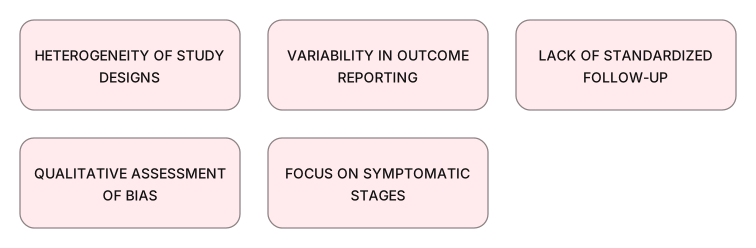
5.4 Limitations:


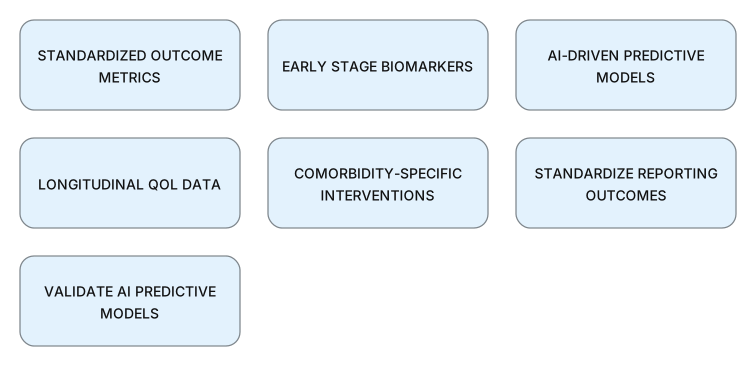
5.5 Future directions:


6) Conclusion
The Fontaine classification is consistently used across studies as a primary metric for assessing PAD severity and evaluating treatment efficacy, though no single comparable numerical outcome (e.g., a pooled success rate or odds ratio) is reported across multiple studies to allow for a central value calculation. This classification remains indispensable for guiding clinical decisions, stratifying patient risk, and assessing the impact of various interventions on disease progression and patient quality of life. The heterogeneity of study designs and outcome reporting across the literature most significantly affects the certainty of synthesized findings. To advance PAD management, future research should prioritize standardized outcome reporting and the development of AI-driven predictive models that integrate Fontaine stages with comprehensive patient data.

References
SAIMSARA Session Index — session.json

Figure 1. Publication-year distribution of included originals

Figure 2. Study-design distribution of included originals
Figure 2. Study-design distribution

Figure 3. Study-type (directionality) distribution of included originals
Figure 3. Directionality distribution

Figure 4. Main extracted research topics
Figure 4. Main extracted research topics (Results)

Figure 5. Limitations of current studies (topics)

Figure 6. Future research directions (topics)