PAD Risk Factors: Systematic Review with ☸️SAIMSARA


saimsara.com Download PDF

Abstract: The aim of this paper is to identify and synthesize the key risk factors associated with peripheral artery disease based on a structured extraction summary of academic literature. The review utilises 261 studies with 2834010 total participants (naïve ΣN). The synthesis of current literature demonstrates that for men, each additional traditional cardiovascular risk factor (smoking, hypertension, hypercholesterolemia, and type 2 diabetes) was associated with a multivariable-adjusted hazard ratio of 2.06 (95% CI, 1.88–2.26) for PAD development over 25 years. This underscores the profound cumulative impact of these factors on PAD risk across diverse populations, particularly those with diabetes. The heterogeneity in study designs and populations represents a significant limitation, potentially affecting the generalizability of some findings. Therefore, a concrete next step involves designing large-scale, prospective cohort studies with standardized PAD diagnostic criteria to further elucidate the interplay of traditional and novel risk factors across diverse global populations, ultimately informing more precise preventive and therapeutic strategies.

Review Stats
Identification of studies via Semantic Scholar (all fields) Identification Screening Included Records identified:n=11576Records excluded:n=10576 Records assessed for eligibilityn=1000Records excluded:n=739 Studies included in reviewn=261 PRISMA Diagram generated by ☸️ SAIMSARA
⛛OSMA Triangle Effect-of Predictor → Outcome pad risk factors  →  Outcome Beneficial for patients ΣN=72427 (3%) Harmful for patients ΣN=2666657 (94%) Neutral ΣN=94926 (3%) 0 ⛛OSMA Triangle generated by ☸️SAIMSARA
Show OSMA legend
Outcome-Sentiment Meta-Analysis (OSMA): (LLM-only)
Frame: Effect-of Predictor → Outcome • Source: Semantic Scholar
Outcome: Outcome Typical timepoints: 10-y, peri/post-op. Reported metrics: %, CI, p.
Common endpoints: Common endpoints: complications, mortality, healing.
Predictor: pad risk factors — exposure/predictor. Doses/units seen: 60 g, 25 kg, 17 ml, 100 g, 60 ml, 45 ml. Routes seen: iv, oral. Typical comparator: individuals with only pad, control, those with coronary artery, coronary….

  • 1) Beneficial for patients — Outcome with pad risk factors — [18], [72], [76], [82], [97], [192], [214], [255] — ΣN=72427
  • 2) Harmful for patients — Outcome with pad risk factors — [1], [2], [4], [5], [6], [7], [8], [10], [11], [12], [13], [14], [15], [16], [17], [19], [20], [21], [22], [23], [24], [25], [26], [27], [28], [29], [30], [31], [32], [33], [34], [35], [36], [37], [38], [39], [40], [41], [42], [43], [44], [45], [46], [47], [48], [49], [50], [52], [53], [54], [55], [66], [68], [69], [70], [71], [73], [74], [75], [77], [78], [79], [80], [81], [84], [85], [88], [89], [90], [91], [92], [93], [94], [95], [98], [99], [100], [101], [104], [105], [107], [109], [110], [112], [113], [114], [115], [117], [119], [120], [121], [122], [124], [125], [127], [129], [131], [133], [134], [135], [136], [137], [138], [139], [140], [141], [143], [147], [148], [149], [150], [151], [152], [153], [154], [155], [156], [157], [158], [159], [160], [161], [162], [163], [164], [165], [166], [167], [168], [169], [170], [171], [172], [173], [174], [175], [176], [178], [179], [180], [181], [182], [183], [184], [185], [187], [188], [189], [190], [191], [193], [194], [196], [197], [198], [199], [200], [201], [202], [203], [204], [205], [206], [207], [210], [213], [216], [218], [219], [220], [222], [223], [224], [225], [226], [227], [228], [229], [233], [234], [235], [236], [238], [239], [241], [242], [243], [244], [245], [246], [247], [248], [249], [252], [253], [254], [257], [258], [259], [260] — ΣN=2666657
  • 3) No clear effect — Outcome with pad risk factors — [3], [9], [51], [56], [57], [58], [59], [60], [61], [62], [63], [64], [65], [67], [83], [86], [87], [96], [102], [103], [106], [108], [111], [116], [118], [123], [126], [128], [130], [132], [142], [144], [145], [146], [177], [186], [195], [208], [209], [211], [212], [215], [217], [221], [230], [231], [232], [237], [240], [250], [251], [256], [261] — ΣN=94926
1) Introduction
Peripheral artery disease (PAD) is a prevalent atherosclerotic condition affecting the arteries supplying blood to the limbs, most commonly the legs. It is a significant public health concern associated with substantial morbidity and mortality, including increased risks of cardiovascular events, stroke, and limb-related complications such as amputation [1, 104, 170, 244]. Understanding the multifaceted risk factors contributing to PAD development and progression is crucial for effective prevention, early diagnosis, and targeted management strategies. This paper systematically synthesizes current evidence on PAD risk factors, drawing exclusively from a structured extraction summary to provide a comprehensive overview.

2) Aim
The aim of this paper is to identify and synthesize the key risk factors associated with peripheral artery disease based on a structured extraction summary of academic literature.

3) Methods
Systematic review with multilayer AI research agent: keyword normalization, retrieval & structuring, and paper synthesis (see SAIMSARA About section for details).


4) Results
4.1 Study characteristics
The included studies predominantly comprised cohort, cross-sectional, and mixed designs, with a few randomized controlled trials. Populations varied widely, including individuals with type 2 diabetes (T2D) [1, 2, 13, 18], HIV-infected patients [15, 40], general community-dwelling adults [14, 98], and specific patient cohorts such as those with chronic kidney disease or undergoing hemodialysis [65, 143]. Follow-up periods, when specified, ranged from 90 days to 39 years [8, 97].

4.2 Main numerical result aligned to the query
The cumulative impact of traditional cardiovascular risk factors significantly increases the likelihood of developing peripheral artery disease. For men, each additional risk factor (smoking, hypertension, hypercholesterolemia, and type 2 diabetes) was associated with a multivariable-adjusted hazard ratio (HR) of 2.06 (95% CI, 1.88–2.26) for PAD development over 25 years [37]. Similarly, individuals with type 2 diabetes who had all five PAD risk factors not at target showed a substantially higher adjusted hazard ratio for PAD of 9.28 (95% CI 3.62-23.79) compared to 1.41 (95% CI 1.23-1.63) for those with all risk factors within target [2].

4.3 Topic synthesis


5) Discussion
5.1 Principal finding
The synthesis reveals that for men, each additional traditional cardiovascular risk factor (smoking, hypertension, hypercholesterolemia, and type 2 diabetes) increases the hazard of PAD development by 2.06-fold (95% CI, 1.88–2.26) [37]. This highlights the compounding effect of multiple risk factors on PAD incidence.

5.2 Clinical implications


5.3 Research implications / key gaps


5.4 Limitations


5.5 Future directions


6) Conclusion
The synthesis of current literature demonstrates that for men, each additional traditional cardiovascular risk factor (smoking, hypertension, hypercholesterolemia, and type 2 diabetes) was associated with a multivariable-adjusted hazard ratio of 2.06 (95% CI, 1.88–2.26) for PAD development over 25 years [37]. This underscores the profound cumulative impact of these factors on PAD risk across diverse populations, particularly those with diabetes. The heterogeneity in study designs and populations represents a significant limitation, potentially affecting the generalizability of some findings. Therefore, a concrete next step involves designing large-scale, prospective cohort studies with standardized PAD diagnostic criteria to further elucidate the interplay of traditional and novel risk factors across diverse global populations, ultimately informing more precise preventive and therapeutic strategies.

References
SAIMSARA Session Index — session.json

Figure 1. Publication-year distribution of included originals

Figure 2. Study-design distribution of included originals
Figure 2. Study-design distribution

Figure 3. Study-type (directionality) distribution of included originals
Figure 3. Directionality distribution

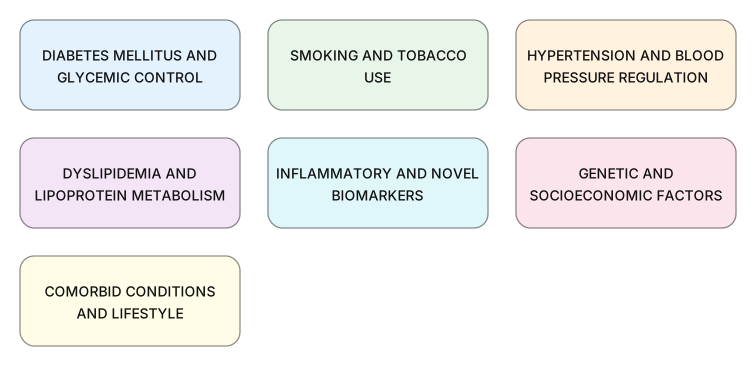
Figure 4. Main extracted research topics
Figure 4. Main extracted research topics (Results)

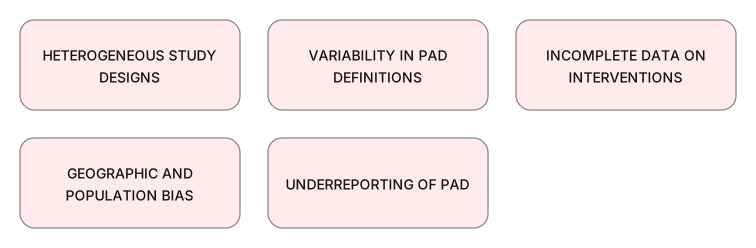
Figure 5. Limitations of current studies (topics)

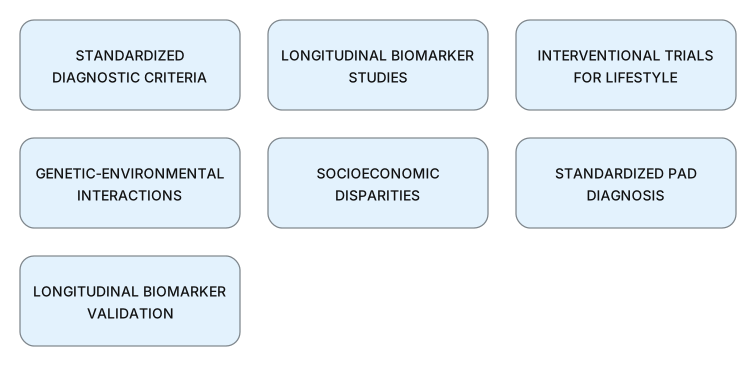
Figure 6. Future research directions (topics)