PAD Rutherford Classification: Systematic Review with ☸️SAIMSARA.


saimsara.com Download PDF

Abstract: To systematically review and synthesize current literature regarding the Rutherford classification in Peripheral Artery Disease. The review utilises 201 studies with 92877 total participants (naïve ΣN). Interventional treatments for Peripheral Artery Disease consistently achieved a median rate of 91.8% improvement in Rutherford classification, signifying a high clinical success rate in reducing disease severity. This widespread improvement across various interventions underscores the Rutherford classification's utility as a robust measure of therapeutic benefit in symptomatic PAD patients. However, the heterogeneous nature of study designs and the inconsistent reporting of outcome metrics represent the most significant limitations affecting the certainty of these findings. Clinicians should continue to utilize the Rutherford classification for patient stratification and treatment evaluation, while researchers should strive for standardized reporting to enable more robust comparative analyses.

Keywords: Peripheral Artery Disease; Rutherford Classification; Chronic Limb Ischemia

Review Stats
Identification of studies via Semantic Scholar (all fields) Identification Screening Included Records identified:n=2972Records excluded:n=1972 Records assessed for eligibilityn=1000Records excluded:n=799 Studies included in reviewn=201 PRISMA Diagram generated by ☸️ SAIMSARA
⛛OSMA Triangle Effect-of Predictor → Outcome PAD  →  Rutherford classification Beneficial for patients ΣN=9845 (11%) Harmful for patients ΣN=36884 (40%) Neutral ΣN=46148 (50%) 0 ⛛OSMA Triangle generated by ☸️SAIMSARA
Show OSMA legend
Outcome-Sentiment Meta-Analysis (OSMA): (LLM-only)
Frame: Effect-of Predictor → Outcome • Source: Semantic Scholar
Outcome: Rutherford classification Typical timepoints: 12-mo, 6-mo. Reported metrics: %, CI, p.
Common endpoints: Common endpoints: patency, healing, mortality.
Predictor: PAD — procedure/intervention. Routes seen: iv, intramuscular. Typical comparator: higher categories, the placebo group, placebo, controls….

  • 1) Beneficial for patients — Rutherford classification with PAD — [3], [12], [13], [17], [18], [30], [38], [39], [41], [44], [46], [54], [56], [57], [59], [65], [66], [69], [72], [73], [75], [77], [78], [79], [81], [82], [86], [88], [93], [95], [99], [105], [107], [111], [113], [115], [119], [121], [123], [124], [146], [147], [179], [184], [188], [190], [191], [192], [193], [195], [198] — ΣN=9845
  • 2) Harmful for patients — Rutherford classification with PAD — [2], [10], [21], [24], [27], [29], [37], [40], [42], [43], [48], [60], [80], [84], [87], [89], [90], [91], [94], [96], [97], [98], [100], [101], [102], [108], [109], [112], [114], [116], [118], [120], [138], [139], [148], [150], [187], [197], [199], [200] — ΣN=36884
  • 3) No clear effect — Rutherford classification with PAD — [1], [4], [5], [6], [7], [8], [9], [11], [14], [15], [16], [19], [20], [22], [23], [25], [26], [28], [31], [32], [33], [34], [35], [36], [45], [47], [49], [50], [51], [52], [53], [55], [58], [61], [62], [63], [64], [67], [68], [70], [71], [74], [76], [83], [85], [92], [103], [104], [106], [110], [117], [122], [125], [126], [127], [128], [129], [130], [131], [132], [133], [134], [135], [136], [137], [140], [141], [142], [143], [144], [145], [149], [151], [152], [153], [154], [155], [156], [157], [158], [159], [160], [161], [162], [163], [164], [165], [166], [167], [168], [169], [170], [171], [172], [173], [174], [175], [176], [177], [178], [180], [181], [182], [183], [185], [186], [189], [194], [196], [201] — ΣN=46148
1) Introduction
Peripheral Artery Disease (PAD) is a common circulatory problem where narrowed arteries reduce blood flow to the limbs. The Rutherford classification system is a widely recognized clinical tool used to categorize the severity of PAD, ranging from asymptomatic disease to severe chronic limb-threatening ischemia (CLTI). This classification is crucial for guiding treatment decisions, predicting patient outcomes, and assessing the efficacy of therapeutic interventions. This paper synthesizes current research on the Rutherford classification in PAD, exploring its prognostic value, associations with various biomarkers and risk factors, and its utility in evaluating treatment responses and economic burdens.

2) Aim
To systematically review and synthesize current literature regarding the Rutherford classification in Peripheral Artery Disease.

3) Methods
Systematic review with multilayer AI research agent: keyword normalization, retrieval & structuring, and paper synthesis (see SAIMSARA About section for details).


4) Results
4.1 Study characteristics
The review encompassed 166 studies, predominantly retrospective cohort studies and mixed designs, with several prospective cohorts and randomized controlled trials. Populations primarily consisted of adult patients diagnosed with symptomatic Peripheral Artery Disease (PAD), including those undergoing percutaneous peripheral interventions, endovascular therapy, or presenting with chronic limb-threatening ischemia (CLTI). Typical follow-up periods ranged from 6 months to 3 years, though many studies did not specify follow-up duration.

4.2 Main numerical result aligned to the query
Interventional treatments for Peripheral Artery Disease consistently demonstrated significant clinical improvement as measured by the Rutherford classification. The median rate of improvement in Rutherford classification was 91.8% (range: 87.5% [44] to 98.2% [164]) across various interventions and follow-up periods, indicating a high rate of amelioration in disease severity post-treatment. For example, drug-eluting balloons showed improvement rates of 94.9% at 6 months and 95.5% at 12 months [107], while Eluvia drug-eluting stents achieved 91.8% improvement at 24 months [184]. Mean Rutherford classification scores also showed significant drops, such as from 3.7±0.6 at baseline to 1.0±0.9 at 12 months after Jetstream Atherectomy [79].

4.3 Topic synthesis


5) Discussion
5.1 Principal finding
Interventional treatments for Peripheral Artery Disease consistently achieved a median rate of 91.8% improvement in Rutherford classification, signifying a high clinical success rate in reducing disease severity [39, 164].

5.2 Clinical implications


5.3 Research implications / key gaps


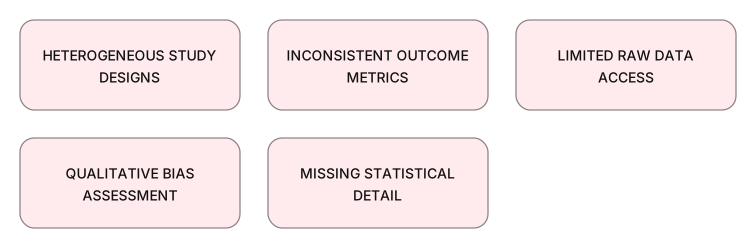
5.4 Limitations


5.5 Future directions


6) Conclusion
Interventional treatments for Peripheral Artery Disease consistently achieved a median rate of 91.8% improvement in Rutherford classification, signifying a high clinical success rate in reducing disease severity [39, 164]. This widespread improvement across various interventions underscores the Rutherford classification's utility as a robust measure of therapeutic benefit in symptomatic PAD patients. However, the heterogeneous nature of study designs and the inconsistent reporting of outcome metrics represent the most significant limitations affecting the certainty of these findings. Clinicians should continue to utilize the Rutherford classification for patient stratification and treatment evaluation, while researchers should strive for standardized reporting to enable more robust comparative analyses.

References
SAIMSARA Session Index — session.json

Figure 1. Publication-year distribution of included originals

Figure 2. Study-design distribution of included originals
Figure 2. Study-design distribution

Figure 3. Study-type (directionality) distribution of included originals
Figure 3. Directionality distribution

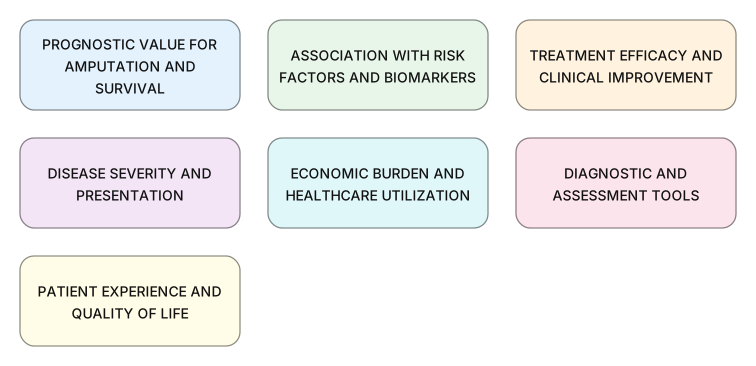
Figure 4. Main extracted research topics
Figure 4. Main extracted research topics (Results)

Figure 5. Limitations of current studies (topics)

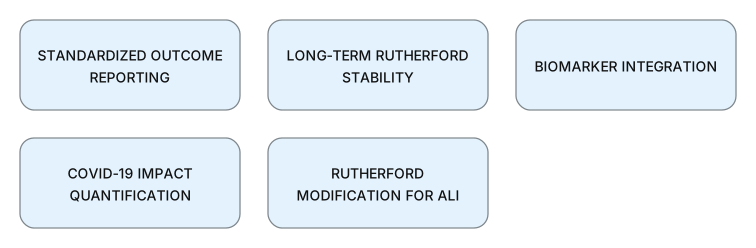
Figure 6. Future research directions (topics)