PAD TASC Classification: Systematic Review with ☸️SAIMSARA.


saimsara.com Download PDF

Abstract: This paper aims to systematically review the current literature on the application and implications of the TASC classification in peripheral artery disease, synthesizing findings related to its role in predicting disease complexity, guiding interventions, and correlating with patient outcomes and associated biomarkers. The review utilises 156 studies with 58532 total participants (naïve ΣN). For femoropopliteal lesions classified as TASC C or D, endovascular interventions achieve a median 1-year primary patency rate of 78.0% (range: 57.33%–85.6%). The TASC classification remains a cornerstone for assessing peripheral artery disease severity, guiding treatment decisions, and predicting outcomes across various anatomical segments and patient populations. However, the reliance on retrospective study designs and the inherent heterogeneity in outcome reporting represent the most significant limitations to drawing definitive conclusions. A concrete next study should involve large-scale prospective comparative trials to definitively assess long-term outcomes of endovascular versus surgical approaches for complex TASC C/D lesions.

Keywords: Peripheral Artery Disease; TASC classification; TASC II classification; Endovascular treatment; PAD severity

Review Stats
Identification of studies via Semantic Scholar (all fields) Identification Screening Included Records identified:n=2456Records excluded:n=1456 Records assessed for eligibilityn=1000Records excluded:n=844 Studies included in reviewn=156 PRISMA Diagram generated by ☸️ SAIMSARA
⛛OSMA Triangle Effect-of Predictor → Outcome PAD TASC classification  →  Outcome Beneficial for patients ΣN=1483 (3%) Harmful for patients ΣN=31956 (55%) Neutral ΣN=25093 (43%) 0 ⛛OSMA Triangle generated by ☸️SAIMSARA
Show OSMA legend
Outcome-Sentiment Meta-Analysis (OSMA): (LLM-only)
Frame: Effect-of Predictor → Outcome • Source: Semantic Scholar
Outcome: Outcome Typical timepoints: 2-y, 12-mo. Reported metrics: %, CI, p.
Common endpoints: Common endpoints: patency, complications, survival.
Predictor: PAD TASC classification — exposure/predictor. Routes seen: iv. Typical comparator: iliac stenting alone, direct surgical bypass, other antibody deficiencies, ba alone. the tasc ii….

  • 1) Beneficial for patients — Outcome with PAD TASC classification — [2], [3], [5], [13], [20], [22], [28], [45], [49], [50], [58], [59], [60], [66], [67], [151], [153] — ΣN=1483
  • 2) Harmful for patients — Outcome with PAD TASC classification — [4], [7], [11], [12], [14], [21], [23], [39], [46], [47], [48], [52], [73], [74], [75], [86], [100], [101], [102], [103], [105], [110], [111], [121], [122], [154], [156] — ΣN=31956
  • 3) No clear effect — Outcome with PAD TASC classification — [1], [6], [8], [9], [10], [15], [16], [17], [18], [19], [24], [25], [26], [27], [29], [30], [31], [32], [33], [34], [35], [36], [37], [38], [40], [41], [42], [43], [44], [51], [53], [54], [55], [56], [57], [61], [62], [63], [64], [65], [68], [69], [70], [71], [72], [76], [77], [78], [79], [80], [81], [82], [83], [84], [85], [87], [88], [89], [90], [91], [92], [93], [94], [95], [96], [97], [98], [99], [104], [106], [107], [108], [109], [112], [113], [114], [115], [116], [117], [118], [119], [120], [123], [124], [125], [126], [127], [128], [129], [130], [131], [132], [133], [134], [135], [136], [137], [138], [139], [140], [141], [142], [143], [144], [145], [146], [147], [148], [149], [150], [152], [155] — ΣN=25093
1) Introduction
Peripheral artery disease (PAD) represents a significant global health burden, characterized by stenotic or occlusive lesions in the arteries supplying the limbs. Accurate classification of PAD severity and anatomical complexity is crucial for guiding treatment strategies and predicting outcomes. The Trans-Atlantic Inter-Society Consensus (TASC) classification, particularly TASC II, has emerged as a widely adopted system for categorizing peripheral arterial lesions, ranging from simple (TASC A/B) to complex (TASC C/D). This classification system informs decisions regarding endovascular versus surgical revascularization and is increasingly integrated with prognostic biomarkers and advanced diagnostic technologies. Understanding the multifaceted role of TASC classification in PAD, from risk stratification to therapeutic planning and outcome prediction, is essential for optimizing patient care.

2) Aim
This paper aims to systematically review the current literature on the application and implications of the TASC classification in peripheral artery disease, synthesizing findings related to its role in predicting disease complexity, guiding interventions, and correlating with patient outcomes and associated biomarkers.

3) Methods
Systematic review with multilayer AI research agent: keyword normalization, retrieval & structuring, and paper synthesis (see SAIMSARA About section for details).


4) Results
4.1 Study characteristics
The included studies predominantly employed mixed, retrospective cohort, or cross-sectional designs, with a smaller number of prospective cohorts and randomized controlled trials (RCTs). Populations consistently focused on peripheral artery disease (PAD) patients, often stratified by TASC II classification, examining lesions in aorto-iliac, femoro-popliteal, and infrapopliteal regions. Follow-up periods varied widely, ranging from short-term (30 days) to mid-term (6 months, 1 year, 2 years), and long-term (3 years, 5 years, 10 years), with many studies not specifying a follow-up duration.

4.2 Main numerical result aligned to the query
For femoropopliteal lesions classified as TASC C or D, the 1-year primary patency rate following endovascular interventions showed a median of 78.0% (range: 57.33%–85.6%) [5, 45, 58, 110, 112]. Technical success rates for endovascular procedures were generally high across lesion types, with specific reports of 97.7% for TASC II A and B iliac artery occlusions [2], 98.67% for complex femoropopliteal diseases [5], and 87% for infra-popliteal TASC C and D lesions [22]. However, technical success could be lower for TASC D lesions compared to TASC A lesions (65.0% vs. 95.8%) [121], and TASC D lesions were associated with higher perioperative complication rates compared to TASC C lesions (10% vs. 0%, p=0.011) [20].

4.3 Topic synthesis


5) Discussion
5.1 Principal finding
The central finding reveals that for femoropopliteal lesions classified as TASC C or D, endovascular interventions achieve a median 1-year primary patency rate of 78.0% (range: 57.33%–85.6%) [5, 45, 58, 110, 112]. This highlights the variable but generally acceptable efficacy of endovascular approaches for complex lesions, despite TASC II D lesions being associated with lower technical success and higher complication rates in some contexts [20, 121].

5.2 Clinical implications


5.3 Research implications / key gaps


5.4 Limitations


5.5 Future directions


6) Conclusion
For femoropopliteal lesions classified as TASC C or D, endovascular interventions achieve a median 1-year primary patency rate of 78.0% (range: 57.33%–85.6%) [5, 45, 58, 110, 112]. The TASC classification remains a cornerstone for assessing peripheral artery disease severity, guiding treatment decisions, and predicting outcomes across various anatomical segments and patient populations. However, the reliance on retrospective study designs and the inherent heterogeneity in outcome reporting represent the most significant limitations to drawing definitive conclusions. A concrete next study should involve large-scale prospective comparative trials to definitively assess long-term outcomes of endovascular versus surgical approaches for complex TASC C/D lesions.

References
SAIMSARA Session Index — session.json

Figure 1. Publication-year distribution of included originals

Figure 2. Study-design distribution of included originals
Figure 2. Study-design distribution

Figure 3. Study-type (directionality) distribution of included originals
Figure 3. Directionality distribution

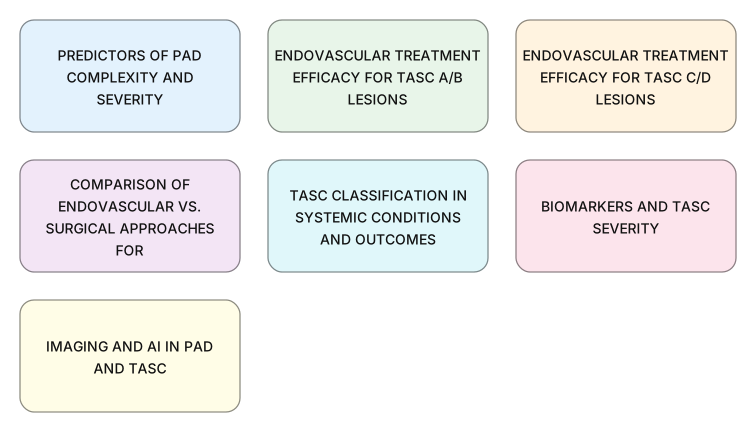
Figure 4. Main extracted research topics
Figure 4. Main extracted research topics (Results)

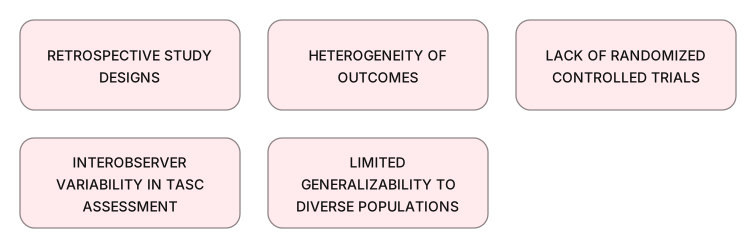
Figure 5. Limitations of current studies (topics)

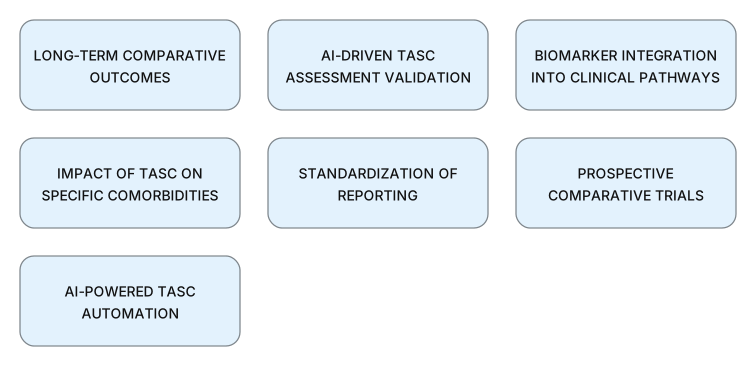
Figure 6. Future research directions (topics)