PAD Venous Arterialization: Systematic Review with ☸️SAIMSARA.


saimsara.com Download PDF

Abstract: This paper aims to systematically review the current evidence on venous arterialization for PAD, particularly in the context of limb salvage and wound healing, and to identify key clinical and research implications. The review utilises 37 studies with 44718 total participants (naïve ΣN). Technical success rates for percutaneous deep venous arterialization (pDVA) and transcatheter arterialization of deep veins were consistently high, with a median technical success of 100% and a range from 96.6% to 100% across multiple studies. These results suggest that venous arterialization is a feasible and effective intervention for patients with advanced peripheral arterial disease and chronic limb-threatening ischemia, particularly those with no conventional revascularization options. However, the small sample sizes and heterogeneous study designs represent the single limitation that most affects certainty regarding broad generalizability. A concrete next study should involve larger, multicenter randomized controlled trials to definitively establish the efficacy and long-term benefits of venous arterialization.

Keywords: Peripheral Artery Disease; Venous Arterialization; Chronic Limb-Threatening Ischemia

Review Stats
Identification of studies via Semantic Scholar (all fields) Identification Screening Included Records identified:n=97762Records excluded:n=96762 Records assessed for eligibilityn=1000Records excluded:n=963 Studies included in reviewn=37 PRISMA Diagram generated by ☸️ SAIMSARA
⛛OSMA Triangle Effect-of Predictor → Outcome pad venous arterialization  →  Outcome Beneficial for patients ΣN=392 (1%) Harmful for patients ΣN=0 (0%) Neutral ΣN=44326 (99%) 0 ⛛OSMA Triangle generated by ☸️SAIMSARA
Show OSMA legend
Outcome-Sentiment Meta-Analysis (OSMA): (LLM-only)
Frame: Effect-of Predictor → Outcome • Source: Semantic Scholar
Outcome: Outcome Typical timepoints: 24-mo, 6-mo. Reported metrics: %, CI, p.
Common endpoints: Common endpoints: healing, patency, survival.
Predictor: pad venous arterialization — exposure/predictor. Routes seen: oral. Typical comparator: venous aneurysms, provider management, those without pad, the control group….

  • 1) Beneficial for patients — Outcome with pad venous arterialization — [2], [3], [4], [5], [6], [9], [11], [12], [15], [16], [22], [25], [31], [37] — ΣN=392
  • 2) Harmful for patients — Outcome with pad venous arterialization — 0 — ΣN=0
  • 3) No clear effect — Outcome with pad venous arterialization — [1], [7], [8], [10], [13], [14], [17], [18], [19], [20], [21], [23], [24], [26], [27], [28], [29], [30], [32], [33], [34], [35], [36] — ΣN=44326

1) Introduction
Peripheral arterial disease (PAD) represents a significant global health burden, often leading to chronic limb-threatening ischemia (CLTI) and severe tissue loss, particularly in patients with no-option revascularization. Traditional revascularization strategies aim to restore arterial flow directly. However, for patients with diffuse or end-stage PAD, these options may be exhausted. Venous arterialization, a technique that repurposes the venous system to deliver arterialized blood to ischemic tissues, has emerged as a promising alternative. This approach seeks to improve perfusion by reversing flow in the venous network, thereby supplying oxygen and nutrients to compromised distal extremities. The current paper synthesizes recent findings on venous arterialization, focusing on its application, outcomes, and associated considerations in PAD management.

2) Aim
This paper aims to systematically review the current evidence on venous arterialization for PAD, particularly in the context of limb salvage and wound healing, and to identify key clinical and research implications.

3) Methods
Systematic review with multilayer AI research agent: keyword normalization, retrieval & structuring, and paper synthesis (see SAIMSARA About section for details).


4) Results
4.1 Study characteristics:
The included studies comprise a mix of designs, predominantly retrospective and prospective cohort studies, case series, and mixed-design studies, along with individual case reports and experimental animal models. Populations primarily include patients with advanced peripheral arterial disease (PAD), chronic limb-threatening ischemia (CLTI), and specific injuries like heel pad degloving. Follow-up periods typically range from 6 months to 3 years, with some studies reporting longer-term or in-hospital observations.

4.2 Main numerical result aligned to the query:
Technical success rates for percutaneous deep venous arterialization (pDVA) and transcatheter arterialization of deep veins were consistently high, with a median technical success of 100% and a range from 96.6% to 100% across multiple studies [3, 4, 5, 6, 16]. Amputation-free survival (AFS) at 6 months ranged from 66.1% to 83.9% [3, 6]. Limb salvage rates ranged from 71% to 86.8% [3, 4, 5, 6]. Complete wound healing rates showed more variability, ranging from 25% to 100% [2, 3, 4, 5, 6].

4.3 Topic synthesis:


5) Discussion
5.1 Principal finding:
The principal finding is that technical success for venous arterialization procedures in patients with advanced peripheral arterial disease (PAD) and chronic limb-threatening ischemia (CLTI) is remarkably high, with a median of 100% (range 96.6% to 100%) [3, 4, 5, 6, 16]. This indicates the feasibility and immediate procedural effectiveness of this innovative approach in a challenging patient population.

5.2 Clinical implications:


5.3 Research implications / key gaps:


5.4 Limitations:


5.5 Future directions:


6) Conclusion
Technical success rates for percutaneous deep venous arterialization (pDVA) and transcatheter arterialization of deep veins were consistently high, with a median technical success of 100% and a range from 96.6% to 100% across multiple studies [3, 4, 5, 6, 16]. These results suggest that venous arterialization is a feasible and effective intervention for patients with advanced peripheral arterial disease and chronic limb-threatening ischemia, particularly those with no conventional revascularization options. However, the small sample sizes and heterogeneous study designs represent the single limitation that most affects certainty regarding broad generalizability. A concrete next study should involve larger, multicenter randomized controlled trials to definitively establish the efficacy and long-term benefits of venous arterialization.

References
SAIMSARA Session Index — session.json

Figure 1. Publication-year distribution of included originals

Figure 2. Study-design distribution of included originals
Figure 2. Study-design distribution

Figure 3. Study-type (directionality) distribution of included originals
Figure 3. Directionality distribution

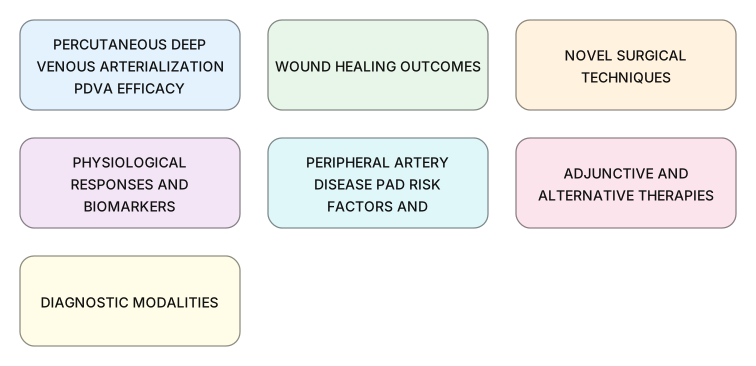
Figure 4. Main extracted research topics
Figure 4. Main extracted research topics (Results)

Figure 5. Limitations of current studies (topics)

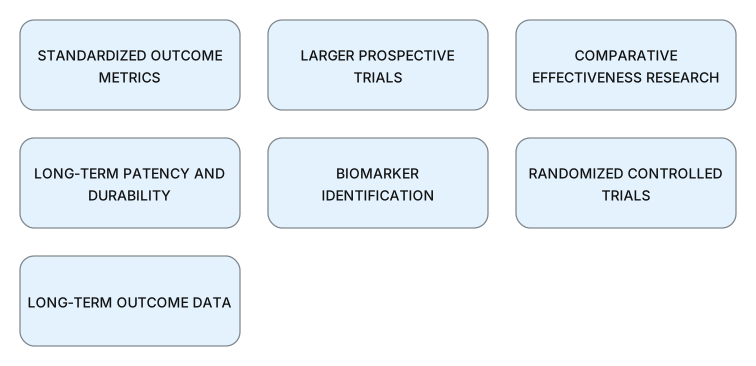
Figure 6. Future research directions (topics)