Peripheral Artery Disease and Air Pollution: Systematic Review with ☸️SAIMSARA.


saimsara.com Download PDF

Abstract: The aim of this paper is to systematically review the evidence linking air pollution exposure to peripheral artery disease, identify key pollutants and their effects, explore underlying mechanisms, and highlight areas for future research and clinical consideration. The review utilises 209 studies with 2078198 total participants (naïve ΣN). Long-term exposure to specific air pollutants is significantly associated with an increased risk of peripheral artery disease (PAD) occurrence, with hazard ratios of 1.686 (95% CI, 1.108–2.565) for sulfur dioxide and 1.200 (95% CI, 1.077–1.336) for nitrogen dioxide for a 0.01 ppm increase. These findings, supported by evidence of increased hospital admissions for PAD patients with higher PM2.5 levels, underscore air pollution as a critical, quantifiable risk factor for PAD across diverse populations. The heterogeneity in study designs and exposure metrics represents the most significant limitation affecting the certainty and generalizability of current evidence. Therefore, a concrete next step is to conduct standardized, prospective cohort studies with consistent air pollution exposure assessment and long-term follow-up to precisely quantify the impact on PAD progression and clinical outcomes.

Review Stats
Identification of studies via Semantic Scholar (all fields) Identification Screening Included Records identified:n=1089Records excluded:n=89 Records assessed for eligibilityn=1000Records excluded:n=791 Studies included in reviewn=209 PRISMA Diagram generated by ☸️ SAIMSARA
⛛OSMA Triangle Effect-of Predictor → Outcome air pollution  →  peripheral artery disease Beneficial for patients ΣN=41728 (2%) Harmful for patients ΣN=1226533 (59%) Neutral ΣN=809937 (39%) 0 ⛛OSMA Triangle generated by ☸️SAIMSARA
Show OSMA legend
Outcome-Sentiment Meta-Analysis (OSMA): (LLM-only)
Frame: Effect-of Predictor → Outcome • Source: Semantic Scholar
Outcome: peripheral artery disease Typical timepoints: 5-y, peri/post-op. Reported metrics: %, CI, p.
Common endpoints: Common endpoints: mortality, admission, complications.
Predictor: air pollution — exposure/predictor. Doses/units seen: 100 μg. Routes seen: intravenous. Typical comparator: ldl cholesterol, control, those without pcos, males….

  • 1) Beneficial for patients — peripheral artery disease with air pollution — [42], [59], [65], [157], [160], [163], [169] — ΣN=41728
  • 2) Harmful for patients — peripheral artery disease with air pollution — [2], [8], [13], [14], [16], [17], [18], [19], [22], [28], [30], [39], [53], [54], [55], [56], [58], [62], [63], [64], [66], [67], [68], [69], [70], [71], [72], [73], [74], [76], [78], [79], [83], [84], [86], [87], [88], [95], [98], [100], [101], [102], [103], [104], [106], [108], [110], [117], [118], [120], [121], [122], [123], [127], [128], [134], [137], [138], [140], [146], [151], [153], [155], [156], [158], [159], [161], [162], [164], [165], [167], [168], [170], [171], [174], [188], [198], [200] — ΣN=1226533
  • 3) No clear effect — peripheral artery disease with air pollution — [1], [3], [4], [5], [6], [7], [9], [10], [11], [12], [15], [20], [21], [23], [24], [25], [26], [27], [29], [31], [32], [33], [34], [35], [36], [37], [38], [40], [41], [43], [44], [45], [46], [47], [48], [49], [50], [51], [52], [57], [60], [61], [75], [77], [80], [81], [82], [85], [89], [90], [91], [92], [93], [94], [96], [97], [99], [105], [107], [109], [111], [112], [113], [114], [115], [116], [119], [124], [125], [126], [129], [130], [131], [132], [133], [135], [136], [139], [141], [142], [143], [144], [145], [147], [148], [149], [150], [152], [154], [166], [172], [173], [175], [176], [177], [178], [179], [180], [181], [182], [183], [184], [185], [186], [187], [189], [190], [191], [192], [193], [194], [195], [196], [197], [199], [201], [202], [203], [204], [205], [206], [207], [208], [209] — ΣN=809937
1) Introduction
Peripheral artery disease (PAD) is a significant global health concern, characterized by the narrowing of arteries outside of the heart and brain, often leading to reduced blood flow to the limbs. Traditionally, risk factors such as smoking and diabetes mellitus have been well-established [23, 48, 41, 111]. However, a growing body of evidence suggests that environmental factors, particularly air pollution, play an increasingly critical role in the incidence, progression, and severity of cardiovascular diseases (CVDs), including PAD [1, 3, 20, 29, 37, 62, 78, 97, 123, 126, 127, 192, 198, 200]. Ambient air pollutants, such as particulate matter (PM2.5, PM10), nitrogen dioxide (NO2), sulfur dioxide (SO2), and ozone (O3), are implicated in various cardiovascular pathologies, including atherosclerosis, coronary artery disease (CAD), and myocardial infarction [11, 13, 16, 17, 18, 19, 22, 36, 38, 40, 42, 44, 45, 47, 49, 51, 53, 54, 55, 67, 70, 71, 73, 75, 77, 81, 83, 84, 86, 88, 94, 95, 98, 99, 100, 101, 104, 105, 106, 108, 109, 110, 117, 118, 119, 121, 122, 128, 130, 131, 134, 136, 139, 140, 141, 146, 149, 150, 151, 152, 153, 155, 156, 157, 158, 159, 161, 162, 166, 167, 169, 170, 174, 180, 183, 184, 188, 198, 199]. This paper aims to synthesize current research on the association between air pollution and PAD.

2) Aim
The aim of this paper is to systematically review the evidence linking air pollution exposure to peripheral artery disease, identify key pollutants and their effects, explore underlying mechanisms, and highlight areas for future research and clinical consideration.

3) Methods
Systematic review with multilayer AI research agent: keyword normalization, retrieval & structuring, and paper synthesis (see SAIMSARA About section for details).


4) Results
4.1 Study characteristics
The included studies employed a variety of designs, predominantly cohort studies, mixed methods, and cross-sectional analyses, with some randomized controlled trials (RCTs) and experimental studies. Populations ranged from large biobanks (e.g., UK Biobank, GeneBank, Korean National Health Insurance Service-National Sample Cohort) to specific patient groups (e.g., PAD patients, CAD patients, T2DM patients), healthy adults, and even animal models (mice). Follow-up periods varied widely, from short-term (hours to days) to long-term (up to 21.7 years), with many studies not specifying follow-up duration.

4.2 Main numerical result aligned to the query
Long-term exposure to specific air pollutants is significantly associated with an increased risk of peripheral artery disease (PAD). For every 0.01 ppm increase in sulfur dioxide (SO2) concentration, the hazard ratio (HR) for PAD occurrence is 1.686 (95% CI, 1.108–2.565) [28, 39]. Similarly, for every 0.01 ppm increase in nitrogen dioxide (NO2) concentration, the HR for PAD occurrence is 1.200 (95% CI, 1.077–1.336) [28, 39]. Furthermore, an analytical model indicated that for every 10 µg/m³ increase in PM2.5 concentration, the number of hospital admissions for PAD patients increases by 0.26% [2].

4.3 Topic synthesis


5) Discussion
5.1 Principal finding
The principal finding of this review is that long-term exposure to air pollution, specifically sulfur dioxide (SO2) and nitrogen dioxide (NO2), significantly increases the risk of peripheral artery disease (PAD) occurrence, with hazard ratios of 1.686 (95% CI, 1.108–2.565) and 1.200 (95% CI, 1.077–1.336) respectively for a 0.01 ppm increase [28, 39]. This highlights air pollution as a critical, quantifiable risk factor for PAD.

5.2 Clinical implications


5.3 Research implications / key gaps


5.4 Limitations


5.5 Future directions


6) Conclusion
Long-term exposure to specific air pollutants is significantly associated with an increased risk of peripheral artery disease (PAD) occurrence, with hazard ratios of 1.686 (95% CI, 1.108–2.565) for sulfur dioxide and 1.200 (95% CI, 1.077–1.336) for nitrogen dioxide for a 0.01 ppm increase [28, 39]. These findings, supported by evidence of increased hospital admissions for PAD patients with higher PM2.5 levels [2], underscore air pollution as a critical, quantifiable risk factor for PAD across diverse populations. The heterogeneity in study designs and exposure metrics represents the most significant limitation affecting the certainty and generalizability of current evidence. Therefore, a concrete next step is to conduct standardized, prospective cohort studies with consistent air pollution exposure assessment and long-term follow-up to precisely quantify the impact on PAD progression and clinical outcomes.

References
SAIMSARA Session Index — session.json

Figure 1. Publication-year distribution of included originals

Figure 2. Study-design distribution of included originals
Figure 2. Study-design distribution

Figure 3. Study-type (directionality) distribution of included originals
Figure 3. Directionality distribution

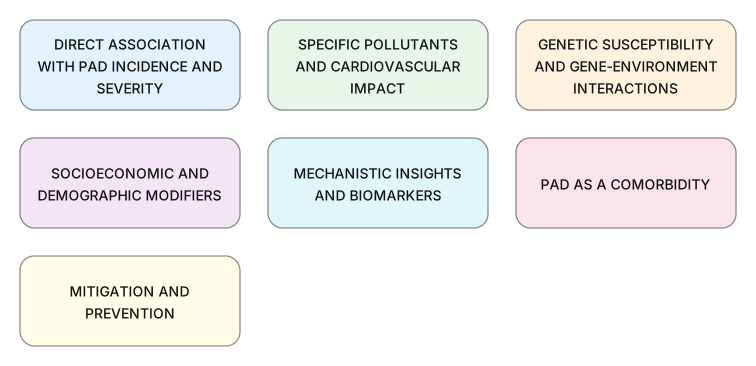
Figure 4. Main extracted research topics
Figure 4. Main extracted research topics (Results)

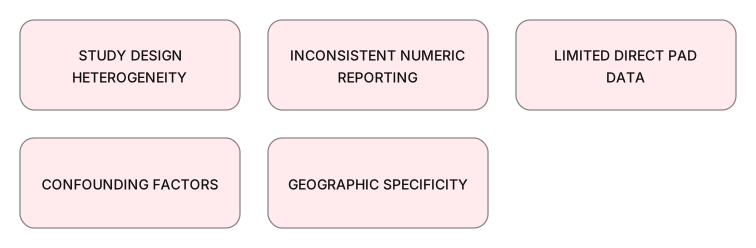
Figure 5. Limitations of current studies (topics)

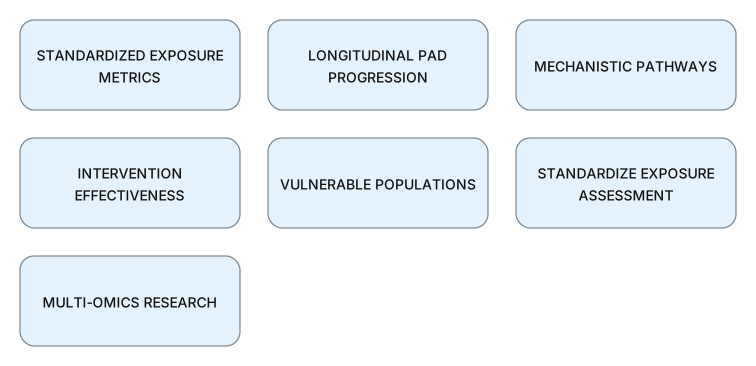
Figure 6. Future research directions (topics)