Peripheral Artery Disease Diagnostics: Systematic Review with ☸️SAIMSARA.


saimsara.com Download PDF

Abstract: This paper aims to systematically review and synthesize the diverse diagnostic methodologies for peripheral artery disease, as presented in recent academic literature, to identify current trends, highlight promising innovations, and delineate critical gaps for future research. The review utilises 173 studies with 546493 total participants (naïve ΣN). For peripheral artery disease diagnosis, the ankle-brachial index (ABI) demonstrated a median sensitivity of 76.5% (range: 56.5%–95.2%) and a median specificity of 84.3% (range: 68.8%–100%) across various studies. While ABI remains a cornerstone, its generalizability is impacted by the heterogeneity of study populations and comparators. The significant variability in study designs and patient cohorts across the literature most affects certainty. Clinicians should consider combining ABI with other diagnostic modalities or novel biomarkers, especially in high-risk groups or when ABI results are inconclusive, to improve diagnostic accuracy.

Keywords: Peripheral Artery Disease; Biomarkers; Ankle-Brachial

Review Stats
Identification of studies via Semantic Scholar (all fields) Identification Screening Included Records identified:n=90229Records excluded:n=89229 Records assessed for eligibilityn=1000Records excluded:n=827 Studies included in reviewn=173 PRISMA Diagram generated by ☸️ SAIMSARA
⛛OSMA Triangle Effect-of Predictor → Outcome peripheral artery disease diagnostics  →  Outcome Beneficial for patients ΣN=14839 (3%) Harmful for patients ΣN=341604 (63%) Neutral ΣN=190050 (35%) 0 ⛛OSMA Triangle generated by ☸️SAIMSARA
Show OSMA legend
Outcome-Sentiment Meta-Analysis (OSMA): (LLM-only)
Frame: Effect-of Predictor → Outcome • Source: Semantic Scholar
Outcome: Outcome Typical timepoints: 2-y, 30-day. Reported metrics: %, CI, p.
Common endpoints: Common endpoints: complications, mortality, functional.
Predictor: peripheral artery disease diagnostics — exposure/predictor. Doses/units seen: 0.675 mg, 1.2 mg. Typical comparator: the reference group, pad-only, using either test alone, angiography for diagnosing pad….

  • 1) Beneficial for patients — Outcome with peripheral artery disease diagnostics — [1], [2], [4], [5], [6], [7], [8], [9], [11], [18], [19], [20], [24], [25], [64], [89], [117], [118], [120], [122], [125] — ΣN=14839
  • 2) Harmful for patients — Outcome with peripheral artery disease diagnostics — [15], [16], [17], [33], [54], [57], [59], [61], [67], [82], [93], [95], [108], [109], [115], [121], [127], [132], [142], [157], [160], [163], [165], [170], [173] — ΣN=341604
  • 3) No clear effect — Outcome with peripheral artery disease diagnostics — [3], [10], [12], [13], [14], [21], [22], [23], [26], [27], [28], [29], [30], [31], [32], [34], [35], [36], [37], [38], [39], [40], [41], [42], [43], [44], [45], [46], [47], [48], [49], [50], [51], [52], [53], [55], [56], [58], [60], [62], [63], [65], [66], [68], [69], [70], [71], [72], [73], [74], [75], [76], [77], [78], [79], [80], [81], [83], [84], [85], [86], [87], [88], [90], [91], [92], [94], [96], [97], [98], [99], [100], [101], [102], [103], [104], [105], [106], [107], [110], [111], [112], [113], [114], [116], [119], [123], [124], [126], [128], [129], [130], [131], [133], [134], [135], [136], [137], [138], [139], [140], [141], [143], [144], [145], [146], [147], [148], [149], [150], [151], [152], [153], [154], [155], [156], [158], [159], [161], [162], [164], [166], [167], [168], [169], [171], [172] — ΣN=190050
1) Introduction
Peripheral artery disease (PAD) represents a significant global health burden, characterized by atherosclerotic stenosis or occlusion in arteries supplying the limbs, most commonly the lower extremities. Accurate and timely diagnosis of PAD is crucial for effective management, prevention of limb loss, and reduction of cardiovascular morbidity and mortality. Traditional diagnostic methods, such as the ankle-brachial index (ABI), face limitations in certain patient populations, particularly those with incompressible arteries due to medial arterial calcification. This necessitates the continuous exploration and validation of novel diagnostic approaches, ranging from advanced imaging techniques and innovative physiological measurements to sophisticated biomarker panels and artificial intelligence (AI)-driven models.

2) Aim
This paper aims to systematically review and synthesize the diverse diagnostic methodologies for peripheral artery disease, as presented in recent academic literature, to identify current trends, highlight promising innovations, and delineate critical gaps for future research.

3) Methods
Systematic review with multilayer AI research agent: keyword normalization, retrieval & structuring, and paper synthesis (see SAIMSARA About section for details).


4) Results
4.1 Study characteristics
The reviewed studies predominantly employed cohort, cross-sectional, or mixed designs, with some prospective and retrospective analyses. Populations varied, including general PAD patients, those with diabetes mellitus (T2DM), critical limb ischemia (CLI), and specific conditions like abdominal aortic aneurysm (AAA) or chronic kidney disease (CKD). Follow-up periods, when specified, ranged from short-term assessments (e.g., 1 hour post-intervention [33]) to several years (e.g., 4.3 years [31], 25 years [171]).

4.2 Main numerical result aligned to the query
For peripheral artery disease diagnosis, the ankle-brachial index (ABI) demonstrated a median sensitivity of 76.5% (range: 56.5% [36]–95.2% [24]) and a median specificity of 84.3% (range: 68.8% [98]–100% [135]). These values reflect variability across studies, which utilized different comparators and patient populations, including asymptomatic individuals and those with suspected claudication.

4.3 Topic synthesis


5) Discussion
5.1 Principal finding
The ankle-brachial index (ABI), a foundational diagnostic tool for peripheral artery disease, demonstrates a median sensitivity of 76.5% (range: 56.5%–95.2%) and a median specificity of 84.3% (range: 68.8%–100%) across various studies, indicating its continued relevance despite acknowledged limitations in certain contexts [18, 24, 36, 98, 135].

5.2 Clinical implications


5.3 Research implications / key gaps


5.4 Limitations


5.5 Future directions


6) Conclusion
For peripheral artery disease diagnosis, the ankle-brachial index (ABI) demonstrated a median sensitivity of 76.5% (range: 56.5% [36]–95.2% [24]) and a median specificity of 84.3% (range: 68.8% [98]–100% [135]) across various studies. While ABI remains a cornerstone, its generalizability is impacted by the heterogeneity of study populations and comparators. The significant variability in study designs and patient cohorts across the literature most affects certainty. Clinicians should consider combining ABI with other diagnostic modalities or novel biomarkers, especially in high-risk groups or when ABI results are inconclusive, to improve diagnostic accuracy.

References
SAIMSARA Session Index — session.json

Figure 1. Publication-year distribution of included originals

Figure 2. Study-design distribution of included originals
Figure 2. Study-design distribution

Figure 3. Study-type (directionality) distribution of included originals
Figure 3. Directionality distribution

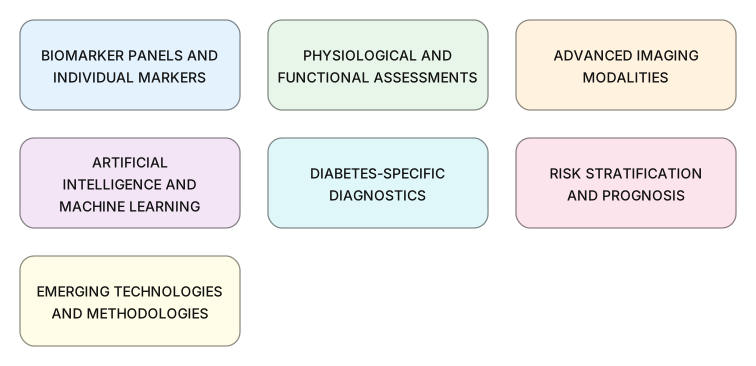
Figure 4. Main extracted research topics
Figure 4. Main extracted research topics (Results)

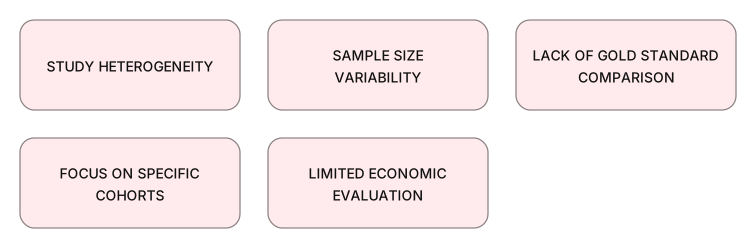
Figure 5. Limitations of current studies (topics)

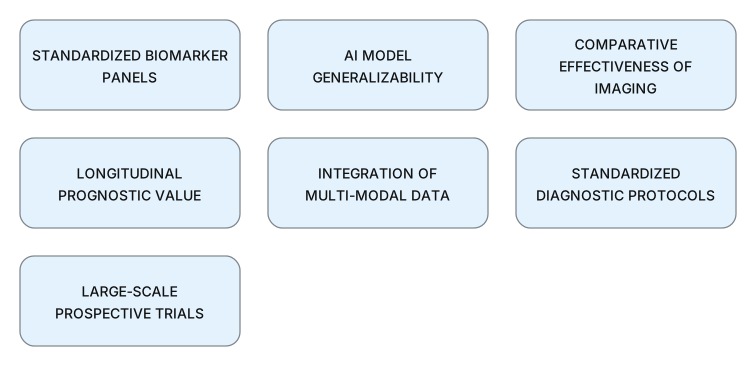
Figure 6. Future research directions (topics)