Peripheral Artery Disease and Gender: Systematic Review with ☸️SAIMSARA.


saimsara.com Download PDF

Abstract: The aim of this paper is to systematically review and synthesize the current evidence regarding peripheral artery disease and gender, identifying specific differences in epidemiology, pathophysiology, clinical characteristics, treatment, and outcomes. The review utilises 313 studies with 2050605 total participants (naïve ΣN). The relationship between gender and peripheral artery disease (PAD) burden and outcomes is complex and often contradictory across studies, preventing a single, directly comparable numerical central value. For instance, age-adjusted multiple cause-of-death (MCOD) rates for PAD were higher in males (25.6) than females (19.4) in the US from 1999-2017. The generalizability of findings is limited by the diverse study populations and varying definitions of PAD and its outcomes. The most significant limitation affecting certainty is the Inconsistent Outcome Definitions, which hinders direct comparison and synthesis of numerical results. A practical takeaway for clinicians is to be aware of the nuanced and often conflicting evidence regarding gender differences in PAD, and to consider individualized risk assessment and management strategies that account for these disparities.

Review Stats
Identification of studies via Semantic Scholar (all fields) Identification Screening Included Records identified:n=1648Records excluded:n=648 Records assessed for eligibilityn=1000Records excluded:n=687 Studies included in reviewn=313 PRISMA Diagram generated by ☸️ SAIMSARA
⛛OSMA Triangle Effect-of Predictor → Outcome gender  →  peripheral artery disease Beneficial for patients ΣN=13384 (1%) Harmful for patients ΣN=676924 (33%) Neutral ΣN=1360297 (66%) 0 ⛛OSMA Triangle generated by ☸️SAIMSARA
Show OSMA legend
Outcome-Sentiment Meta-Analysis (OSMA): (LLM-only)
Frame: Effect-of Predictor → Outcome • Source: Semantic Scholar
Outcome: peripheral artery disease Typical timepoints: peri/post-op, 5-y. Reported metrics: %, CI, p.
Common endpoints: Common endpoints: mortality, complications, admission.
Predictor: gender — exposure/predictor. Doses/units seen: 25.04 mg, 52.73 mg, 0.22 mg, 0.23 mg. Routes seen: iv. Typical comparator: men, women over a 13-year period, males, 54….

  • 1) Beneficial for patients — peripheral artery disease with gender — [18], [20], [53], [136], [158], [164], [168], [172], [189], [193], [196], [199] — ΣN=13384
  • 2) Harmful for patients — peripheral artery disease with gender — [1], [4], [11], [13], [14], [16], [23], [27], [30], [33], [34], [41], [44], [50], [55], [62], [68], [71], [74], [75], [76], [77], [79], [81], [88], [97], [98], [99], [103], [105], [114], [119], [123], [130], [131], [135], [138], [139], [140], [142], [143], [145], [148], [150], [152], [155], [156], [157], [159], [161], [167], [170], [174], [188], [190], [194], [195], [197], [226], [231], [247], [250], [260], [264], [269], [275], [282], [283], [286], [302], [303], [309] — ΣN=676924
  • 3) No clear effect — peripheral artery disease with gender — [2], [3], [5], [6], [7], [8], [9], [10], [12], [15], [17], [19], [21], [22], [24], [25], [26], [28], [29], [31], [32], [35], [36], [37], [38], [39], [40], [42], [43], [45], [46], [47], [48], [49], [51], [52], [54], [56], [57], [58], [59], [60], [61], [63], [64], [65], [66], [67], [69], [70], [72], [73], [78], [80], [82], [83], [84], [85], [86], [87], [89], [90], [91], [92], [93], [94], [95], [96], [100], [101], [102], [104], [106], [107], [108], [109], [110], [111], [112], [113], [115], [116], [117], [118], [120], [121], [122], [124], [125], [126], [127], [128], [129], [132], [133], [134], [137], [141], [144], [146], [147], [149], [151], [153], [154], [160], [162], [163], [165], [166], [169], [171], [173], [175], [176], [177], [178], [179], [180], [181], [182], [183], [184], [185], [186], [187], [191], [192], [198], [200], [201], [202], [203], [204], [205], [206], [207], [208], [209], [210], [211], [212], [213], [214], [215], [216], [217], [218], [219], [220], [221], [222], [223], [224], [225], [227], [228], [229], [230], [232], [233], [234], [235], [236], [237], [238], [239], [240], [241], [242], [243], [244], [245], [246], [248], [249], [251], [252], [253], [254], [255], [256], [257], [258], [259], [261], [262], [263], [265], [266], [267], [268], [270], [271], [272], [273], [274], [276], [277], [278], [279], [280], [281], [284], [285], [287], [288], [289], [290], [291], [292], [293], [294], [295], [296], [297], [298], [299], [300], [301], [304], [305], [306], [307], [308], [310], [311], [312], [313] — ΣN=1360297
1) Introduction
Peripheral artery disease (PAD) is a significant global public health concern, characterized by the narrowing of arteries that supply blood to the limbs, most commonly the legs. Its burden and temporal trends vary considerably by location, age, socioeconomic status, and notably, gender [7, 14, 152]. Understanding these gender-specific differences in PAD prevalence, risk factors, clinical presentation, treatment responses, and outcomes is crucial for optimizing diagnosis, management, and prognosis [3, 16]. While some studies suggest a heavier absolute burden in males, others indicate elevated age-standardized rates or worse clinical outcomes in females, highlighting complex and interacting factors contributing to gender-related inequities in PAD [14, 16, 152]. This paper synthesizes current research on the interplay between PAD and gender, identifying key themes and research gaps.

2) Aim
The aim of this paper is to systematically review and synthesize the current evidence regarding peripheral artery disease and gender, identifying specific differences in epidemiology, pathophysiology, clinical characteristics, treatment, and outcomes.

3) Methods
Systematic review with multilayer AI research agent: keyword normalization, retrieval & structuring, and paper synthesis (see SAIMSARA About section for details).


4) Results
4.1 Study characteristics
The included studies predominantly employed cohort (e.g., [1, 5, 10]) and cross-sectional designs (e.g., [2, 9, 18]), often retrospective, with some mixed-design studies [3, 4, 11]. Populations ranged from large national registries [8, 14, 15] and multi-ethnic cohorts [10] to specific patient groups such as those with type 2 diabetes mellitus (T2DM) [1, 29, 33], vascular surgery inpatients [2], or individuals undergoing specific interventions [4, 11, 30]. Follow-up periods varied widely, from 30-day post-operative [4] to 13 years [15], or were not specified for cross-sectional designs.

4.2 Main numerical result aligned to the query
The relationship between gender and peripheral artery disease (PAD) burden and outcomes is complex and often contradictory across studies, preventing a single, directly comparable numerical central value. For instance, age-adjusted multiple cause-of-death (MCOD) rates for PAD were higher in males (25.6) than females (19.4) in the US from 1999-2017 [8]. Conversely, in a Thai population, the age-standardized prevalence of PAD was 9.00% in women compared to 3.88% in men, with female gender being a statistically significant risk factor (OR = 1.9) [174]. In another cohort, the risk of PAD was positively correlated with metabolic syndrome (MetS) components, with a significantly stronger association observed in female patients [1]. Similarly, females exhibited elevated age-standardized rates of PAD from 1990-2019 in the United States, despite males bearing a heavier absolute burden [14]. In contrast, male gender was identified as an independent predictor of PAD (OR = 0.441, 95% CI: 0.249-0.782) in one cohort [18] and was associated with a 1.77-fold higher odds of PAD in T2DM patients in another [135].

4.3 Topic synthesis


5) Discussion
5.1 Principal finding
The relationship between gender and peripheral artery disease (PAD) burden and outcomes is complex and often contradictory across studies, preventing a single, directly comparable numerical central value. For instance, age-adjusted multiple cause-of-death (MCOD) rates for PAD were higher in males (25.6) than females (19.4) in the US from 1999-2017 [8].

5.2 Clinical implications


5.3 Research implications / key gaps


5.4 Limitations


5.5 Future directions


6) Conclusion
The relationship between gender and peripheral artery disease (PAD) burden and outcomes is complex and often contradictory across studies, preventing a single, directly comparable numerical central value. For instance, age-adjusted multiple cause-of-death (MCOD) rates for PAD were higher in males (25.6) than females (19.4) in the US from 1999-2017 [8]. The generalizability of findings is limited by the diverse study populations and varying definitions of PAD and its outcomes. The most significant limitation affecting certainty is the Inconsistent Outcome Definitions, which hinders direct comparison and synthesis of numerical results. A practical takeaway for clinicians is to be aware of the nuanced and often conflicting evidence regarding gender differences in PAD, and to consider individualized risk assessment and management strategies that account for these disparities.

References
SAIMSARA Session Index — session.json

Figure 1. Publication-year distribution of included originals

Figure 2. Study-design distribution of included originals
Figure 2. Study-design distribution

Figure 3. Study-type (directionality) distribution of included originals
Figure 3. Directionality distribution

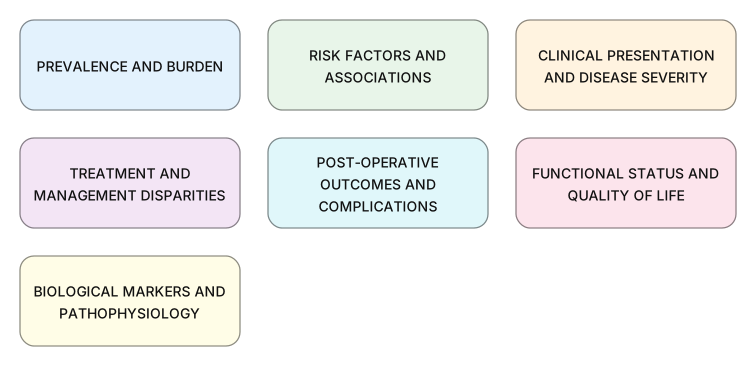
Figure 4. Main extracted research topics
Figure 4. Main extracted research topics (Results)

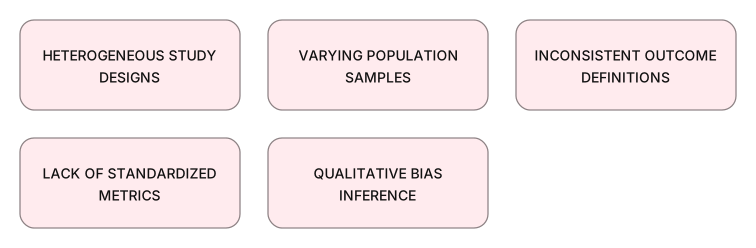
Figure 5. Limitations of current studies (topics)

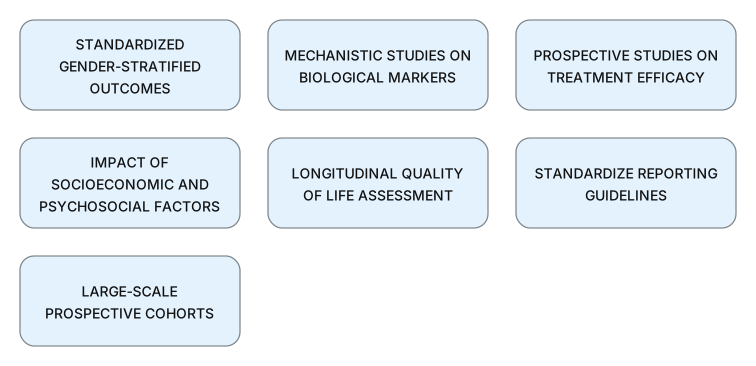
Figure 6. Future research directions (topics)