Peripheral Artery Disease GLASS: Systematic Review with ☸️SAIMSARA.


saimsara.com Download PDF

Abstract: To synthesize current research on peripheral artery disease, focusing on the utility and implications of the Global Limb Anatomic Staging System (GLASS), and to identify key themes, clinical applications, and future research directions. The review utilises 142 studies with 1759452 total participants (naïve ΣN). The Global Limb Anatomic Staging System (GLASS) consistently demonstrated prognostic value for limb outcomes and survival in peripheral artery disease (PAD) patients. Specifically, higher GLASS stages were associated with worse outcomes, including lower technical success rates, higher amputation and mortality rates at 12 months (p=0.012, p=0.001, p=0.021, p=0.015). This prognostic utility applies broadly to PAD patients, particularly those with chronic limb-threatening ischemia undergoing revascularization. The reliance on heterogeneous study designs and varied outcome reporting represents the single limitation that most affects certainty. A concrete next step is to conduct large-scale prospective randomized controlled trials to validate GLASS-guided treatment algorithms.

Keywords: Peripheral Artery Disease; Global Limb Anatomic Staging System; Chronic Limb-Threatening Ischemia; Endovascular Re

Review Stats
Identification of studies via Semantic Scholar (all fields) Identification Screening Included Records identified:n=41656Records excluded:n=40656 Records assessed for eligibilityn=1000Records excluded:n=858 Studies included in reviewn=142 PRISMA Diagram generated by ☸️ SAIMSARA
⛛OSMA Triangle Effect-of Predictor → Outcome GLASS  →  peripheral artery disease Beneficial for patients ΣN=5201 (0%) Harmful for patients ΣN=952978 (54%) Neutral ΣN=801273 (46%) 0 ⛛OSMA Triangle generated by ☸️SAIMSARA
Show OSMA legend
Outcome-Sentiment Meta-Analysis (OSMA): (LLM-only)
Frame: Effect-of Predictor → Outcome • Source: Semantic Scholar
Outcome: peripheral artery disease Typical timepoints: peri/post-op, 5-y. Reported metrics: %, CI, p.
Common endpoints: Common endpoints: mortality, complications, admission.
Predictor: GLASS — procedure/intervention. Routes seen: im, iv, oral. Typical comparator: dual antiplatelet therapy, antiplatelet therapy alone, walking exercise alone, a control group….

  • 1) Beneficial for patients — peripheral artery disease with GLASS — [10], [13], [14], [17], [22], [24], [30], [49], [60], [71], [88], [128], [137] — ΣN=5201
  • 2) Harmful for patients — peripheral artery disease with GLASS — [7], [9], [16], [19], [20], [21], [23], [29], [31], [32], [33], [34], [39], [41], [42], [44], [45], [47], [50], [51], [52], [55], [56], [63], [65], [66], [68], [74], [75], [76], [81], [82], [87], [90], [99], [103], [108], [113], [117], [121], [124], [125], [126], [127], [130], [131], [133], [134], [135], [138] — ΣN=952978
  • 3) No clear effect — peripheral artery disease with GLASS — [1], [2], [3], [4], [5], [6], [8], [11], [12], [15], [18], [25], [26], [27], [28], [35], [36], [37], [38], [40], [43], [46], [48], [53], [54], [57], [58], [59], [61], [62], [64], [67], [69], [70], [72], [73], [77], [78], [79], [80], [83], [84], [85], [86], [89], [91], [92], [93], [94], [95], [96], [97], [98], [100], [101], [102], [104], [105], [106], [107], [109], [110], [111], [112], [114], [115], [116], [118], [119], [120], [122], [123], [129], [132], [136], [139], [140], [141], [142] — ΣN=801273
1) Introduction
Peripheral artery disease (PAD) represents a significant global health challenge, characterized by atherosclerotic occlusion of vessels outside the heart, primarily affecting the lower extremities [102, 106]. Its severe manifestation, chronic limb-threatening ischemia (CLTI), poses a high risk of amputation and mortality [7, 93, 97]. Accurate staging and prognosis are crucial for guiding treatment strategies and improving patient outcomes. The Global Limb Anatomic Staging System (GLASS) has emerged as a key tool for classifying anatomical patterns of PAD and assessing disease severity [6, 8]. This paper systematically reviews the current literature on PAD, with a specific focus on the application, prognostic value, and technological advancements related to the GLASS classification system.

2) Aim
To synthesize current research on peripheral artery disease, focusing on the utility and implications of the Global Limb Anatomic Staging System (GLASS), and to identify key themes, clinical applications, and future research directions.

3) Methods
Systematic review with multilayer AI research agent: keyword normalization, retrieval & structuring, and paper synthesis (see SAIMSARA About section for details).


4) Results
4.1 Study characteristics
The included studies predominantly comprised retrospective cohort (e.g., [1, 2, 5, 7, 9, 14, 15, 17, 32, 33, 35, 108]) and mixed-design studies (e.g., [2, 5, 7, 8, 35, 38, 39, 41, 42, 46, 48, 49, 53, 54, 56, 57, 58, 59, 60, 61, 64, 65, 69, 72, 73, 74, 75, 83, 84, 85, 86, 90, 91, 93, 94, 95, 96, 97, 104, 105, 106, 107, 109, 110, 111, 112, 113, 115, 116, 118, 119, 122, 123, 124, 125, 126, 127, 128, 129, 130, 131, 132, 133, 134, 135, 136, 137, 138, 141, 142]), with a smaller number of prospective cohort studies (e.g., [4, 10, 13, 18, 23, 24, 25, 26, 30, 32, 44, 47, 58, 66, 68, 82, 87, 89, 114, 117, 120, 121, 129, 137]) and randomized controlled trials (RCTs) (e.g., [10, 13, 16, 18, 24, 25, 26, 30, 82, 89, 95, 120, 122]). Populations ranged from general PAD patients to specific subgroups such as those with chronic limb-threatening ischemia (CLTI) [4, 7, 8, 32, 58], femoro-popliteal chronic total occlusions (CTOs) [5], or undergoing endovascular treatment [2, 4, 14, 15, 35]. Follow-up periods varied widely, from 3 months [1] to 12 months [4, 7, 32, 43] and up to 5 years [108, 114, 117, 125].

4.2 Main numerical result aligned to the query
The Global Limb Anatomic Staging System (GLASS) consistently demonstrated prognostic value for limb outcomes and survival in peripheral artery disease (PAD) patients. Specifically, higher GLASS stages were associated with worse outcomes, including lower technical success rates, higher amputation and mortality rates at 12 months (p=0.012, p=0.001, p=0.021, p=0.015) [7]. For instance, GLASS III anatomy was linked to worse limb-based patency, limb salvage, amputation-free survival, and overall survival compared to GLASS I at 12 months (p=0.005, p=0.037, p=0.021, p<0.001 respectively) [32]. Similarly, GLASS IV lesions were associated with significantly lower patency rates and higher major adverse limb events (MALE) incidence at 24 months (p=0.002) [33]. Computer vision and automated machine learning models achieved high accuracy in classifying GLASS grades and predicting limb outcomes, with validation accuracy of 95% and test accuracy of 93% for limb outcome prediction [1], and 100% accuracy in testing for anatomical pattern classification [3].

4.3 Topic synthesis


5) Discussion
5.1 Principal finding
The Global Limb Anatomic Staging System (GLASS) consistently serves as a critical prognostic tool, with higher stages correlating significantly with worse limb-related outcomes, including increased amputation and mortality rates, as evidenced by studies showing higher stages associated with lower technical success rates, higher amputation and mortality rates at 12 months (p=0.012, p=0.001, p=0.021, p=0.015) [7].

5.2 Clinical implications


5.3 Research implications / key gaps


5.4 Limitations


5.5 Future directions


6) Conclusion
The Global Limb Anatomic Staging System (GLASS) consistently demonstrated prognostic value for limb outcomes and survival in peripheral artery disease (PAD) patients. Specifically, higher GLASS stages were associated with worse outcomes, including lower technical success rates, higher amputation and mortality rates at 12 months (p=0.012, p=0.001, p=0.021, p=0.015) [7]. This prognostic utility applies broadly to PAD patients, particularly those with chronic limb-threatening ischemia undergoing revascularization. The reliance on heterogeneous study designs and varied outcome reporting represents the single limitation that most affects certainty. A concrete next step is to conduct large-scale prospective randomized controlled trials to validate GLASS-guided treatment algorithms.

References
SAIMSARA Session Index — session.json

Figure 1. Publication-year distribution of included originals

Figure 2. Study-design distribution of included originals
Figure 2. Study-design distribution

Figure 3. Study-type (directionality) distribution of included originals
Figure 3. Directionality distribution

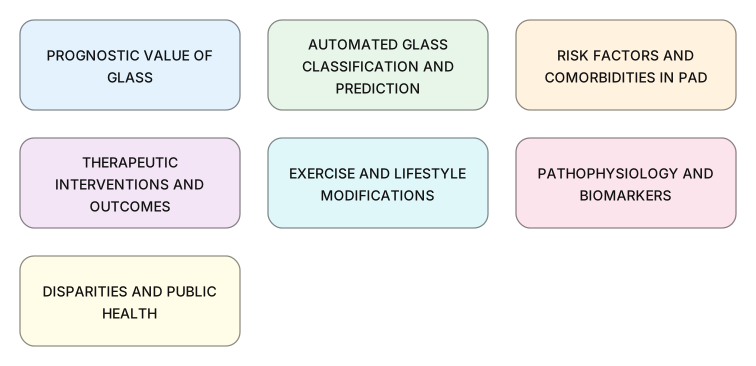
Figure 4. Main extracted research topics
Figure 4. Main extracted research topics (Results)

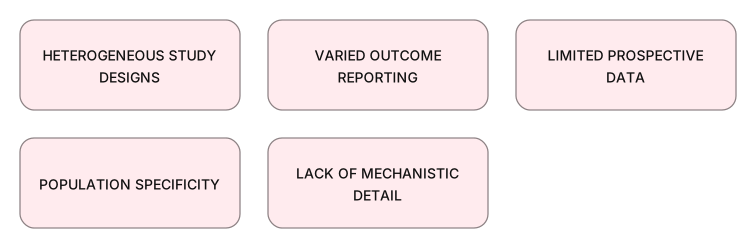
Figure 5. Limitations of current studies (topics)

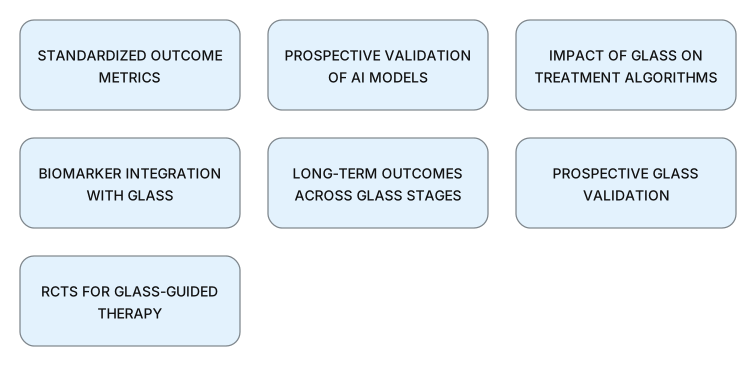
Figure 6. Future research directions (topics)