Peripheral Artery Disease and Life Style Changes: Systematic Review with ☸️SAIMSARA.


saimsara.com Download PDF

Abstract: This paper aims to systematically review and synthesize the current evidence regarding the role and efficacy of lifestyle changes in the management of peripheral artery disease, focusing on their impact on disease severity, functional outcomes, and quality of life. The review utilises 206 studies with 99706 total participants (naïve ΣN). Lifestyle interventions, particularly supervised exercise training, consistently improve functional capacity and health-related quality of life in patients with peripheral artery disease, despite observed variability in individual responses. These benefits are observed across various populations, including those with comorbidities like type 2 diabetes, highlighting the broad applicability of such interventions. However, the heterogeneity of outcome measures and study designs limits direct quantitative comparisons, and the significant prevalence of non-responders to exercise remains a key challenge. Clinicians should prioritize comprehensive lifestyle modifications and exercise therapy, while future research should focus on developing personalized interventions and long-term adherence strategies to improve outcomes for all PAD patients.

Keywords: Peripheral Artery Disease; Lifestyle Modifications; Exercise Therapy; Cardiovascular Risk Factors; Disease Management; Quality of Life; Supervised Exercise; Physical Activity; Prevention; Diabetes Mellitus

Review Stats
Identification of studies via Semantic Scholar (all fields) Identification Screening Included Records identified:n=1182Records excluded:n=182 Records assessed for eligibilityn=1000Records excluded:n=794 Studies included in reviewn=206 PRISMA Diagram generated by ☸️ SAIMSARA
⛛OSMA Triangle Effect-of Predictor → Outcome life style changes  →  peripheral artery disease Beneficial for patients ΣN=35659 (36%) Harmful for patients ΣN=3183 (3%) Neutral ΣN=60864 (61%) 0 ⛛OSMA Triangle generated by ☸️SAIMSARA
Show OSMA legend
Outcome-Sentiment Meta-Analysis (OSMA): (LLM-only)
Frame: Effect-of Predictor → Outcome • Source: Semantic Scholar
Outcome: peripheral artery disease Typical timepoints: 1-y, 12-mo. Reported metrics: %, CI, p.
Common endpoints: Common endpoints: qol, mortality, functional.
Predictor: life style changes — exposure/predictor. Doses/units seen: 80 mg, 40 mg, 4 kg. Routes seen: sc. Typical comparator: men, control, those with aaa alone or, heart failure….

  • 1) Beneficial for patients — peripheral artery disease with life style changes — [2], [3], [12], [19], [21], [25], [30], [36], [37], [38], [40], [42], [45], [46], [48], [50], [54], [55], [56], [57], [62], [63], [65], [67], [69], [70], [71], [73], [74], [75], [93], [94], [96], [136], [150], [160], [161], [166], [168], [169], [174], [176], [179], [185], [189], [190], [192], [194], [195], [196], [197], [202], [204], [206] — ΣN=35659
  • 2) Harmful for patients — peripheral artery disease with life style changes — [35], [49], [51], [59], [60], [64], [68], [72], [175] — ΣN=3183
  • 3) No clear effect — peripheral artery disease with life style changes — [1], [4], [5], [6], [7], [8], [9], [10], [11], [13], [14], [15], [16], [17], [18], [20], [22], [23], [24], [26], [27], [28], [29], [31], [32], [33], [34], [39], [41], [43], [44], [47], [52], [53], [58], [61], [66], [76], [77], [78], [79], [80], [81], [82], [83], [84], [85], [86], [87], [88], [89], [90], [91], [92], [95], [97], [98], [99], [100], [101], [102], [103], [104], [105], [106], [107], [108], [109], [110], [111], [112], [113], [114], [115], [116], [117], [118], [119], [120], [121], [122], [123], [124], [125], [126], [127], [128], [129], [130], [131], [132], [133], [134], [135], [137], [138], [139], [140], [141], [142], [143], [144], [145], [146], [147], [148], [149], [151], [152], [153], [154], [155], [156], [157], [158], [159], [162], [163], [164], [165], [167], [170], [171], [172], [173], [177], [178], [180], [181], [182], [183], [184], [186], [187], [188], [191], [193], [198], [199], [200], [201], [203], [205] — ΣN=60864
1) Introduction
Peripheral artery disease (PAD) represents a significant global health challenge, characterized by reduced blood flow to the limbs, primarily the lower extremities [68, 129]. It is a manifestation of systemic atherosclerosis and is associated with substantial morbidity, including functional impairment, reduced quality of life, and increased risk of major cardiovascular events such as heart attack and stroke [72, 121, 172, 176]. The global burden of PAD continues to grow, driven by demographic changes and rising metabolic risk factors, particularly in low socio-demographic index (SDI) regions and among the elderly [5, 6, 15, 26, 64, 76, 91, 130]. Modifiable lifestyle factors, including high fasting plasma glucose, high systolic blood pressure, tobacco use, sedentary behavior, and unhealthy dietary patterns, are major contributors to PAD incidence and mortality [14, 15, 20, 53, 59, 68, 70, 81, 90, 113, 139, 143, 175, 189, 195]. Consequently, lifestyle modifications are recognized as fundamental to both the prevention and management of PAD, aiming to reduce disease severity, improve functional status, and enhance patients' health-related quality of life (HRQoL) [1, 11, 30, 54, 56, 73, 79, 89, 136, 179, 196, 197]. This paper synthesizes current evidence on the efficacy and impact of lifestyle changes in patients with PAD.

2) Aim
This paper aims to systematically review and synthesize the current evidence regarding the role and efficacy of lifestyle changes in the management of peripheral artery disease, focusing on their impact on disease severity, functional outcomes, and quality of life.

3) Methods
Systematic review with multilayer AI research agent: keyword normalization, retrieval & structuring, and paper synthesis (see SAIMSARA About section for details).


4) Results
4.1 Study characteristics:
The included studies comprise a diverse range of designs, with a notable presence of randomized controlled trials (RCTs) [3, 8, 9, 13, 23, 25, 31, 37, 39, 40, 41, 42, 44, 45, 47, 48, 50, 51, 52, 55, 63, 74, 82, 87, 89, 92, 93, 96, 116, 118, 120, 134, 135, 146, 157, 161, 166, 199, 201], cohort studies [2, 4, 12, 29, 35, 36, 57, 58, 69, 73, 76, 85, 90, 91, 95, 97, 102, 118, 123, 124, 138, 144, 149, 156, 158, 164, 167, 175, 178, 183, 188, 190, 196, 205], and cross-sectional studies [4, 53, 81, 100, 133, 147, 174, 185, 189, 202]. Populations primarily include patients with symptomatic peripheral artery disease (PAD) at various Fontaine or Rutherford stages, often with comorbidities such as type 2 diabetes (T2D) or other lifestyle-related diseases [2, 3, 8, 9, 23, 38, 46, 60, 82, 84, 92, 99, 119, 128, 136, 153, 161, 162, 174, 175, 196]. Follow-up periods range from short-term interventions of weeks (e.g., 8 weeks [40, 50], 10 weeks [39], 12 weeks [3, 25, 33, 41, 44, 47, 63, 93, 146]) to several months (e.g., 3 months [2, 21, 34, 42, 51, 71, 88, 117, 199], 4 months [37], 6 months [23, 45, 55, 62, 116, 185, 206]) and longer durations up to multiple years (e.g., 1 year [35, 75, 86, 89, 144, 166, 178], 5 years [85, 95], 10 years [188], 30 years [7]).

4.2 Main numerical result aligned to the query:
Lifestyle interventions, particularly supervised exercise training (SET) and home-based physical activity, consistently demonstrate improvements in functional capacity and health-related quality of life (HRQoL) in patients with peripheral artery disease (PAD). For instance, SET significantly improved peak walking distance (PFWD) by +102% and maximal walking distance (MWD) by +87%, alongside a +14% increase in 6-minute walking distance (6MWD) in symptomatic PAD patients [2]. Other studies reported clinically meaningful increases in 6MWD by 34.1 meters [33], or by 1211 total daily steps and 11 minutes in moderate-to-vigorous physical activity (MVPA) associated with large HRQoL improvements [25]. Despite these benefits, a significant prevalence of nonresponse (24.6% [33], 31.8% [47]) and poor response (32.3% [33], 43.2% [47]) to SET has been observed, indicating substantial inter-individual variability in outcomes.

4.3 Topic synthesis:


5) Discussion
5.1 Principal finding:
Lifestyle interventions, particularly supervised exercise training, consistently improve functional capacity and health-related quality of life in patients with peripheral artery disease, despite observed variability in individual responses [2, 3, 25, 33].

5.2 Clinical implications:


5.3 Research implications / key gaps:


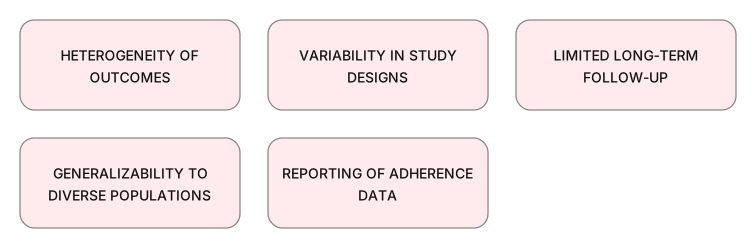
5.4 Limitations:


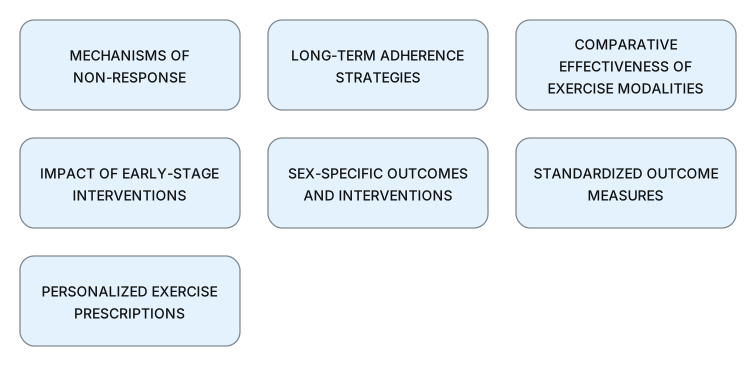
5.5 Future directions:


6) Conclusion
Lifestyle interventions, particularly supervised exercise training, consistently improve functional capacity and health-related quality of life in patients with peripheral artery disease, despite observed variability in individual responses [2, 3, 25, 33]. These benefits are observed across various populations, including those with comorbidities like type 2 diabetes, highlighting the broad applicability of such interventions. However, the heterogeneity of outcome measures and study designs limits direct quantitative comparisons, and the significant prevalence of non-responders to exercise remains a key challenge. Clinicians should prioritize comprehensive lifestyle modifications and exercise therapy, while future research should focus on developing personalized interventions and long-term adherence strategies to improve outcomes for all PAD patients.

References
SAIMSARA Session Index — session.json

Figure 1. Publication-year distribution of included originals

Figure 2. Study-design distribution of included originals
Figure 2. Study-design distribution

Figure 3. Study-type (directionality) distribution of included originals
Figure 3. Directionality distribution

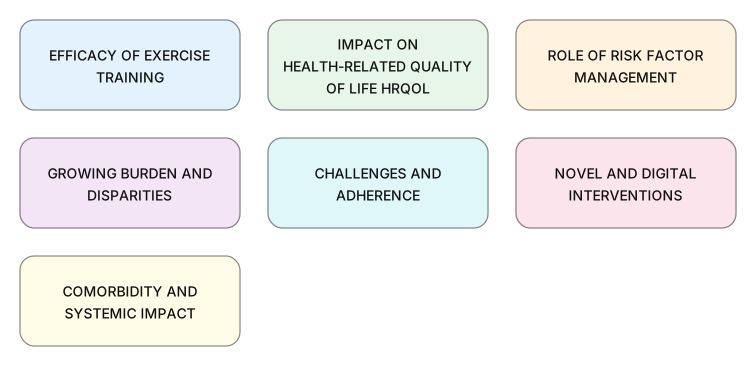
Figure 4. Main extracted research topics
Figure 4. Main extracted research topics (Results)

Figure 5. Limitations of current studies (topics)

Figure 6. Future research directions (topics)