Peripheral Artery Disease Pathophysiology: Systematic Review with ☸️SAIMSARA.


saimsara.com Download PDF

Abstract: This paper aims to synthesize current understanding of the pathophysiology of peripheral artery disease by systematically extracting and integrating findings from recent research, highlighting key molecular and cellular mechanisms, contributing risk factors, and their clinical implications. The review utilises 183 studies with 1018071 total participants (naïve ΣN). The median observed risk association for peripheral artery disease (PAD) or its related outcomes, reported as odds ratios (OR) or hazard ratios (HR), was 1.41, with a range from 1.17 to 2.06. This underscores the significant impact of various pathological mechanisms on PAD development and adverse outcomes across diverse patient populations. The heterogeneity of study designs and reporting, however, represents a significant limitation to the certainty of these findings. Clinicians should prioritize comprehensive risk factor management and consider the systemic nature of PAD, while future research should focus on validating specific biomarkers and developing targeted therapies for mitochondrial dysfunction.

Keywords: Peripheral Artery Disease; Atherosclerosis; Inflammation; Thrombosis; Vascular Dysfunction; Mitochondrial

Review Stats
Identification of studies via Semantic Scholar (all fields) Identification Screening Included Records identified:n=53157Records excluded:n=52157 Records assessed for eligibilityn=1000Records excluded:n=817 Studies included in reviewn=183 PRISMA Diagram generated by ☸️ SAIMSARA
⛛OSMA Triangle Effect-of Predictor → Outcome Predictor  →  Outcome Beneficial for patients ΣN=60648 (6%) Harmful for patients ΣN=616545 (61%) Neutral ΣN=340878 (33%) 0 ⛛OSMA Triangle generated by ☸️SAIMSARA
Show OSMA legend
Outcome-Sentiment Meta-Analysis (OSMA): (LLM-only)
Frame: Effect-of Predictor → Outcome • Source: Semantic Scholar
Outcome: Outcome Typical timepoints: peri/post-op, 30-day. Reported metrics: %, CI, p.
Common endpoints: Common endpoints: complications, mortality, functional.
Predictor: Predictor — exposure/predictor. Typical comparator: coronary atherosclerosis, those without vascular disease, control, those without pad….

  • 1) Beneficial for patients — Outcome with Predictor — [16], [24], [39], [44], [77], [79], [82], [85], [90], [92], [94], [106], [110], [118], [135], [141], [177], [182] — ΣN=60648
  • 2) Harmful for patients — Outcome with Predictor — [1], [3], [4], [5], [6], [7], [9], [10], [11], [12], [13], [14], [15], [17], [18], [19], [21], [22], [25], [33], [37], [51], [54], [55], [56], [60], [65], [66], [67], [68], [69], [71], [72], [73], [75], [81], [83], [84], [86], [87], [91], [95], [96], [98], [99], [104], [107], [108], [111], [112], [114], [126], [128], [129], [133], [134], [136], [137], [138], [139], [142], [144], [148], [149], [153], [155], [156], [158], [159], [161], [162], [163], [166], [168], [169], [174], [175], [178], [179], [180], [181], [183] — ΣN=616545
  • 3) No clear effect — Outcome with Predictor — [2], [8], [20], [23], [26], [27], [28], [29], [30], [31], [32], [34], [35], [36], [38], [40], [41], [42], [43], [45], [46], [47], [48], [49], [50], [52], [53], [57], [58], [59], [61], [62], [63], [64], [70], [74], [76], [78], [80], [88], [89], [93], [97], [100], [101], [102], [103], [105], [109], [113], [115], [116], [117], [119], [120], [121], [122], [123], [124], [125], [127], [130], [131], [132], [140], [143], [145], [146], [147], [150], [151], [152], [154], [157], [160], [164], [165], [167], [170], [171], [172], [173], [176] — ΣN=340878
1) Introduction
Peripheral artery disease (PAD) is a prevalent atherosclerotic condition affecting arteries outside of the heart and brain, leading to reduced blood flow, particularly in the lower extremities. Its pathophysiology is complex and multifactorial, involving a cascade of inflammatory, metabolic, and cellular processes that contribute to vascular dysfunction, arterial remodeling, and tissue ischemia [1, 7, 15, 25, 38]. Understanding these intricate mechanisms is crucial for effective prevention, diagnosis, and treatment strategies, especially given PAD's significant association with other cardiovascular diseases (CVD) and adverse outcomes [18, 21, 25, 71, 133].

2) Aim
This paper aims to synthesize current understanding of the pathophysiology of peripheral artery disease by systematically extracting and integrating findings from recent research, highlighting key molecular and cellular mechanisms, contributing risk factors, and their clinical implications.

3) Methods
Systematic review with multilayer AI research agent: keyword normalization, retrieval & structuring, and paper synthesis (see SAIMSARA About section for details).


4) Results
4.1 Study characteristics
The included studies featured a diverse range of designs, including mixed methods, cohort studies, cross-sectional analyses, randomized controlled trials, case-control studies, case series, and experimental models, with many studies not explicitly specifying a design. Populations varied from patients with PAD, specific comorbidities like chronic kidney disease (CKD) or diabetes, and coronary artery disease (CAD), to healthy controls and animal models (mice, pigs, rats). Follow-up periods, when reported, ranged from 30 days to 17.4 years, with many studies not specifying a follow-up duration.

4.2 Main numerical result aligned to the query
The median observed risk association for peripheral artery disease (PAD) or its related outcomes, reported as odds ratios (OR) or hazard ratios (HR), was 1.41, with a range from 1.17 to 2.06. Specifically, the triglyceride-glucose index (TyGI) showed an OR of 1.92 (95% CI: 1.50–2.45) for association with PAD [13], while smoking was associated with a HR of 2.06 (95% CI, 1.88-2.26) for incident PAD in men [98]. Galectin-3 and hs-CRP were independently associated with incident PAD, with adjusted HRs of 1.17 (95% CI, 1.05–1.31) and 1.25 (95% CI, 1.05–1.49) respectively [69]. Depressive symptoms were associated with a greater risk of PAD (OR = 1.79, 95% CI = 1.06–3.04) [99], and β2-microglobulin was associated with an increased risk of symptomatic PAD (RR 1.41, 95% CI 1.10 to 1.81) in pooled analyses [96].

4.3 Topic synthesis


5) Discussion
5.1 Principal finding
The synthesis of current research indicates that risk factors for peripheral artery disease (PAD) or its progression are associated with a median increased risk of 1.41 (ranging from 1.17 to 2.06), emphasizing the significant impact of various pathological mechanisms on disease development and adverse outcomes [13, 69, 96, 98, 99].

5.2 Clinical implications


5.3 Research implications / key gaps


5.4 Limitations


5.5 Future directions


6) Conclusion
The median observed risk association for peripheral artery disease (PAD) or its related outcomes, reported as odds ratios (OR) or hazard ratios (HR), was 1.41, with a range from 1.17 to 2.06 [13, 69, 96, 98, 99]. This underscores the significant impact of various pathological mechanisms on PAD development and adverse outcomes across diverse patient populations. The heterogeneity of study designs and reporting, however, represents a significant limitation to the certainty of these findings. Clinicians should prioritize comprehensive risk factor management and consider the systemic nature of PAD, while future research should focus on validating specific biomarkers and developing targeted therapies for mitochondrial dysfunction.

References
SAIMSARA Session Index — session.json

Figure 1. Publication-year distribution of included originals

Figure 2. Study-design distribution of included originals
Figure 2. Study-design distribution

Figure 3. Study-type (directionality) distribution of included originals
Figure 3. Directionality distribution

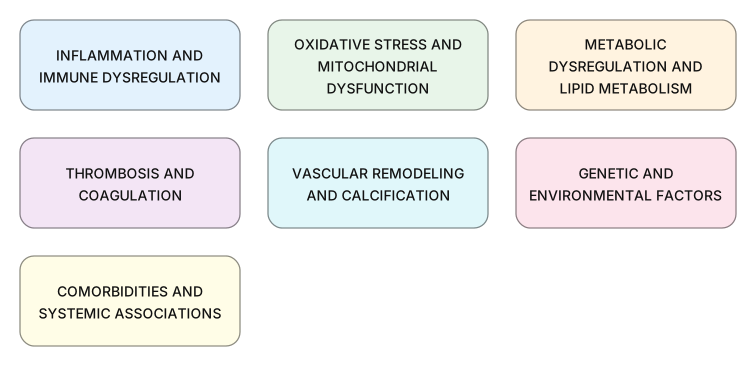
Figure 4. Main extracted research topics
Figure 4. Main extracted research topics (Results)

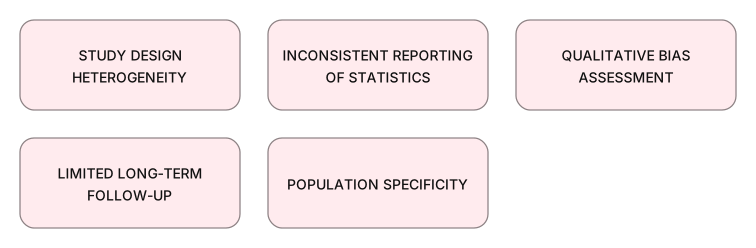
Figure 5. Limitations of current studies (topics)

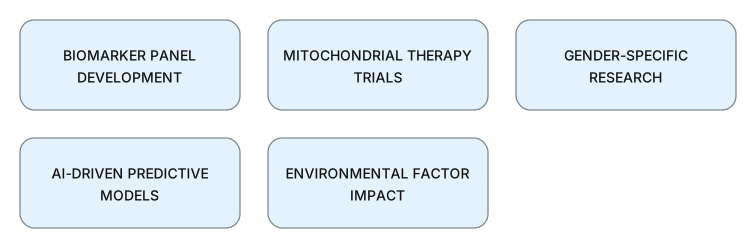
Figure 6. Future research directions (topics)