Peripheral Artery Disease Prognosis: Systematic Review with ☸️SAIMSARA.


saimsara.com Download PDF

Abstract: This paper aims to synthesize current research on peripheral artery disease prognosis, identifying key risk factors, biomarkers, and management strategies that influence patient outcomes. The review utilises 242 studies with 2310079 total participants (naïve ΣN). Direct numerical comparison of a single central value for peripheral artery disease prognosis is challenging due to the high heterogeneity in patient populations, specific endpoints (e.g., all-cause mortality, cardiovascular mortality, major adverse limb events, major adverse cardiovascular events), and follow-up durations across studies. However, a consistent theme is that PAD is associated with significantly elevated mortality and adverse event rates. This dire prognosis extends across diverse patient populations, including those with significant comorbidities like diabetes, hemodialysis, and coronary artery disease. The most impactful limitation affecting certainty is the inherent heterogeneity in study designs, patient cohorts, and reported outcomes, which precludes a single, universally applicable prognostic figure. Clinicians should prioritize comprehensive risk assessment, including evaluation of comorbidities, inflammatory markers, and nutritional status, to guide intensified, personalized management strategies for patients with peripheral artery disease.

Keywords: Peripheral Artery Disease; Prognosis; Mortality; Major Adverse Limb Events; Major Adverse Cardiovascular Events; Biomarkers; Risk Factors; Endovascular Treatment; Hemodialysis; Inflammation

Review Stats
Identification of studies via Semantic Scholar (all fields) Identification Screening Included Records identified:n=1934Records excluded:n=934 Records assessed for eligibilityn=1000Records excluded:n=758 Studies included in reviewn=242 PRISMA Diagram generated by ☸️ SAIMSARA
⛛OSMA Triangle Effect-of Predictor → Outcome peripheral artery disease  →  prognosis Beneficial for patients ΣN=92517 (4%) Harmful for patients ΣN=806845 (35%) Neutral ΣN=1410717 (61%) 0 ⛛OSMA Triangle generated by ☸️SAIMSARA
Show OSMA legend
Outcome-Sentiment Meta-Analysis (OSMA): (LLM-only)
Frame: Effect-of Predictor → Outcome • Source: Semantic Scholar
Outcome: prognosis Typical timepoints: 1-y, 5-y. Reported metrics: %, CI, p.
Common endpoints: Common endpoints: mortality, complications, survival.
Predictor: peripheral artery disease — exposure/predictor. Typical comparator: non-dialysis patients., management by a surgeon, other inflammatory indices, dipeptidyl peptidase-4….

  • 1) Beneficial for patients — prognosis with peripheral artery disease — [8], [13], [18], [24], [73], [80], [82], [88], [91], [133], [137], [177], [183], [198], [217], [222], [242] — ΣN=92517
  • 2) Harmful for patients — prognosis with peripheral artery disease — [1], [3], [4], [6], [10], [11], [12], [14], [15], [16], [20], [22], [25], [54], [56], [57], [62], [63], [64], [67], [68], [75], [76], [78], [79], [81], [87], [89], [90], [93], [98], [100], [126], [127], [131], [136], [138], [143], [144], [146], [149], [150], [159], [160], [161], [163], [165], [171], [172], [175], [176], [180], [185], [186], [187], [189], [190], [192], [193], [195], [196], [197], [201], [202], [203], [204], [205], [207], [209], [210], [211], [212], [213], [219], [221], [224], [225], [226], [227], [229], [230], [232], [233], [234], [236], [237], [239], [240], [241] — ΣN=806845
  • 3) No clear effect — prognosis with peripheral artery disease — [2], [5], [7], [9], [17], [19], [21], [23], [26], [27], [28], [29], [30], [31], [32], [33], [34], [35], [36], [37], [38], [39], [40], [41], [42], [43], [44], [45], [46], [47], [48], [49], [50], [51], [52], [53], [55], [58], [59], [60], [61], [65], [66], [69], [70], [71], [72], [74], [77], [83], [84], [85], [86], [92], [94], [95], [96], [97], [99], [101], [102], [103], [104], [105], [106], [107], [108], [109], [110], [111], [112], [113], [114], [115], [116], [117], [118], [119], [120], [121], [122], [123], [124], [125], [128], [129], [130], [132], [134], [135], [139], [140], [141], [142], [145], [147], [148], [151], [152], [153], [154], [155], [156], [157], [158], [162], [164], [166], [167], [168], [169], [170], [173], [174], [178], [179], [181], [182], [184], [188], [191], [194], [199], [200], [206], [208], [214], [215], [216], [218], [220], [223], [228], [231], [235], [238] — ΣN=1410717
1) Introduction
Peripheral artery disease (PAD) represents a significant global health burden, characterized by progressive atherosclerosis affecting arteries outside of the heart and brain [50, 125, 129]. Its prevalence is notably high in underserved populations [30] and among individuals with comorbidities such as diabetes mellitus (DM), chronic kidney disease (CKD), and coronary artery disease (CAD) [36, 58, 99]. PAD is consistently associated with a poor prognosis, marked by increased risks of major adverse cardiovascular events (MACE), major adverse limb events (MALE), amputation, and all-cause mortality [46, 117, 172]. Understanding the multifaceted determinants of prognosis in PAD is crucial for effective risk stratification, personalized management strategies, and ultimately, improving patient outcomes.

2) Aim
This paper aims to synthesize current research on peripheral artery disease prognosis, identifying key risk factors, biomarkers, and management strategies that influence patient outcomes.

3) Methods
Systematic review with multilayer AI research agent: keyword normalization, retrieval & structuring, and paper synthesis (see SAIMSARA About section for details).


4) Results
4.1 Study characteristics:
The included studies predominantly employed cohort designs, with a mix of retrospective and prospective approaches, alongside some mixed-design studies and randomized controlled trials. Populations frequently included patients with peripheral artery disease (PAD) and various comorbidities such as diabetes, chronic kidney disease (CKD), hemodialysis (HD), coronary artery disease (CAD), acute coronary syndromes (ACS), and those undergoing revascularization procedures. Follow-up periods ranged from short-term (e.g., 30 days, 3 months, 6 months) to long-term (e.g., 1 year, 2 years, 5 years, 10 years, and up to 16 years).

4.2 Main numerical result aligned to the query:
Direct numerical comparison of a single central value for peripheral artery disease prognosis is challenging due to the high heterogeneity in patient populations, specific endpoints (e.g., all-cause mortality, cardiovascular mortality, major adverse limb events, major adverse cardiovascular events), and follow-up durations across studies. However, a consistent theme is that PAD is associated with significantly elevated mortality and adverse event rates. For instance, 10-year cumulative mortality rates after cardiovascular surgery in hemodialysis patients with PAD treated with lower extremity bypass (LEB) reached 58.9%, compared to 15.6% in non-HD CABG patients [1]. In patients with non-ST-segment elevation acute coronary syndromes (NSTEMI), 1-year mortality was 16.2% in PAD patients versus 6.2% in non-PAD patients [6]. For patients with chronic limb-threatening ischemia (CLTI), 5-year amputation-free survival can be as low as 43% [49], with 1-year survival rates without major amputation reported at 45% [122].

4.3 Topic synthesis:


5) Discussion
5.1 Principal finding:
The central finding is that peripheral artery disease is consistently associated with a poor prognosis, characterized by significantly elevated risks of mortality, major adverse cardiovascular events (MACE), and major adverse limb events (MALE), with specific rates varying widely based on patient characteristics and disease severity [1, 6, 46, 117, 172].

5.2 Clinical implications:


5.3 Research implications / key gaps:


5.4 Limitations:


5.5 Future directions:


6) Conclusion
Direct numerical comparison of a single central value for peripheral artery disease prognosis is challenging due to the high heterogeneity in patient populations, specific endpoints (e.g., all-cause mortality, cardiovascular mortality, major adverse limb events, major adverse cardiovascular events), and follow-up durations across studies. However, a consistent theme is that PAD is associated with significantly elevated mortality and adverse event rates [1, 6, 46, 117, 172]. This dire prognosis extends across diverse patient populations, including those with significant comorbidities like diabetes, hemodialysis, and coronary artery disease. The most impactful limitation affecting certainty is the inherent heterogeneity in study designs, patient cohorts, and reported outcomes, which precludes a single, universally applicable prognostic figure. Clinicians should prioritize comprehensive risk assessment, including evaluation of comorbidities, inflammatory markers, and nutritional status, to guide intensified, personalized management strategies for patients with peripheral artery disease.

References
SAIMSARA Session Index — session.json

Figure 1. Publication-year distribution of included originals

Figure 2. Study-design distribution of included originals
Figure 2. Study-design distribution

Figure 3. Study-type (directionality) distribution of included originals
Figure 3. Directionality distribution

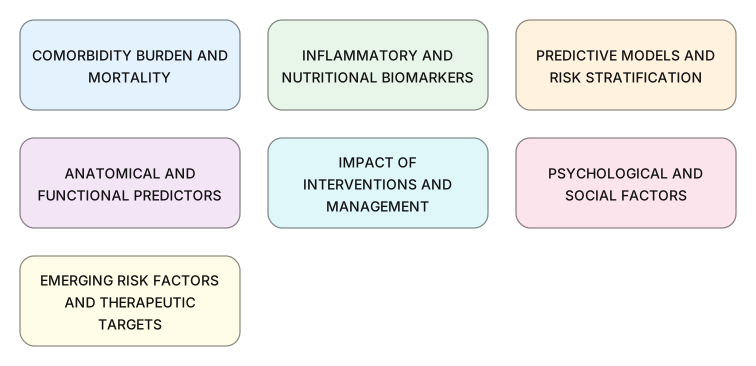
Figure 4. Main extracted research topics
Figure 4. Main extracted research topics (Results)

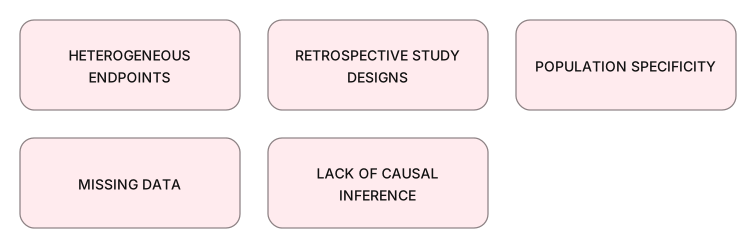
Figure 5. Limitations of current studies (topics)

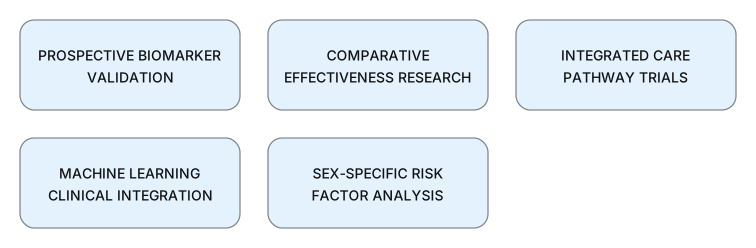
Figure 6. Future research directions (topics)