Peripheral Artery Disease Statin Therapy: Systematic Review with ☸️SAIMSARA.


saimsara.com Download PDF

Abstract: To systematically review and synthesize the current evidence regarding statin therapy in patients with peripheral artery disease, focusing on its impact on clinical outcomes, adherence, and optimal utilization. The review utilises 194 studies with 5193263 total participants (naïve ΣN). Statin therapy is associated with a substantially lower all-cause mortality risk in patients with peripheral artery disease, with median mortality rates of 11.5% (range: 2.8% to 33.3%) for statin users compared to 28.5% (range: 4.8% to 35.2%) for non-users or those with poor adherence. Despite these clear benefits, statin utilization, adherence, and achievement of optimal LDL-C targets remain suboptimal across diverse PAD populations. The primary limitation affecting certainty is the predominance of observational study designs, which inherently carry risks of bias and confounding. Clinicians should prioritize the initiation and intensification of statin therapy, alongside addressing adherence barriers, to improve outcomes for patients with peripheral artery disease.

Keywords: Peripheral artery disease; Statin therapy; Cardiovascular outcomes; Mortality; Limb events; Dyslipidemia; Guid

Review Stats
Identification of studies via Semantic Scholar (all fields) Identification Screening Included Records identified:n=732Records excluded:n=0 Records assessed for eligibilityn=732Records excluded:n=538 Studies included in reviewn=194 PRISMA Diagram generated by ☸️ SAIMSARA
⛛OSMA Triangle Effect-of Predictor → Outcome statin therapy  →  peripheral artery disease Beneficial for patients ΣN=736045 (14%) Harmful for patients ΣN=42346 (1%) Neutral ΣN=4414872 (85%) 0 ⛛OSMA Triangle generated by ☸️SAIMSARA
Show OSMA legend
Outcome-Sentiment Meta-Analysis (OSMA): (LLM-only)
Frame: Effect-of Predictor → Outcome • Source: Semantic Scholar
Outcome: peripheral artery disease Typical timepoints: 5-y, 6-mo. Reported metrics: %, CI, p.
Common endpoints: Common endpoints: mortality, complications, survival.
Predictor: statin therapy — exposure/predictor. Doses/units seen: 70 mg, 100 mg, 300 mg, 55 mg, 2 mg. Routes seen: oral. Typical comparator: low- or moderate-intensity, patients with clinical, untreated pad subjects, pad-only patients….

  • 1) Beneficial for patients — peripheral artery disease with statin therapy — [1], [3], [4], [7], [9], [22], [26], [29], [40], [41], [42], [45], [48], [51], [52], [54], [55], [58], [60], [61], [62], [64], [66], [68], [70], [71], [72], [73], [74], [77], [79], [80], [82], [83], [93], [95], [97], [98], [100], [101], [107], [110], [112], [114], [117], [119], [120], [122], [126], [127], [130], [135], [136], [139], [145], [149], [150], [155], [159], [168], [171], [174], [176], [179], [181], [193] — ΣN=736045
  • 2) Harmful for patients — peripheral artery disease with statin therapy — [13], [38], [56], [57], [65], [67], [69], [75], [102], [186], [188] — ΣN=42346
  • 3) No clear effect — peripheral artery disease with statin therapy — [2], [5], [6], [8], [10], [11], [12], [14], [15], [16], [17], [18], [19], [20], [21], [23], [24], [25], [27], [28], [30], [31], [32], [33], [34], [35], [36], [37], [39], [43], [44], [46], [47], [49], [50], [53], [59], [63], [76], [78], [81], [84], [85], [86], [87], [88], [89], [90], [91], [92], [94], [96], [99], [103], [104], [105], [106], [108], [109], [111], [113], [115], [116], [118], [121], [123], [124], [125], [128], [129], [131], [132], [133], [134], [137], [138], [140], [141], [142], [143], [144], [146], [147], [148], [151], [152], [153], [154], [156], [157], [158], [160], [161], [162], [163], [164], [165], [166], [167], [169], [170], [172], [173], [175], [177], [178], [180], [182], [183], [184], [185], [187], [189], [190], [191], [192], [194] — ΣN=4414872
Introduction
Peripheral artery disease (PAD) represents a significant global health burden, characterized by atherosclerotic narrowing of non-coronary arteries, most commonly affecting the lower extremities. Statin therapy, a cornerstone of lipid-lowering treatment, is widely recommended for patients with PAD due to its proven benefits in reducing cardiovascular events. However, the extent of its utilization, adherence, and impact on various patient populations and outcomes in real-world settings remains a subject of ongoing investigation. This paper synthesizes current evidence on statin therapy for PAD, exploring its efficacy, challenges in implementation, and areas requiring further research.

Aim
To systematically review and synthesize the current evidence regarding statin therapy in patients with peripheral artery disease, focusing on its impact on clinical outcomes, adherence, and optimal utilization.

Methods
Systematic review with multilayer AI research agent: keyword normalization, retrieval & structuring, and paper synthesis (see SAIMSARA About section for details).


Results
4.1 Study characteristics
The included studies predominantly comprised cohort, retrospective, and mixed-design studies, with a smaller number of prospective cohort studies and randomized controlled trials. These studies investigated diverse populations, including symptomatic PAD patients, those undergoing revascularization, patients with kidney failure, diabetes, or polyvascular disease, and individuals with familial hypercholesterolemia. Follow-up periods varied widely, ranging from short-term (e.g., 2 weeks [152]) to long-term (e.g., 15 years [56, 131]).

4.2 Main numerical result aligned to the query
Across studies comparing statin use to no statin use or non-adherence, the median reported all-cause mortality rate for patients on statin therapy was 11.5% (range: 2.8% [7] to 33.3% [1]), while for patients not on statin therapy or with poor adherence, the median all-cause mortality rate was 28.5% (range: 4.8% [7] to 35.2% [1]). This suggests a substantially lower mortality risk associated with statin therapy in peripheral artery disease patients.

4.3 Topic synthesis


Discussion
5.1 Principal finding
The central finding of this review is that statin therapy is associated with a substantially lower all-cause mortality risk in patients with peripheral artery disease, with median mortality rates of 11.5% (range: 2.8% [7] to 33.3% [1]) for statin users compared to 28.5% (range: 4.8% [7] to 35.2% [1]) for non-users or those with poor adherence.

5.2 Clinical implications


5.3 Research implications / key gaps


5.4 Limitations


5.5 Future directions


Conclusion
Statin therapy is associated with a substantially lower all-cause mortality risk in patients with peripheral artery disease, with median mortality rates of 11.5% (range: 2.8% [7] to 33.3% [1]) for statin users compared to 28.5% (range: 4.8% [7] to 35.2% [1]) for non-users or those with poor adherence. Despite these clear benefits, statin utilization, adherence, and achievement of optimal LDL-C targets remain suboptimal across diverse PAD populations. The primary limitation affecting certainty is the predominance of observational study designs, which inherently carry risks of bias and confounding. Clinicians should prioritize the initiation and intensification of statin therapy, alongside addressing adherence barriers, to improve outcomes for patients with peripheral artery disease.

References
SAIMSARA Session Index — session.json

Figure 1. Publication-year distribution of included originals

Figure 2. Study-design distribution of included originals
Figure 2. Study-design distribution

Figure 3. Study-type (directionality) distribution of included originals
Figure 3. Directionality distribution

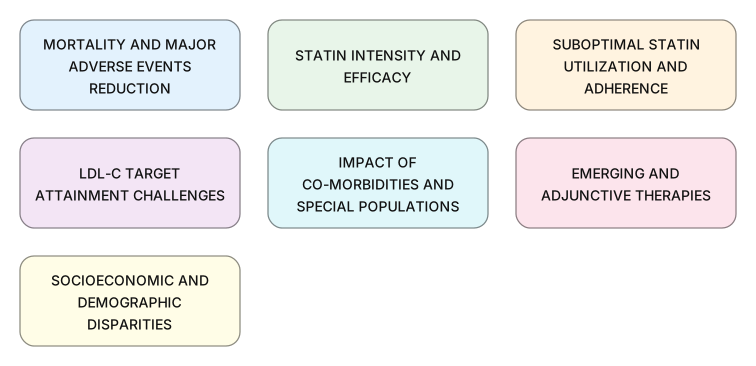
Figure 4. Main extracted research topics
Figure 4. Main extracted research topics (Results)

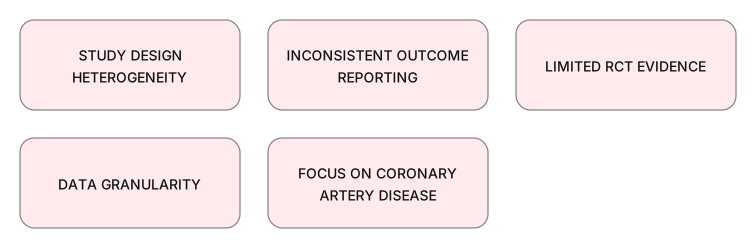
Figure 5. Limitations of current studies (topics)

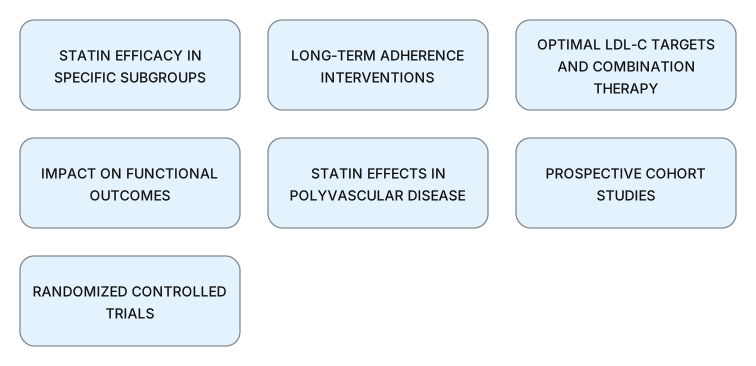
Figure 6. Future research directions (topics)