Peripheral Artery Disease Treatment: Systematic Review with ☸️SAIMSARA.


saimsara.com Download PDF

Abstract: The aim of this systematic review is to synthesize findings from recent research on peripheral artery disease treatments to identify current best practices, emerging therapies, patient-specific considerations, and existing gaps in knowledge. The review utilises 157 studies with 533650 total participants (naïve ΣN). For femoropopliteal peripheral artery disease, drug-coated balloons demonstrated superior primary patency compared to percutaneous transluminal angioplasty at approximately 1 year, with a median patency of 85.6% for DCBs versus 58.7% for PTA. This advantage suggests a shift towards drug-eluting technologies for improved vessel patency in symptomatic PAD patients. The heterogeneity of reported outcomes across studies, particularly in terms of metrics and follow-up durations, represents the most significant limitation to synthesizing a comprehensive understanding of treatment efficacy. Clinicians should prioritize evidence-based endovascular interventions and aggressive medical management, while future research should focus on standardized outcome reporting and large-scale comparative effectiveness trials to refine treatment guidelines.

Keywords: Peripheral Artery Disease; PAD Treatment; ;Intermittent Claudication; Critical Limb Ischemia; Endovascular Procedures;

Review Stats
Identification of studies via Semantic Scholar (all fields) Identification Screening Included Records identified:n=227016Records excluded:n=226016 Records assessed for eligibilityn=1000Records excluded:n=843 Studies included in reviewn=157 PRISMA Diagram generated by ☸️ SAIMSARA
⛛OSMA Triangle Effect-of Predictor → Outcome peripheral artery disease treatment  →  Outcome Beneficial for patients ΣN=54973 (10%) Harmful for patients ΣN=363391 (68%) Neutral ΣN=115286 (22%) 0 ⛛OSMA Triangle generated by ☸️SAIMSARA
Show OSMA legend
Outcome-Sentiment Meta-Analysis (OSMA): (LLM-only)
Frame: Effect-of Predictor → Outcome • Source: Semantic Scholar
Outcome: Outcome Typical timepoints: 1-y, 12-mo. Reported metrics: %, CI, p.
Common endpoints: Common endpoints: mortality, complications, patency.
Predictor: peripheral artery disease treatment — exposure/predictor. Routes seen: oral. Typical comparator: those without anxiety. among, those managed noninvasively, conventional treatment of, clopidogrel and aspirin….

  • 1) Beneficial for patients — Outcome with peripheral artery disease treatment — [1], [3], [4], [7], [8], [11], [13], [16], [17], [20], [24], [25], [34], [55], [57], [78], [79], [95], [100], [101], [102], [104], [119], [121], [125], [146], [155] — ΣN=54973
  • 2) Harmful for patients — Outcome with peripheral artery disease treatment — [10], [12], [14], [21], [22], [27], [54], [75], [77], [88], [94], [99], [105], [113], [116], [117], [120], [122], [124], [133], [137], [138], [145], [152], [156] — ΣN=363391
  • 3) No clear effect — Outcome with peripheral artery disease treatment — [2], [5], [6], [9], [15], [18], [19], [23], [26], [28], [29], [30], [31], [32], [33], [35], [36], [37], [38], [39], [40], [41], [42], [43], [44], [45], [46], [47], [48], [49], [50], [51], [52], [53], [56], [58], [59], [60], [61], [62], [63], [64], [65], [66], [67], [68], [69], [70], [71], [72], [73], [74], [76], [80], [81], [82], [83], [84], [85], [86], [87], [89], [90], [91], [92], [93], [96], [97], [98], [103], [106], [107], [108], [109], [110], [111], [112], [114], [115], [118], [123], [126], [127], [128], [129], [130], [131], [132], [134], [135], [136], [139], [140], [141], [142], [143], [144], [147], [148], [149], [150], [151], [153], [154], [157] — ΣN=115286
1) Introduction
Peripheral artery disease (PAD) is a prevalent circulatory condition characterized by narrowed arteries that reduce blood flow to the limbs, most commonly the legs. This can lead to symptoms such as claudication, critical limb-threatening ischemia (CLTI), and an increased risk of major adverse cardiovascular events (MACE) and major adverse limb events (MALE), including amputation. Effective treatment strategies for PAD are crucial for improving patient outcomes, alleviating symptoms, and preventing severe complications. This paper synthesizes current research on various therapeutic approaches for PAD, encompassing medical, endovascular, surgical, and novel experimental interventions, while also addressing patient-centered care and disparities in treatment.

2) Aim
The aim of this systematic review is to synthesize findings from recent research on peripheral artery disease treatments to identify current best practices, emerging therapies, patient-specific considerations, and existing gaps in knowledge.

3) Methods
Systematic review with multilayer AI research agent: keyword normalization, retrieval & structuring, and paper synthesis (see SAIMSARA About section for details).


4) Results
4.1 Study characteristics
The included studies predominantly comprised prospective cohort studies and randomized controlled trials (RCTs), alongside numerous mixed-design and retrospective analyses. Populations typically involved patients experiencing new-onset or worsening claudication, symptomatic PAD of various severities, or specific subgroups such as those with diabetes or undergoing endovascular procedures. Follow-up periods ranged from 6 months to 5 years, with many studies reporting 12-month outcomes.

4.2 Main numerical result aligned to the query
For femoropopliteal peripheral artery disease, drug-coated balloons (DCBs) demonstrated superior primary patency compared to percutaneous transluminal angioplasty (PTA) at approximately 1 year. The median primary patency for DCBs was 85.6% (range: 82.2%–89.0%) versus 58.7% (range: 52.4%–65.0%) for PTA [11, 25]. This superiority was also observed at 36 months, with DCBs achieving 69.5% primary patency compared to 45.1% for PTA [100].

4.3 Topic synthesis


5) Discussion
5.1 Principal finding
For femoropopliteal peripheral artery disease, drug-coated balloons demonstrated superior primary patency compared to percutaneous transluminal angioplasty at approximately 1 year, with a median patency of 85.6% for DCBs versus 58.7% for PTA [11, 25]. This highlights the sustained advantage of drug-eluting technologies in maintaining vessel patency.

5.2 Clinical implications


5.3 Research implications / key gaps


5.4 Limitations


5.5 Future directions


6) Conclusion
For femoropopliteal peripheral artery disease, drug-coated balloons demonstrated superior primary patency compared to percutaneous transluminal angioplasty at approximately 1 year, with a median patency of 85.6% for DCBs versus 58.7% for PTA [11, 25]. This advantage suggests a shift towards drug-eluting technologies for improved vessel patency in symptomatic PAD patients. The heterogeneity of reported outcomes across studies, particularly in terms of metrics and follow-up durations, represents the most significant limitation to synthesizing a comprehensive understanding of treatment efficacy. Clinicians should prioritize evidence-based endovascular interventions and aggressive medical management, while future research should focus on standardized outcome reporting and large-scale comparative effectiveness trials to refine treatment guidelines.

References
SAIMSARA Session Index — session.json

Figure 1. Publication-year distribution of included originals

Figure 2. Study-design distribution of included originals
Figure 2. Study-design distribution

Figure 3. Study-type (directionality) distribution of included originals
Figure 3. Directionality distribution

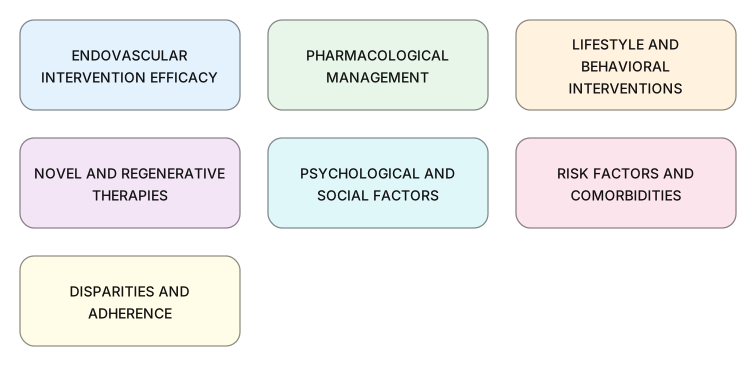
Figure 4. Main extracted research topics
Figure 4. Main extracted research topics (Results)

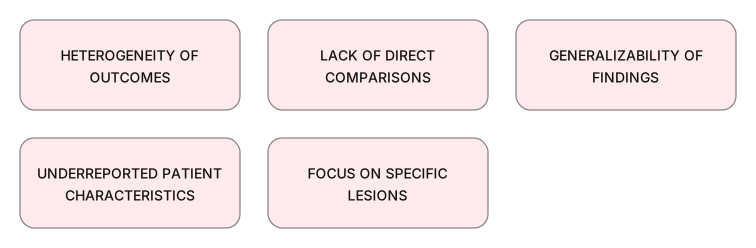
Figure 5. Limitations of current studies (topics)

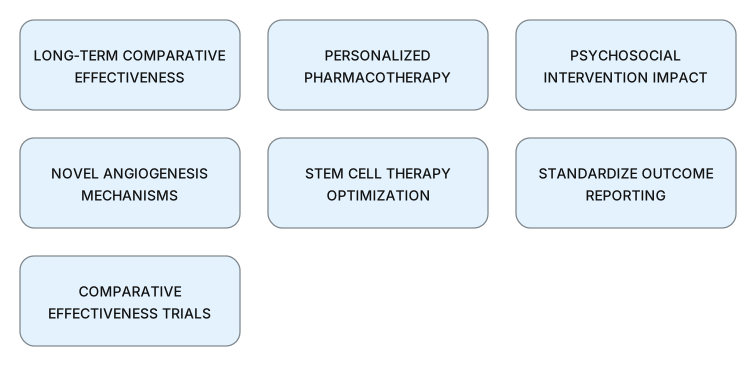
Figure 6. Future research directions (topics)