Peripheral Artery Disease WIFI Classification: Systematic Review with ☸️SAIMSARA.


DOI: 10.62487/saimsaraa133a318


saimsara.com Download PDF

Abstract: This paper aims to systematically review the current evidence on the utility and prognostic value of the WIfI classification system in patients with peripheral artery disease. The review utilises 190 studies with 222085 total participants (naïve ΣN). Higher WIfI stages are consistently associated with a significantly increased risk of adverse outcomes in peripheral artery disease patients, with the median odds ratio or hazard ratio for major amputation or mortality associated with higher WIfI stages (typically stage 3 or 4 compared to lower stages) being 3.74, with a range observed from 2.18 to 7.54. This predictive capability is valuable across various PAD patient settings, including those with chronic limb-threatening ischemia and diabetic foot infections. However, the prevalence of retrospective study designs limits the certainty of causal inferences. Clinicians should integrate WIfI classification into their assessment to tailor revascularization strategies and improve patient outcomes.

Keywords: Peripheral Artery Disease; WIfI Classification; Chronic Limb-Threatening Ischemia; Amputation; Mortality; Risk Stratification; Diabetic Foot; Limb Salvage; Revascularization; Prognosis

Review Stats
Identification of studies via Semantic Scholar (all fields) Identification Screening Included Records identified:n=1099Records excluded:n=99 Records assessed for eligibilityn=1000Records excluded:n=810 Studies included in reviewn=190 PRISMA Diagram generated by ☸️ SAIMSARA
⛛OSMA Triangle Effect-of Predictor → Outcome peripheral artery disease WIfI classification  →  Outcome Beneficial for patients ΣN=1375 (1%) Harmful for patients ΣN=25784 (12%) Neutral ΣN=194926 (88%) 0 ⛛OSMA Triangle generated by ☸️SAIMSARA
Show OSMA legend
Outcome-Sentiment Meta-Analysis (OSMA): (LLM-only)
Frame: Effect-of Predictor → Outcome • Source: Semantic Scholar
Outcome: Outcome Typical timepoints: 1-y, 30-day. Reported metrics: %, CI, p.
Common endpoints: Common endpoints: complications, mortality, healing.
Predictor: peripheral artery disease WIfI classification — exposure/predictor. Routes seen: iv. Typical comparator: non-hd patients, 34.7, clopidogrel plus aspirin in, 71.2….

  • 1) Beneficial for patients — Outcome with peripheral artery disease WIfI classification — [7], [13], [22], [24], [35], [174], [175] — ΣN=1375
  • 2) Harmful for patients — Outcome with peripheral artery disease WIfI classification — [1], [3], [4], [5], [6], [8], [10], [18], [21], [25], [31], [37], [43], [49], [50], [81], [82], [83], [169], [171], [172] — ΣN=25784
  • 3) No clear effect — Outcome with peripheral artery disease WIfI classification — [2], [9], [11], [12], [14], [15], [16], [17], [19], [20], [23], [26], [27], [28], [29], [30], [32], [33], [34], [36], [38], [39], [40], [41], [42], [44], [45], [46], [47], [48], [51], [52], [53], [54], [55], [56], [57], [58], [59], [60], [61], [62], [63], [64], [65], [66], [67], [68], [69], [70], [71], [72], [73], [74], [75], [76], [77], [78], [79], [80], [84], [85], [86], [87], [88], [89], [90], [91], [92], [93], [94], [95], [96], [97], [98], [99], [100], [101], [102], [103], [104], [105], [106], [107], [108], [109], [110], [111], [112], [113], [114], [115], [116], [117], [118], [119], [120], [121], [122], [123], [124], [125], [126], [127], [128], [129], [130], [131], [132], [133], [134], [135], [136], [137], [138], [139], [140], [141], [142], [143], [144], [145], [146], [147], [148], [149], [150], [151], [152], [153], [154], [155], [156], [157], [158], [159], [160], [161], [162], [163], [164], [165], [166], [167], [168], [170], [173], [176], [177], [178], [179], [180], [181], [182], [183], [184], [185], [186], [187], [188], [189], [190] — ΣN=194926
1) Introduction
Peripheral artery disease (PAD) is a prevalent circulatory condition characterized by narrowed arteries that reduce blood flow to the limbs, most commonly the legs. A severe manifestation, chronic limb-threatening ischemia (CLTI), poses a significant risk for amputation and mortality. Accurate risk stratification is crucial for guiding clinical management and improving patient outcomes. The Wound, Ischemia, and foot Infection (WIfI) classification system, developed by the Society for Vascular Surgery (SVS), provides a standardized framework to assess the severity of limb threat based on these three clinical parameters [79, 59]. This system aims to predict amputation risk and the potential benefit of revascularization, thereby informing treatment decisions for PAD patients [187, 59].

2) Aim
This paper aims to systematically review the current evidence on the utility and prognostic value of the WIfI classification system in patients with peripheral artery disease.

3) Methods
Systematic review with multilayer AI research agent: keyword normalization, retrieval & structuring, and paper synthesis (see SAIMSARA About section for details).


4) Results
4.1 Study characteristics:
The included studies predominantly comprised retrospective cohort and mixed designs, with some prospective cohort studies and randomized controlled trials. Populations frequently focused on patients with chronic limb-threatening ischemia (CLTI), diabetic foot infection (DFI), or those undergoing revascularization procedures for peripheral artery disease. Sample sizes varied widely, from single case reports to large cohorts of several thousand patients. Follow-up periods ranged from 30 days to 12 years, with many studies reporting median follow-up times or not specifying duration.

4.2 Main numerical result aligned to the query:
Higher WIfI stages are consistently associated with a significantly increased risk of adverse outcomes in peripheral artery disease patients. The median odds ratio (OR) or hazard ratio (HR) for major amputation or mortality associated with higher WIfI stages (typically stage 3 or 4 compared to lower stages) was 3.74, with a range observed from 2.18 to 7.54 [1, 3, 4, 6, 25, 81, 130, 140].

4.3 Topic synthesis:


5) Discussion
5.1 Principal finding:
The median odds or hazard ratio for major amputation or mortality associated with higher WIfI stages (typically stage 3 or 4 compared to lower stages) was 3.74, with a range observed from 2.18 to 7.54 [1, 3, 4, 6, 25, 81, 130, 140], indicating that higher WIfI scores are consistently linked to a substantially elevated risk of adverse limb and survival outcomes in PAD patients.

5.2 Clinical implications:


5.3 Research implications / key gaps:


5.4 Limitations:


5.5 Future directions:


6) Conclusion
Higher WIfI stages are consistently associated with a significantly increased risk of adverse outcomes in peripheral artery disease patients, with the median odds ratio or hazard ratio for major amputation or mortality associated with higher WIfI stages (typically stage 3 or 4 compared to lower stages) being 3.74, with a range observed from 2.18 to 7.54 [1, 3, 4, 6, 25, 81, 130, 140]. This predictive capability is valuable across various PAD patient settings, including those with chronic limb-threatening ischemia and diabetic foot infections. However, the prevalence of retrospective study designs limits the certainty of causal inferences. Clinicians should integrate WIfI classification into their assessment to tailor revascularization strategies and improve patient outcomes.

References
SAIMSARA Session Index — session.json

Figure 1. Publication-year distribution of included originals

Figure 2. Study-design distribution of included originals
Figure 2. Study-design distribution

Figure 3. Study-type (directionality) distribution of included originals
Figure 3. Directionality distribution

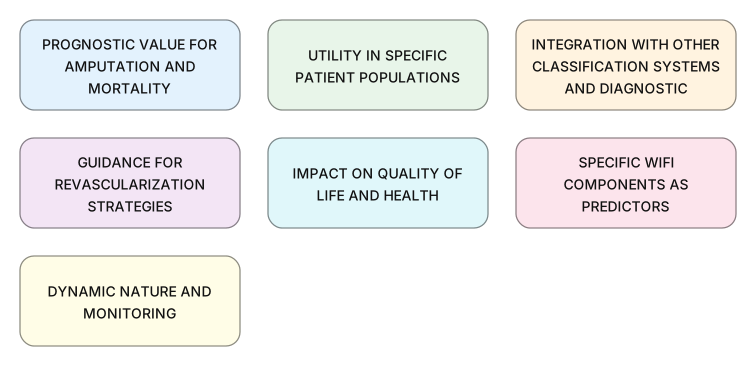
Figure 4. Main extracted research topics
Figure 4. Main extracted research topics (Results)

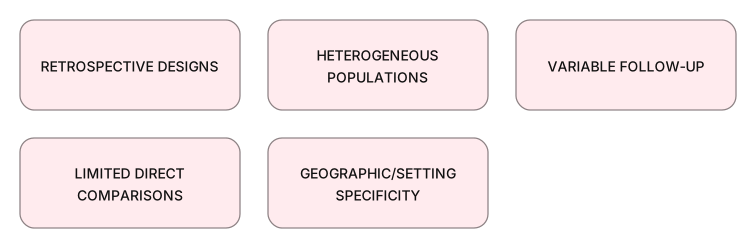
Figure 5. Limitations of current studies (topics)

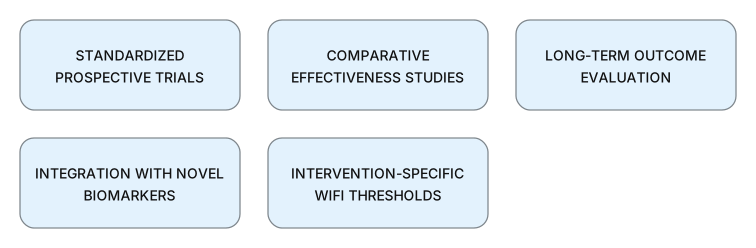
Figure 6. Future research directions (topics)