Popliteal Artery Aneurysm: Systematic Review with ☸️SAIMSARA.


saimsara.com Download PDF

Abstract: The aim of this paper is to provide a comprehensive overview of popliteal artery aneurysms, synthesizing current research on their presentation, etiology, diagnosis, and treatment strategies, as well as identifying key gaps in the literature. The review utilises 217 studies with 15425 total participants (naïve ΣN). Limb salvage rates at 1 year or 12 months for popliteal artery aneurysm (PAA) repair consistently demonstrate high success, with a median unweighted limb salvage rate of 100% and a range from 84.2% to 100%. These high rates are observed across diverse patient populations and treatment modalities, indicating effective limb preservation. However, the heterogeneous study designs and prevalence of retrospective analyses represent a significant limitation, affecting the certainty and generalizability of some findings. A concrete next step is to conduct prospective, randomized controlled trials to compare the long-term efficacy and durability of open versus endovascular repair for popliteal artery aneurysms.

Keywords: Popliteal artery aneurysm; Endovascular repair; Open surgical repair; Thrombosis; Rupture; Limb salvage; Stent-graft; Neutrophil-to-lymphocyte ratio; Apolipoprotein E; Graft patency

Review Stats
Identification of studies via Semantic Scholar (all fields) Identification Screening Included Records identified:n=91658Records excluded:n=90658 Records assessed for eligibilityn=1000Records excluded:n=783 Studies included in reviewn=217 PRISMA Diagram generated by ☸️ SAIMSARA
⛛OSMA Triangle Effect-of Predictor → Outcome popliteal artery aneurysm  →  Outcome Beneficial for patients ΣN=39 (0%) Harmful for patients ΣN=19 (0%) Neutral ΣN=15367 (100%) 0 ⛛OSMA Triangle generated by ☸️SAIMSARA
Show OSMA legend
Outcome-Sentiment Meta-Analysis (OSMA): (LLM-only)
Frame: Effect-of Predictor → Outcome • Source: Semantic Scholar
Outcome: Outcome Typical timepoints: peri/post-op, 5-y. Reported metrics: %, CI, p.
Common endpoints: Common endpoints: patency, mortality, complications.
Predictor: popliteal artery aneurysm — exposure/predictor. Routes seen: oral. Typical comparator: endovascular treatment for, control, open repair of popliteal, women….

  • 1) Beneficial for patients — Outcome with popliteal artery aneurysm — [201] — ΣN=39
  • 2) Harmful for patients — Outcome with popliteal artery aneurysm — [215] — ΣN=19
  • 3) No clear effect — Outcome with popliteal artery aneurysm — [1], [2], [3], [4], [5], [6], [7], [8], [9], [10], [11], [12], [13], [14], [15], [16], [17], [18], [19], [20], [21], [22], [23], [24], [25], [26], [27], [28], [29], [30], [31], [32], [33], [34], [35], [36], [37], [38], [39], [40], [41], [42], [43], [44], [45], [46], [47], [48], [49], [50], [51], [52], [53], [54], [55], [56], [57], [58], [59], [60], [61], [62], [63], [64], [65], [66], [67], [68], [69], [70], [71], [72], [73], [74], [75], [76], [77], [78], [79], [80], [81], [82], [83], [84], [85], [86], [87], [88], [89], [90], [91], [92], [93], [94], [95], [96], [97], [98], [99], [100], [101], [102], [103], [104], [105], [106], [107], [108], [109], [110], [111], [112], [113], [114], [115], [116], [117], [118], [119], [120], [121], [122], [123], [124], [125], [126], [127], [128], [129], [130], [131], [132], [133], [134], [135], [136], [137], [138], [139], [140], [141], [142], [143], [144], [145], [146], [147], [148], [149], [150], [151], [152], [153], [154], [155], [156], [157], [158], [159], [160], [161], [162], [163], [164], [165], [166], [167], [168], [169], [170], [171], [172], [173], [174], [175], [176], [177], [178], [179], [180], [181], [182], [183], [184], [185], [186], [187], [188], [189], [190], [191], [192], [193], [194], [195], [196], [197], [198], [199], [200], [202], [203], [204], [205], [206], [207], [208], [209], [210], [211], [212], [213], [214], [216], [217] — ΣN=15367

1) Introduction
Popliteal artery aneurysms (PAAs) represent a significant clinical challenge, accounting for nearly 70% of all peripheral artery aneurysms [8]. While often asymptomatic, symptomatic PAAs typically manifest with lower extremity ischemia, a condition that can be acutely limb-threatening [8, 110]. Complications such as thrombosis and distal embolization are common [7], and rupture, though rare, can lead to substantial morbidity and mortality, including limb amputation [8, 83]. The management of PAAs involves a spectrum of diagnostic and therapeutic approaches, ranging from open surgical repair to various endovascular techniques. This paper synthesizes current understanding of PAA characteristics, risk factors, treatment modalities, and outcomes.

2) Aim
The aim of this paper is to provide a comprehensive overview of popliteal artery aneurysms, synthesizing current research on their presentation, etiology, diagnosis, and treatment strategies, as well as identifying key gaps in the literature.

3) Methods
Systematic review with multilayer AI research agent: keyword normalization, retrieval & structuring, and paper synthesis (see SAIMSARA About section for details).


4) Results

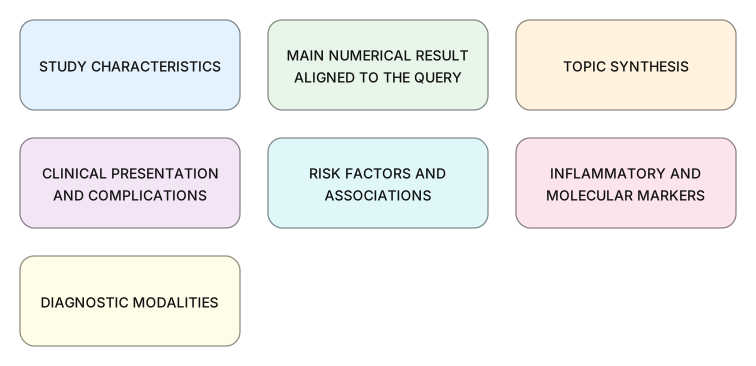
4.1 Study characteristics:
The studies encompassed a diverse range of designs, primarily retrospective cohorts, mixed studies (often including case reports), and some prospective cohorts and randomized controlled trials. Patient populations varied, including those undergoing urgent or elective PAA repair [1], individuals with symptomatic or ruptured PAAs [2, 83], and specific groups such as pediatric patients [33, 76, 101], patients with Marfan syndrome [10, 215], or those with concomitant abdominal aortic aneurysms (AAAs) [129, 191]. Follow-up periods ranged from short-term assessments (e.g., 24 hours, 30 days) [1] to mid-term (e.g., 14.8 months, 27 months) [13, 178] and long-term evaluations (e.g., 5 years, 25 years) [12, 201].

4.2 Main numerical result aligned to the query:
Limb salvage rates at 1 year or 12 months for popliteal artery aneurysm (PAA) repair consistently demonstrate high success. The median unweighted limb salvage rate reported was 100% [77, 177], with a range from 84.2% to 100% [86].

4.3 Topic synthesis:


5) Discussion

5.1 Principal finding:
Limb salvage rates at 1 year or 12 months for popliteal artery aneurysm (PAA) repair consistently demonstrate high success, with a median unweighted limb salvage rate of 100% [77, 177] and a range from 84.2% to 100% [86], indicating effective preservation of the affected limb across various treatment modalities.

5.2 Clinical implications:


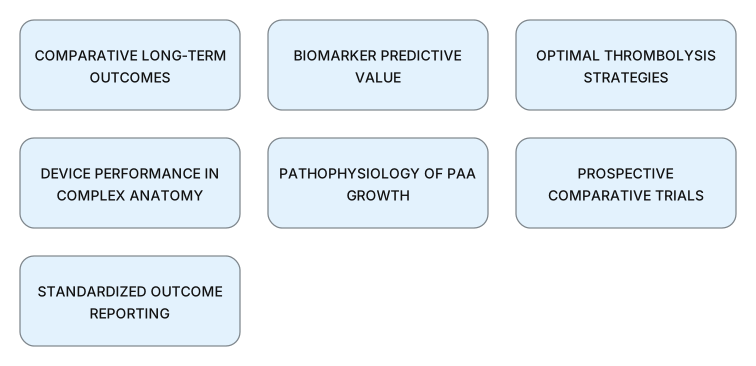
5.3 Research implications / key gaps:


5.4 Limitations:


5.5 Future directions:


6) Conclusion
Limb salvage rates at 1 year or 12 months for popliteal artery aneurysm (PAA) repair consistently demonstrate high success, with a median unweighted limb salvage rate of 100% [77, 177] and a range from 84.2% to 100% [86]. These high rates are observed across diverse patient populations and treatment modalities, indicating effective limb preservation. However, the heterogeneous study designs and prevalence of retrospective analyses represent a significant limitation, affecting the certainty and generalizability of some findings. A concrete next step is to conduct prospective, randomized controlled trials to compare the long-term efficacy and durability of open versus endovascular repair for popliteal artery aneurysms.

References
SAIMSARA Session Index — session.json

Figure 1. Publication-year distribution of included originals

Figure 2. Study-design distribution of included originals
Figure 2. Study-design distribution

Figure 3. Study-type (directionality) distribution of included originals
Figure 3. Directionality distribution

Figure 4. Main extracted research topics
Figure 4. Main extracted research topics (Results)

Figure 5. Limitations of current studies (topics)

Figure 6. Future research directions (topics)