Popliteal Artery Entrapment: Systematic Review with ☸️SAIMSARA.


saimsara.com Download PDF

Abstract: This paper aims to synthesize the current understanding of Popliteal Artery Entrapment Syndrome, encompassing its prevalence, diagnostic methodologies, treatment strategies, and associated clinical outcomes, based on a structured extraction of scientific literature. The review utilises 154 studies with 1545 total participants (naïve ΣN). Long-term surgical treatment for popliteal artery entrapment syndrome (PAES), including myotomy with or without arterial reconstruction, demonstrates excellent patency, with one study reporting a 15-year primary patency of 98%. This robust outcome primarily reflects experience in specialized centers treating symptomatic patients, often young and active individuals. The most significant limitation affecting certainty across the broader understanding of PAES is the heterogeneous study designs, predominantly comprising case reports and small retrospective series. Clinicians should maintain a high index of suspicion for PAES in young, active patients presenting with exertional lower extremity pain, and consider dynamic imaging for definitive diagnosis.

Keywords: Popliteal Artery Entrapment Syndrome; Vascular claudication; Surgical treatment; Arterial reconstruction; Dynamic ultrasound; CT angiography; Functional entrapment; Anatomical variations; Athletes; Acute limb ischemia

Review Stats
Identification of studies via Semantic Scholar (all fields) Identification Screening Included Records identified:n=13701Records excluded:n=12701 Records assessed for eligibilityn=1000Records excluded:n=846 Studies included in reviewn=154 PRISMA Diagram generated by ☸️ SAIMSARA
⛛OSMA Triangle Effect-of Predictor → Outcome Popliteal Artery Entrapment  →  Outcome Beneficial for patients ΣN=0 (0%) Harmful for patients ΣN=34 (2%) Neutral ΣN=1511 (98%) 0 ⛛OSMA Triangle generated by ☸️SAIMSARA
Show OSMA legend
Outcome-Sentiment Meta-Analysis (OSMA): (LLM-only)
Frame: Effect-of Predictor → Outcome • Source: Semantic Scholar
Outcome: Outcome Typical timepoints: 1-y, 15-y. Reported metrics: %, p.
Common endpoints: Common endpoints: occlusion, functional, complications.
Predictor: Popliteal Artery Entrapment — exposure/predictor. Typical comparator: non-dancer athletes, digital subtraction, balloon angioplasty for the, extramuscular grafts….

  • 1) Beneficial for patients — Outcome with Popliteal Artery Entrapment — — — ΣN=0
  • 2) Harmful for patients — Outcome with Popliteal Artery Entrapment — [60], [152], [153], [154] — ΣN=34
  • 3) No clear effect — Outcome with Popliteal Artery Entrapment — [1], [2], [3], [4], [5], [6], [7], [8], [9], [10], [11], [12], [13], [14], [15], [16], [17], [18], [19], [20], [21], [22], [23], [24], [25], [26], [27], [28], [29], [30], [31], [32], [33], [34], [35], [36], [37], [38], [39], [40], [41], [42], [43], [44], [45], [46], [47], [48], [49], [50], [51], [52], [53], [54], [55], [56], [57], [58], [59], [61], [62], [63], [64], [65], [66], [67], [68], [69], [70], [71], [72], [73], [74], [75], [76], [77], [78], [79], [80], [81], [82], [83], [84], [85], [86], [87], [88], [89], [90], [91], [92], [93], [94], [95], [96], [97], [98], [99], [100], [101], [102], [103], [104], [105], [106], [107], [108], [109], [110], [111], [112], [113], [114], [115], [116], [117], [118], [119], [120], [121], [122], [123], [124], [125], [126], [127], [128], [129], [130], [131], [132], [133], [134], [135], [136], [137], [138], [139], [140], [141], [142], [143], [144], [145], [146], [147], [148], [149], [150], [151] — ΣN=1511
1) Introduction
Popliteal Artery Entrapment Syndrome (PAES) is a condition characterized by the abnormal compression of the popliteal artery, often leading to exertional lower extremity pain, such as intermittent claudication, particularly in young, active individuals and athletes [3, 4, 8, 10, 38, 53, 81, 85, 86, 99, 102, 104, 105, 106, 111, 112, 123, 136]. This compression can be anatomical, due to aberrant muscle or tendon insertions, or functional, where normal muscle contraction causes compression [2, 13, 22, 25, 82, 103, 101, 149]. Diagnosis can be challenging due to its rarity, varied presentation, and potential for confusion with other lower limb injuries or conditions like chronic exertional compartment syndrome (CECS) or cystic adventitial disease [24, 61, 99, 106, 108, 110]. Early diagnosis and appropriate treatment are crucial for preventing long-term complications, including arterial occlusion, aneurysm formation, or limb ischemia [23, 40, 52, 60, 74, 78, 94, 152].

2) Aim
This paper aims to synthesize the current understanding of Popliteal Artery Entrapment Syndrome, encompassing its prevalence, diagnostic methodologies, treatment strategies, and associated clinical outcomes, based on a structured extraction of scientific literature.

3) Methods
Systematic review with multilayer AI research agent: keyword normalization, retrieval & structuring, and paper synthesis (see SAIMSARA About section for details).


4) Results
4.1 Study characteristics
The reviewed literature comprises a diverse range of study designs, including numerous case reports detailing unique presentations in athletes, military personnel, and young individuals [2, 3, 4, 5, 8, 9, 10, 11, 23, 35, 36, 37, 58, 63, 68, 69, 73, 76, 77, 78, 79, 81, 84, 85, 89, 90, 91, 94, 107, 108, 111, 112, 132, 141, 145, 146]. Retrospective studies analyze patient cohorts treated for PAES or related conditions, providing insights into surgical outcomes and diagnostic prevalence over periods ranging from 15 months to 15 years [1, 7, 13, 15, 22, 29, 31, 42, 44, 75, 118, 124, 153]. Prospective studies and randomized controlled trials (RCTs) are less common but address specific interventions like atherectomy or stent placement for popliteal artery lesions [14, 74, 114, 116, 119, 122]. Anatomical studies on cadavers also contribute to understanding popliteal artery variations [27, 93, 113].

4.2 Main numerical result aligned to the query
No single comparable numeric outcome exists across the diverse studies regarding the primary patency or success rates of interventions specifically for popliteal artery entrapment syndrome (PAES) due to varying definitions, follow-up durations, and patient populations. However, long-term surgical outcomes for PAES, including myotomy with or without arterial reconstruction, demonstrate good patency, with one study reporting a 15-year primary patency of 98% and freedom from target lesion revascularization of 92.4% in a cohort of 47 patients [1]. Another study on surgical treatment for PAES (49 limbs in 38 patients) reported all patients cured of their symptoms at a median follow-up of 34 months [42]. For acute popliteal artery occlusion, which can be caused by entrapment, intra-arterial thrombolysis showed a technical success of 90% and clinical success of 87% at 30 days [74].

4.3 Topic synthesis


5) Discussion
5.1 Principal finding
Long-term surgical treatment for popliteal artery entrapment syndrome (PAES), including myotomy with or without arterial reconstruction, demonstrates excellent patency, with one study reporting a 15-year primary patency of 98% [1].

5.2 Clinical implications


5.3 Research implications / key gaps


5.4 Limitations


5.5 Future directions


6) Conclusion
Long-term surgical treatment for popliteal artery entrapment syndrome (PAES), including myotomy with or without arterial reconstruction, demonstrates excellent patency, with one study reporting a 15-year primary patency of 98% [1]. This robust outcome primarily reflects experience in specialized centers treating symptomatic patients, often young and active individuals. The most significant limitation affecting certainty across the broader understanding of PAES is the heterogeneous study designs, predominantly comprising case reports and small retrospective series. Clinicians should maintain a high index of suspicion for PAES in young, active patients presenting with exertional lower extremity pain, and consider dynamic imaging for definitive diagnosis.

References
SAIMSARA Session Index — session.json

Figure 1. Publication-year distribution of included originals

Figure 2. Study-design distribution of included originals
Figure 2. Study-design distribution

Figure 3. Study-type (directionality) distribution of included originals
Figure 3. Directionality distribution

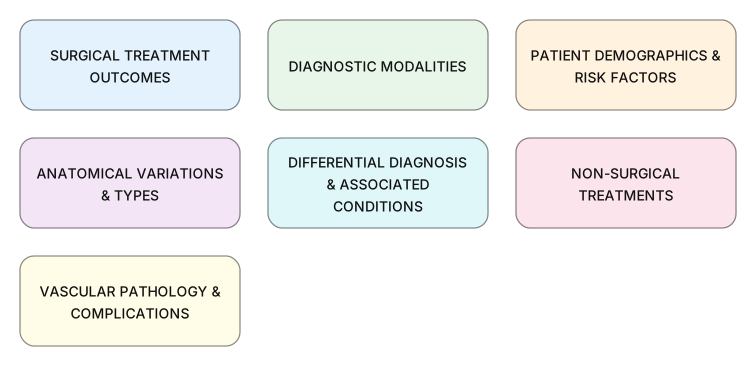
Figure 4. Main extracted research topics
Figure 4. Main extracted research topics (Results)

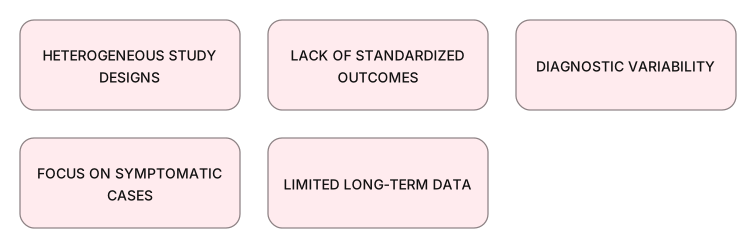
Figure 5. Limitations of current studies (topics)

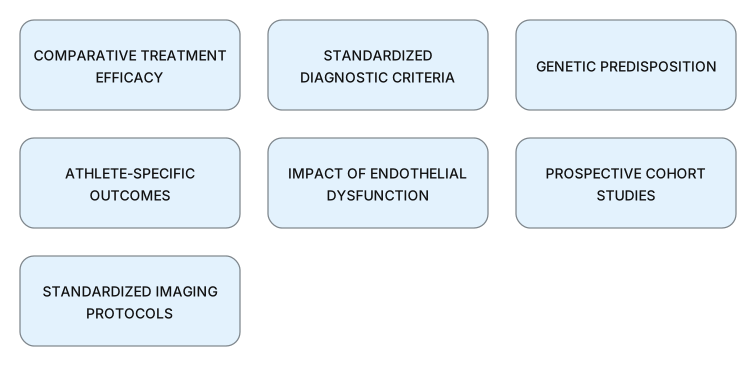
Figure 6. Future research directions (topics)