Rotational Thrombectomy: Systematic Review with ☸️SAIMSARA.


saimsara.com Download PDF

Abstract: This paper aims to systematically review the current landscape of rotational thrombectomy, synthesizing its technical success, patency rates, safety profiles, and applications across various vascular pathologies, and to identify key research gaps and future directions. The review utilises 60 studies with 2410 total participants (naïve ΣN). The median 12-month primary patency rate for rotational thrombectomy across various vascular beds was 65%, with a range from 53.8% to 92.3%, demonstrating its variable but often effective role in restoring and maintaining vascular patency. This technique is broadly applicable across arterial, venous, and dialysis access occlusions, offering significant clinical benefits such as high technical success rates and a potential reduction in post-thrombotic syndrome. However, the reliance on heterogeneous study designs and varied patient populations represents the single limitation that most affects the certainty and generalizability of these findings. Clinicians should consider rotational thrombectomy as a valuable tool, often in conjunction with adjunctive therapies, for a wide range of thrombotic conditions, while acknowledging the need for further robust comparative research.

Keywords: Rotational Thrombectomy; Mechanical Thrombectomy; Vascular Occlusion; Deep Vein Thrombosis; Peripheral Artery Disease

Review Stats
Identification of studies via Semantic Scholar (all fields) Identification Screening Included Records identified:n=1039567Records excluded:n=1038567 Records assessed for eligibilityn=1000Records excluded:n=940 Studies included in reviewn=60 PRISMA Diagram generated by ☸️ SAIMSARA
⛛OSMA Triangle Effect-of Predictor → Outcome Rotational Thrombectomy  →  Outcome Beneficial for patients ΣN=0 (0%) Harmful for patients ΣN=0 (0%) Neutral ΣN=2410 (100%) 0 ⛛OSMA Triangle generated by ☸️SAIMSARA
Show OSMA legend
Outcome-Sentiment Meta-Analysis (OSMA): (LLM-only)
Frame: Effect-of Predictor → Outcome • Source: Semantic Scholar
Outcome: Outcome Typical timepoints: 12-mo, 1-mo. Reported metrics: %, CI, p.
Common endpoints: Common endpoints: complications, patency, occlusion.
Predictor: Rotational Thrombectomy — exposure/predictor. Typical comparator: balloon maceration for, stenting, 3d rotational angiography, local thrombolysis or a….

  • 1) Beneficial for patients — Outcome with Rotational Thrombectomy — — — ΣN=0
  • 2) Harmful for patients — Outcome with Rotational Thrombectomy — — — ΣN=0
  • 3) No clear effect — Outcome with Rotational Thrombectomy — [1], [2], [3], [4], [5], [6], [7], [8], [9], [10], [11], [12], [13], [14], [15], [16], [17], [18], [19], [20], [21], [22], [23], [24], [25], [26], [27], [28], [29], [30], [31], [32], [33], [34], [35], [36], [37], [38], [39], [40], [41], [42], [43], [44], [45], [46], [47], [48], [49], [50], [51], [52], [53], [54], [55], [56], [57], [58], [59], [60] — ΣN=2410
1) Introduction
Rotational thrombectomy (RT) represents a significant advancement in the endovascular management of thrombotic occlusions across various vascular beds. This minimally invasive technique utilizes specialized catheters to mechanically fragment and remove thrombus, aiming to restore blood flow and prevent long-term complications. Its application has expanded from peripheral arterial disease to venous thromboses, dialysis access occlusions, and even cerebrovascular events. This paper synthesizes current evidence on the efficacy, safety, and emerging applications of rotational thrombectomy, drawing insights from a diverse body of literature.

2) Aim
This paper aims to systematically review the current landscape of rotational thrombectomy, synthesizing its technical success, patency rates, safety profiles, and applications across various vascular pathologies, and to identify key research gaps and future directions.

3) Methods
Systematic review with multilayer AI research agent: keyword normalization, retrieval & structuring, and paper synthesis (see SAIMSARA About section for details).


4) Results
4.1 Study characteristics:
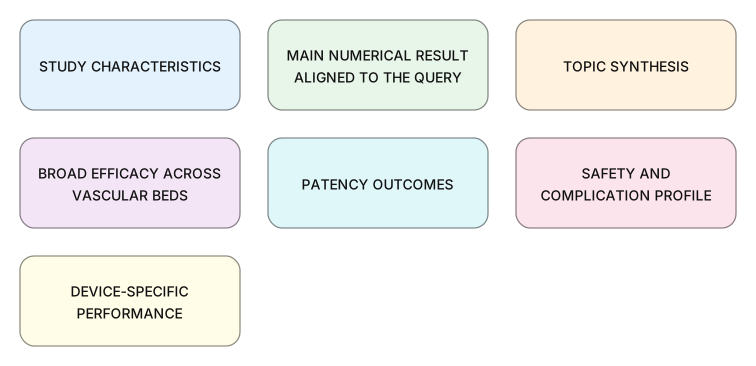
The included studies predominantly featured mixed study designs, combining retrospective and prospective elements, with a notable number of purely retrospective analyses and case series. Populations varied widely, encompassing patients with symptomatic venous stent occlusions, thrombosed arteriovenous fistulas or grafts, total vascular occlusions of the lower extremity, acute/subacute deep vein thrombosis (DVT), acute ischemic stroke, and acute lower limb ischemia. Follow-up periods ranged from short-term (3 months) to longer-term (12 months, 18 months, or even 9 years in a case report), with several studies not specifying follow-up duration.

4.2 Main numerical result aligned to the query:
Across various vascular beds including lower extremity arterial occlusions, femoropopliteal arteries, iliofemoral deep vein thrombosis, and arteriovenous fistulas/grafts, the 12-month primary patency rates for rotational thrombectomy procedures ranged from 53.8% to 92.3% [4, 6, 21, 28, 30, 32, 34]. The median 12-month primary patency rate observed in these studies was 65%. This heterogeneity reflects the diverse patient populations, vascular anatomies, and specific devices employed in different clinical scenarios.

4.3 Topic synthesis:


5) Discussion
5.1 Principal finding:
The median 12-month primary patency rate for rotational thrombectomy across various vascular beds was 65%, with a range from 53.8% to 92.3% [4, 6, 21, 28, 30, 32, 34], indicating its variable but often effective role in restoring and maintaining vascular patency.

5.2 Clinical implications:


5.3 Research implications / key gaps:


5.4 Limitations:


5.5 Future directions:


6) Conclusion
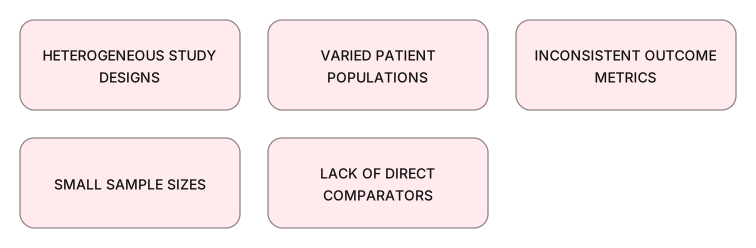
The median 12-month primary patency rate for rotational thrombectomy across various vascular beds was 65%, with a range from 53.8% to 92.3% [4, 6, 21, 28, 30, 32, 34], demonstrating its variable but often effective role in restoring and maintaining vascular patency. This technique is broadly applicable across arterial, venous, and dialysis access occlusions, offering significant clinical benefits such as high technical success rates and a potential reduction in post-thrombotic syndrome. However, the reliance on heterogeneous study designs and varied patient populations represents the single limitation that most affects the certainty and generalizability of these findings. Clinicians should consider rotational thrombectomy as a valuable tool, often in conjunction with adjunctive therapies, for a wide range of thrombotic conditions, while acknowledging the need for further robust comparative research.

References
SAIMSARA Session Index — session.json

Figure 1. Publication-year distribution of included originals

Figure 2. Study-design distribution of included originals
Figure 2. Study-design distribution

Figure 3. Study-type (directionality) distribution of included originals
Figure 3. Directionality distribution

Figure 4. Main extracted research topics
Figure 4. Main extracted research topics (Results)

Figure 5. Limitations of current studies (topics)

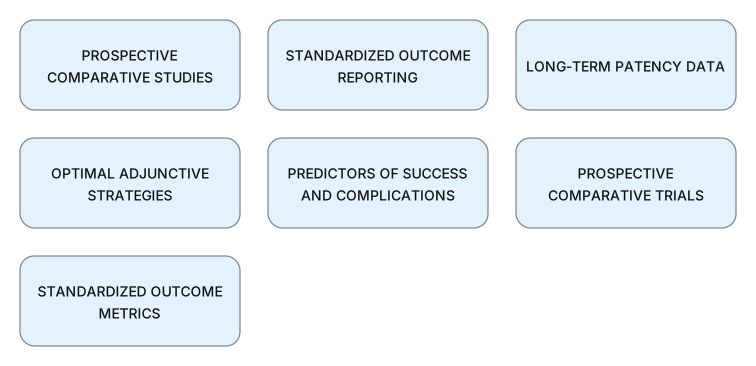
Figure 6. Future research directions (topics)