Spinal Cord Stimulation PAD CLI CLTI: Systematic Review with ☸️SAIMSARA.


saimsara.com Download PDF

Abstract: To systematically review the efficacy and impact of spinal cord stimulation in patients with chronic limb-threatening ischemia (CLTI) and critical limb ischemia (CLI), as well as to contextualize findings with related applications of spinal cord stimulation and functional electrical stimulation. The review utilises 35 studies with 664 total participants (naïve ΣN). For patients with chronic limb-threatening ischemia (CLTI) or end-stage peripheral artery disease (PAD) unsuitable for revascularization, spinal cord stimulation (SCS) demonstrated a median limb salvage rate of 94.65% (range: 92.3% to 97%) at 1-year follow-up. These findings, primarily from cohort studies, suggest that SCS is a promising intervention for preserving limbs and improving quality of life in this challenging patient group. However, the reliance on retrospective and mixed study designs with relatively small sample sizes represents the most significant limitation, impacting the certainty and generalizability of the results. Future randomized controlled trials are critically needed to establish the definitive efficacy and optimal application of SCS in CLTI.

Keywords: Spinal Cord Stimulation; Chronic Limb-Threatening Ischemia; Critical Limb Ischemia

Review Stats
Identification of studies via Semantic Scholar (all fields) Identification Screening Included Records identified:n=31778Records excluded:n=30778 Records assessed for eligibilityn=1000Records excluded:n=965 Studies included in reviewn=35 PRISMA Diagram generated by ☸️ SAIMSARA
⛛OSMA Triangle Effect-of Predictor → Outcome spinal cord stimulation pad  →  cli clti Beneficial for patients ΣN=356 (54%) Harmful for patients ΣN=0 (0%) Neutral ΣN=308 (46%) 0 ⛛OSMA Triangle generated by ☸️SAIMSARA
Show OSMA legend
Outcome-Sentiment Meta-Analysis (OSMA): (LLM-only)
Frame: Effect-of Predictor → Outcome • Source: Semantic Scholar
Outcome: cli clti Typical timepoints: 24-mo, 1-y. Reported metrics: %, CI, p.
Common endpoints: Common endpoints: functional, qol, healing.
Predictor: spinal cord stimulation pad — exposure/predictor. Routes seen: sc. Typical comparator: cylindrical leads for, trt alone on untrained muscles, trt alone, the nutritional counseling….

  • 1) Beneficial for patients — cli clti with spinal cord stimulation pad — [1], [2], [4], [10], [12] — ΣN=356
  • 2) Harmful for patients — cli clti with spinal cord stimulation pad — — — ΣN=0
  • 3) No clear effect — cli clti with spinal cord stimulation pad — [3], [5], [6], [7], [8], [9], [11], [13], [14], [15], [16], [17], [18], [19], [20], [21], [22], [23], [24], [25], [26], [27], [28], [29], [30], [31], [32], [33], [34], [35] — ΣN=308
1) Introduction
Chronic limb-threatening ischemia (CLTI), often a severe manifestation of peripheral artery disease (PAD), presents a significant challenge in vascular medicine, frequently leading to amputation and reduced quality of life, particularly in patients for whom revascularization is not an option. Spinal cord stimulation (SCS) has emerged as a neuromodulatory intervention, offering a potential therapeutic avenue by influencing pain pathways and improving microcirculation. This paper synthesizes current evidence on SCS, specifically its application in CLTI and critical limb ischemia (CLI), alongside broader insights into SCS technologies and mechanisms gleaned from related applications in chronic pain and spinal cord injury (SCI).

2) Aim
To systematically review the efficacy and impact of spinal cord stimulation in patients with chronic limb-threatening ischemia (CLTI) and critical limb ischemia (CLI), as well as to contextualize findings with related applications of spinal cord stimulation and functional electrical stimulation.

3) Methods
Systematic review with multilayer AI research agent: keyword normalization, retrieval & structuring, and paper synthesis (see SAIMSARA About section for details).


4) Results
4.1 Study characteristics:
The included studies comprise retrospective and prospective cohort studies, mixed designs, and randomized controlled trials, alongside narrative reviews and case series. Populations primarily include diabetic patients with CLTI or end-stage PAD unsuitable for revascularization [1, 2, 4], as well as patients with chronic low back and leg pain [10, 12] and individuals with spinal cord injury [8, 9, 16, 17, 19, 20, 28]. Follow-up periods range from 6 months to 30 months, with some studies focusing on immediate outcomes or lacking specified follow-up.

4.2 Main numerical result aligned to the query:
For patients with chronic limb-threatening ischemia (CLTI) or end-stage peripheral artery disease (PAD) unsuitable for revascularization, spinal cord stimulation (SCS) demonstrated a median limb salvage rate of 94.65% (range: 92.3% to 97%) at 1-year follow-up [1, 2]. One study reported an 88% limb salvage rate at 2-year follow-up [4]. Additionally, SCS significantly improved pain intensity and quality of life in these populations, with pain reduction from a median VAS of 7.5 to 0 at 2 years in one cohort [4].

4.3 Topic synthesis:


5) Discussion
5.1 Principal finding:
The principal finding is that spinal cord stimulation (SCS) achieved a median limb salvage rate of 94.65% (range: 92.3% to 97%) at 1-year follow-up in patients with chronic limb-threatening ischemia (CLTI) or end-stage peripheral artery disease (PAD) who were not candidates for revascularization [1, 2]. This suggests a significant potential for SCS in preserving limbs in a highly vulnerable patient population.

5.2 Clinical implications:


5.3 Research implications / key gaps:


5.4 Limitations:


5.5 Future directions:


6) Conclusion
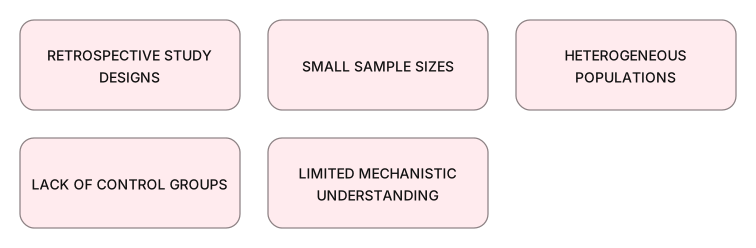
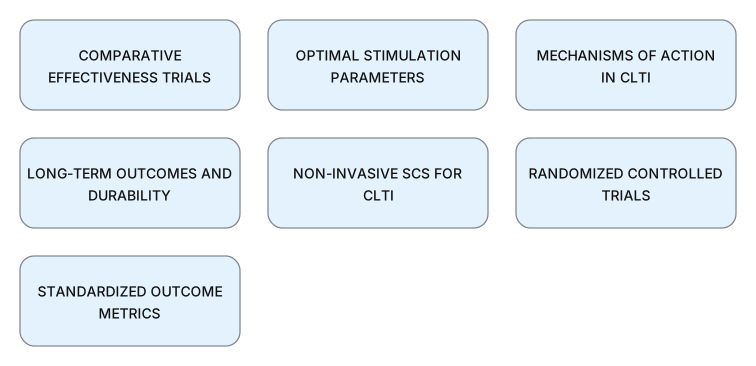
For patients with chronic limb-threatening ischemia (CLTI) or end-stage peripheral artery disease (PAD) unsuitable for revascularization, spinal cord stimulation (SCS) demonstrated a median limb salvage rate of 94.65% (range: 92.3% to 97%) at 1-year follow-up [1, 2]. These findings, primarily from cohort studies, suggest that SCS is a promising intervention for preserving limbs and improving quality of life in this challenging patient group. However, the reliance on retrospective and mixed study designs with relatively small sample sizes represents the most significant limitation, impacting the certainty and generalizability of the results. Future randomized controlled trials are critically needed to establish the definitive efficacy and optimal application of SCS in CLTI.

References
SAIMSARA Session Index — session.json

Figure 1. Publication-year distribution of included originals

Figure 2. Study-design distribution of included originals
Figure 2. Study-design distribution

Figure 3. Study-type (directionality) distribution of included originals
Figure 3. Directionality distribution

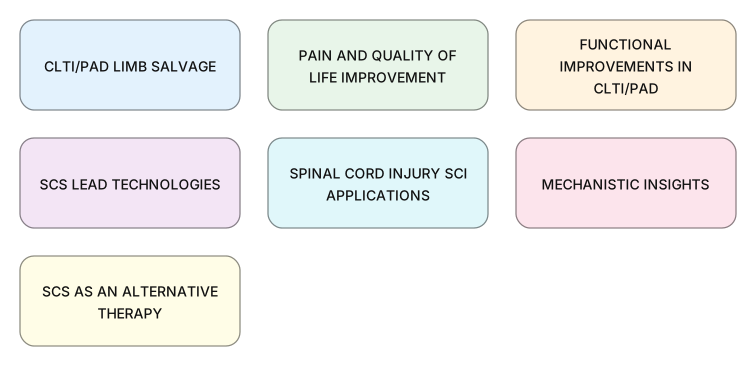
Figure 4. Main extracted research topics
Figure 4. Main extracted research topics (Results)

Figure 5. Limitations of current studies (topics)

Figure 6. Future research directions (topics)