Stent Peripheral Artery Disease: Systematic Review with ☸️SAIMSARA.


saimsara.com Download PDF

Abstract: This paper aims to systematically review the current evidence regarding the use of stents in peripheral artery disease, focusing on their efficacy, safety, and the factors influencing outcomes, to identify clinical implications and future research directions. The review utilises 168 studies with 256041 total participants (naïve ΣN). The median 12-month primary patency rate for various stent types in peripheral artery disease was 85.6%, ranging from 73.1% to 100%, indicating that stent-based interventions are generally effective for revascularization in symptomatic peripheral artery disease, particularly in femoropopliteal and aortoiliac segments. However, the heterogeneity of stent types, lesion characteristics, and follow-up durations across studies represents the most significant limitation to drawing definitive conclusions. Clinicians should consider drug-eluting stents for superior patency in appropriate lesions, while future research must prioritize large-scale, long-term randomized controlled trials to definitively assess the safety of paclitaxel-coated devices and optimize antiplatelet regimens.

Keywords: Peripheral Artery Disease; Stents; Drug-Eluting Stents; Femoropopliteal Artery; Restenosis; Primary Patency; Endovascular Procedures; Target Lesion Revascularization; Bare Metal Stents; In-Stent Restenosis

Review Stats
Identification of studies via Semantic Scholar (all fields) Identification Screening Included Records identified:n=62757Records excluded:n=61757 Records assessed for eligibilityn=1000Records excluded:n=832 Studies included in reviewn=168 PRISMA Diagram generated by ☸️ SAIMSARA
⛛OSMA Triangle Effect-of Predictor → Outcome stent  →  peripheral artery disease Beneficial for patients ΣN=43623 (17%) Harmful for patients ΣN=71476 (28%) Neutral ΣN=140942 (55%) 0 ⛛OSMA Triangle generated by ☸️SAIMSARA
Show OSMA legend
Outcome-Sentiment Meta-Analysis (OSMA): (LLM-only)
Frame: Effect-of Predictor → Outcome • Source: Semantic Scholar
Outcome: peripheral artery disease Typical timepoints: 12-mo, 24-mo. Reported metrics: %, CI, p.
Common endpoints: Common endpoints: patency, restenosis, mortality.
Predictor: stent — procedure/intervention. Typical comparator: bare metal stents, non-stent interventions but, stent grafts in peripheral, those who did not receive ivus….

  • 1) Beneficial for patients — peripheral artery disease with stent — [1], [3], [10], [22], [23], [27], [28], [30], [31], [34], [38], [40], [41], [43], [44], [46], [47], [48], [49], [54], [55], [58], [61], [62], [64], [69], [70], [75], [76], [80], [83], [84], [87], [88], [90], [91], [92], [93], [97], [98], [99], [104], [106], [110], [111], [115], [116], [118], [121], [122], [123], [124], [159], [160] — ΣN=43623
  • 2) Harmful for patients — peripheral artery disease with stent — [12], [19], [26], [29], [33], [35], [39], [42], [45], [50], [51], [52], [73], [74], [77], [78], [94], [100], [101], [105], [107], [125], [155], [156], [164], [165], [167] — ΣN=71476
  • 3) No clear effect — peripheral artery disease with stent — [2], [4], [5], [6], [7], [8], [9], [11], [13], [14], [15], [16], [17], [18], [20], [21], [24], [25], [32], [36], [37], [53], [56], [57], [59], [60], [63], [65], [66], [67], [68], [71], [72], [79], [81], [82], [85], [86], [89], [95], [96], [102], [103], [108], [109], [112], [113], [114], [117], [119], [120], [126], [127], [128], [129], [130], [131], [132], [133], [134], [135], [136], [137], [138], [139], [140], [141], [142], [143], [144], [145], [146], [147], [148], [149], [150], [151], [152], [153], [154], [157], [158], [161], [162], [163], [166], [168] — ΣN=140942
1) Introduction
Peripheral artery disease (PAD) represents a significant global health burden, characterized by atherosclerotic narrowing of non-coronary arteries, most commonly affecting the lower extremities. Symptomatic PAD often manifests as claudication or critical limb ischemia (CLI), necessitating revascularization to improve blood flow, alleviate symptoms, and prevent limb loss. Endovascular interventions, particularly stent implantation, have become a cornerstone of PAD management, offering a less invasive alternative to open surgical bypass. Stents mechanically support the vessel lumen, aiming to restore patency and reduce the incidence of restenosis. However, the landscape of stent technology is continuously evolving, with various stent types (e.g., bare metal stents (BMS), drug-eluting stents (DES), covered stents, bioresorbable scaffolds) and adjunctive therapies being developed and evaluated. This paper synthesizes current evidence on the efficacy, safety, and associated factors of stent-based interventions for PAD, drawing upon a comprehensive structured extraction of recent literature.

2) Aim
This paper aims to systematically review the current evidence regarding the use of stents in peripheral artery disease, focusing on their efficacy, safety, and the factors influencing outcomes, to identify clinical implications and future research directions.

3) Methods
Systematic review with multilayer AI research agent: keyword normalization, retrieval & structuring, and paper synthesis (see SAIMSARA About section for details).


4) Results
4.1 Study characteristics
The included literature comprises a diverse range of study designs, predominantly retrospective and prospective cohort studies, with several randomized controlled trials (RCTs) and experimental animal models. Populations primarily consisted of patients with symptomatic peripheral artery disease, often involving femoropopliteal, aortoiliac, and infrapopliteal arterial segments, with some studies focusing on specific subgroups such as diabetics or those with calcified lesions. Follow-up periods varied widely, ranging from short-term (e.g., 30 days) to extended durations (up to 7 years), with 12-month and 24-month outcomes commonly reported for patency and reintervention rates.

4.2 Main numerical result aligned to the query
The median 12-month primary patency rate for various stent types in peripheral artery disease was 85.6%, ranging from 73.1% to 100% [1, 34, 70, 93, 99, 103, 110, 111, 126]. For instance, one RCT reported 12-month primary patency for DES at 83.2% compared to 74.3% for BMS (P<0.01) [1]. Another study found 12-month primary patency rates of 84.9% for Zilver PTX and 88.1% for Eluvia stents [103].

4.3 Topic synthesis


5) Discussion
5.1 Principal finding
The median 12-month primary patency rate for various stent types in peripheral artery disease was 85.6%, ranging from 73.1% to 100% [1, 34, 70, 93, 99, 103, 110, 111, 126], indicating generally favorable short-to-mid-term outcomes for stent-based interventions.

5.2 Clinical implications


5.3 Research implications / key gaps


5.4 Limitations


5.5 Future directions


6) Conclusion
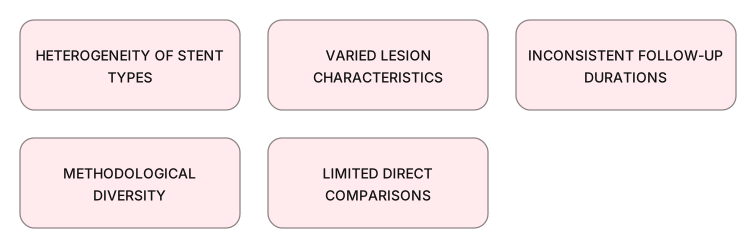
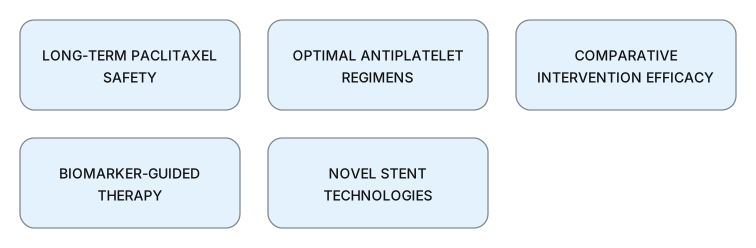
The median 12-month primary patency rate for various stent types in peripheral artery disease was 85.6%, ranging from 73.1% to 100% [1, 34, 70, 93, 99, 103, 110, 111, 126], indicating that stent-based interventions are generally effective for revascularization in symptomatic peripheral artery disease, particularly in femoropopliteal and aortoiliac segments. However, the heterogeneity of stent types, lesion characteristics, and follow-up durations across studies represents the most significant limitation to drawing definitive conclusions. Clinicians should consider drug-eluting stents for superior patency in appropriate lesions, while future research must prioritize large-scale, long-term randomized controlled trials to definitively assess the safety of paclitaxel-coated devices and optimize antiplatelet regimens.

References
SAIMSARA Session Index — session.json

Figure 1. Publication-year distribution of included originals

Figure 2. Study-design distribution of included originals
Figure 2. Study-design distribution

Figure 3. Study-type (directionality) distribution of included originals
Figure 3. Directionality distribution

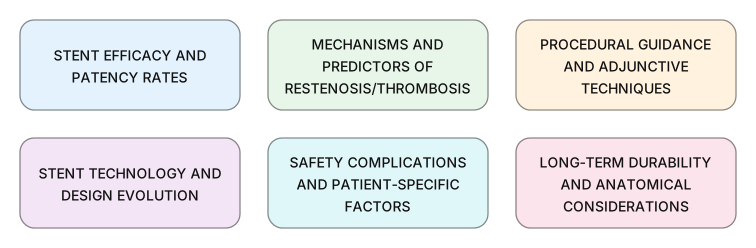
Figure 4. Main extracted research topics
Figure 4. Main extracted research topics (Results)

Figure 5. Limitations of current studies (topics)

Figure 6. Future research directions (topics)