Sympathectomy Peripheral Artery Disease: Systematic Review with ☸️SAIMSARA.


saimsara.com Download PDF

Abstract: This paper aims to systematically review the available evidence on sympathectomy in peripheral artery disease, synthesizing findings on its efficacy, clinical applications, and associated factors to identify current knowledge gaps and future research directions. The review utilises 36 studies with 170679 total participants (naïve ΣN). Lumbar sympathectomy surgery resulted in a 59% increase in arterial diameter and a 201% increase in perfusion compared with sham surgery in Sprague-Dawley rats. While this animal data suggests significant physiological benefits, the generalizability to human peripheral artery disease is limited by the scarcity of comparable quantitative efficacy data in human studies. The most significant limitation affecting certainty is the limited human efficacy data, which largely consists of qualitative observations or small, uncontrolled studies. Therefore, a concrete next step involves conducting large-scale, randomized controlled trials to definitively establish the efficacy and safety of sympathectomy in specific human PAD populations, such as those with chronic limb-threatening ischemia or Buerger's disease.

Keywords: Sympathectomy; Peripheral Artery Disease; Lumbar Sympathectomy; Chronic Limb Ischemia; Is

Review Stats
Identification of studies via Semantic Scholar (all fields) Identification Screening Included Records identified:n=258Records excluded:n=0 Records assessed for eligibilityn=258Records excluded:n=222 Studies included in reviewn=36 PRISMA Diagram generated by ☸️ SAIMSARA
⛛OSMA Triangle Effect-of Predictor → Outcome sympathectomy  →  peripheral artery disease Beneficial for patients ΣN=450 (0%) Harmful for patients ΣN=0 (0%) Neutral ΣN=170229 (100%) 0 ⛛OSMA Triangle generated by ☸️SAIMSARA
Show OSMA legend
Outcome-Sentiment Meta-Analysis (OSMA): (LLM-only)
Frame: Effect-of Predictor → Outcome • Source: Semantic Scholar
Outcome: peripheral artery disease Typical timepoints: peri/post-op, 1-y. Reported metrics: %, CI, p.
Common endpoints: Common endpoints: mortality, complications, admission.
Predictor: sympathectomy — exposure/predictor. Typical comparator: sham surgery, sham, control, heart failure patients with no….

  • 1) Beneficial for patients — peripheral artery disease with sympathectomy — [17] — ΣN=450
  • 2) Harmful for patients — peripheral artery disease with sympathectomy — — — ΣN=0
  • 3) No clear effect — peripheral artery disease with sympathectomy — [1], [2], [3], [4], [5], [6], [7], [8], [9], [10], [11], [12], [13], [14], [15], [16], [18], [19], [20], [21], [22], [23], [24], [25], [26], [27], [28], [29], [30], [31], [32], [33], [34], [35], [36] — ΣN=170229
1) Introduction
Peripheral artery disease (PAD) represents a significant global health burden, characterized by stenoses or occlusions in arteries supplying the limbs, often leading to chronic limb-threatening ischemia (CLTI) and a high risk of amputation [3, 22, 23]. PAD is frequently associated with other cardiovascular diseases, increasing the risk of adverse events such as stroke and mortality [7, 18, 22]. While conventional treatments include lifestyle modifications, medical management, and revascularization, a substantial proportion of patients still face severe outcomes, including amputation [3]. Sympathectomy, a procedure aimed at disrupting sympathetic nerve pathways, has historically been considered for improving limb perfusion in various peripheral vascular conditions, including thromboangiitis obliterans (Buerger's disease) and occlusive PAD [10, 21, 23, 29, 31, 35]. This paper synthesizes the current understanding of sympathectomy in the context of PAD, drawing from recent findings on its mechanisms, efficacy, and associated clinical considerations.

2) Aim
This paper aims to systematically review the available evidence on sympathectomy in peripheral artery disease, synthesizing findings on its efficacy, clinical applications, and associated factors to identify current knowledge gaps and future research directions.

3) Methods
Systematic review with multilayer AI research agent: keyword normalization, retrieval & structuring, and paper synthesis (see SAIMSARA About section for details).


4) Results
4.1 Study characteristics: The included studies comprise a diverse range of designs, including cohort, experimental, cross-sectional, and mixed studies, with several not specifying their design. Populations varied from chronic limb-threatening ischemia (CLTI) patients to Sprague-Dawley rats, lower extremity peripheral artery disease (LE-PAD) patients, and large general population cohorts. Follow-up periods ranged from 1 week to 18 years, with many studies not reporting follow-up duration.

4.2 Main numerical result aligned to the query:
Lumbar sympathectomy surgery resulted in a 59% increase in arterial diameter and a 201% increase in perfusion compared with sham surgery in Sprague-Dawley rats [2]. While direct comparable numerical efficacy metrics for sympathectomy in human peripheral artery disease are not consistently reported across studies, qualitative findings suggest that sympathectomies yield good results in early stages of thromboangiitis obliterans and vasospastic disease [10] and are a method for improvement of lower limb perfusion in occlusive peripheral artery disease [23]. However, one study noted that sympathectomy may not be more effective in treating Buerger's disease than cigarette smoking cessation or pharmaceutical therapy [16].

4.3 Topic synthesis:


5) Discussion
5.1 Principal finding: The most direct numerical evidence for sympathectomy's efficacy comes from an animal model, where lumbar sympathectomy increased arterial diameter by 59% and perfusion by 201% compared to sham surgery [2]. While human data on quantitative efficacy is limited, qualitative reports support its role in improving lower limb perfusion and limb salvage in occlusive peripheral artery disease and Buerger's disease [10, 23, 30, 35].

5.2 Clinical implications:


5.3 Research implications / key gaps:


5.4 Limitations:


5.5 Future directions:


6) Conclusion
Lumbar sympathectomy surgery resulted in a 59% increase in arterial diameter and a 201% increase in perfusion compared with sham surgery in Sprague-Dawley rats [2]. While this animal data suggests significant physiological benefits, the generalizability to human peripheral artery disease is limited by the scarcity of comparable quantitative efficacy data in human studies. The most significant limitation affecting certainty is the limited human efficacy data, which largely consists of qualitative observations or small, uncontrolled studies. Therefore, a concrete next step involves conducting large-scale, randomized controlled trials to definitively establish the efficacy and safety of sympathectomy in specific human PAD populations, such as those with chronic limb-threatening ischemia or Buerger's disease.

References
SAIMSARA Session Index — session.json

Figure 1. Publication-year distribution of included originals

Figure 2. Study-design distribution of included originals
Figure 2. Study-design distribution

Figure 3. Study-type (directionality) distribution of included originals
Figure 3. Directionality distribution

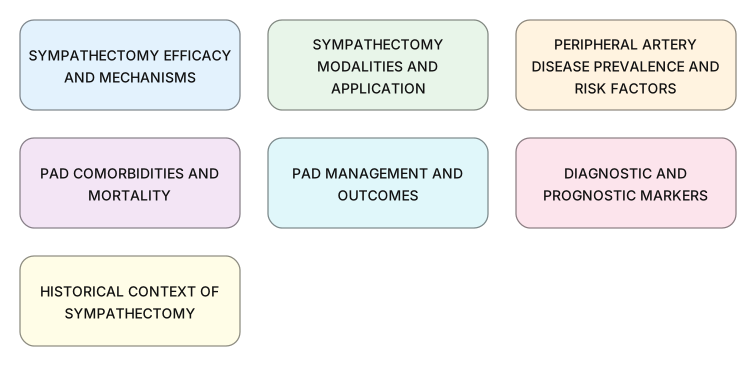
Figure 4. Main extracted research topics
Figure 4. Main extracted research topics (Results)

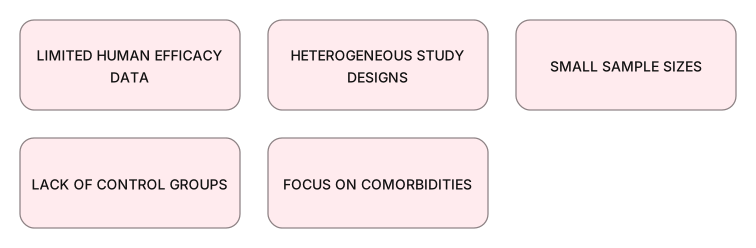
Figure 5. Limitations of current studies (topics)

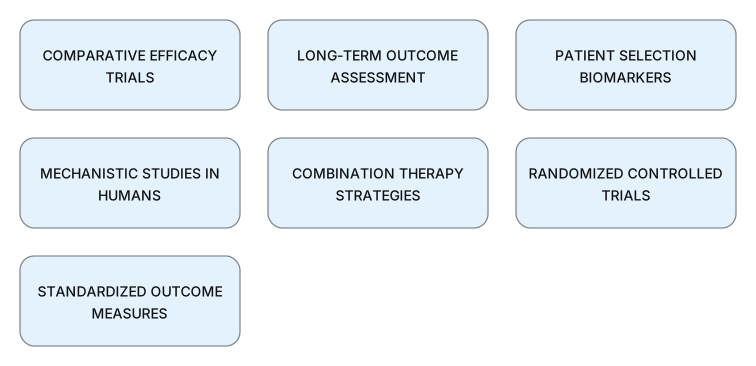
Figure 6. Future research directions (topics)