Ultrasound Screening of Carotid Stenosis: Systematic Review with ☸️SAIMSARA.


saimsara.com Download PDF

Abstract: The aim of this paper is to systematically review and synthesize current research on ultrasound screening of carotid stenosis, focusing on diagnostic performance, plaque vulnerability assessment, and associated clinical implications and research gaps. The review utilises 189 studies with 195389 total participants (naïve ΣN). For the detection of carotid stenosis ≥50%, color Doppler ultrasound demonstrated a median sensitivity of 93.3% (range: 90% to 97.8%) and a median specificity of 84.3% (range: 64.2% to 97%). This indicates that ultrasound is a highly capable tool for identifying significant carotid stenosis across diverse patient populations. However, the Heterogeneous Diagnostic Criteria across centers remains a significant limitation, impacting consistency in diagnosis. Clinicians should be aware of the variability in diagnostic thresholds and consider advanced ultrasound techniques and AI integration for more precise risk stratification and personalized management strategies.

Keywords: Carotid Stenosis; Ultrasound Imaging; Atherosclerosis; Diagnosis; Plaque Characteristics; Cerebrovascular Disease; Doppler Ultrasonography; Vulnerable Plaque; Screening; Risk Stratification

Review Stats
Identification of studies via Semantic Scholar (all fields) Identification Screening Included Records identified:n=4863Records excluded:n=3863 Records assessed for eligibilityn=1000Records excluded:n=811 Studies included in reviewn=189 PRISMA Diagram generated by ☸️ SAIMSARA
⛛OSMA Triangle Effect-of Predictor → Outcome ultrasound screening  →  carotid stenosis Beneficial for patients ΣN=2177 (1%) Harmful for patients ΣN=13593 (7%) Neutral ΣN=179619 (92%) 0 ⛛OSMA Triangle generated by ☸️SAIMSARA
Show OSMA legend
Outcome-Sentiment Meta-Analysis (OSMA): (LLM-only)
Frame: Effect-of Predictor → Outcome • Source: Semantic Scholar
Outcome: carotid stenosis Typical timepoints: 3-day, 2-day. Reported metrics: %, CI, p.
Common endpoints: Common endpoints: complications, occlusion, restenosis.
Predictor: ultrasound screening — exposure/predictor. Doses/units seen: 70 mg. Routes seen: iv. Typical comparator: asymptomatic patients, catheter angiography for, the standard srucc criteria, whites….

  • 1) Beneficial for patients — carotid stenosis with ultrasound screening — [12], [29], [43], [48], [49], [77], [99], [123], [124] — ΣN=2177
  • 2) Harmful for patients — carotid stenosis with ultrasound screening — [23], [25], [33], [35], [36], [40], [41], [45], [46], [105], [114] — ΣN=13593
  • 3) No clear effect — carotid stenosis with ultrasound screening — [1], [2], [3], [4], [5], [6], [7], [8], [9], [10], [11], [13], [14], [15], [16], [17], [18], [19], [20], [21], [22], [24], [26], [27], [28], [30], [31], [32], [34], [37], [38], [39], [42], [44], [47], [50], [51], [52], [53], [54], [55], [56], [57], [58], [59], [60], [61], [62], [63], [64], [65], [66], [67], [68], [69], [70], [71], [72], [73], [74], [75], [76], [78], [79], [80], [81], [82], [83], [84], [85], [86], [87], [88], [89], [90], [91], [92], [93], [94], [95], [96], [97], [98], [100], [101], [102], [103], [104], [106], [107], [108], [109], [110], [111], [112], [113], [115], [116], [117], [118], [119], [120], [121], [122], [125], [126], [127], [128], [129], [130], [131], [132], [133], [134], [135], [136], [137], [138], [139], [140], [141], [142], [143], [144], [145], [146], [147], [148], [149], [150], [151], [152], [153], [154], [155], [156], [157], [158], [159], [160], [161], [162], [163], [164], [165], [166], [167], [168], [169], [170], [171], [172], [173], [174], [175], [176], [177], [178], [179], [180], [181], [182], [183], [184], [185], [186], [187], [188], [189] — ΣN=179619
1) Introduction
Carotid artery stenosis (CAS), a narrowing of the carotid arteries, is a significant risk factor for ischemic stroke. Early detection and characterization of CAS are crucial for patient management and stroke prevention. Ultrasound, particularly duplex ultrasound (DUS), is a primary non-invasive imaging modality for screening and diagnosing CAS due to its accessibility and real-time capabilities. This paper synthesizes recent advancements and findings regarding ultrasound-based screening for carotid stenosis, encompassing diagnostic accuracy, plaque characterization, hemodynamic assessment, and the integration of emerging technologies like artificial intelligence.

2) Aim
The aim of this paper is to systematically review and synthesize current research on ultrasound screening of carotid stenosis, focusing on diagnostic performance, plaque vulnerability assessment, and associated clinical implications and research gaps.

3) Methods
Systematic review with multilayer AI research agent: keyword normalization, retrieval & structuring, and paper synthesis (see SAIMSARA About section for details).


4) Results
4.1 Study characteristics: The included studies employed a variety of designs, predominantly mixed methods, alongside cohort (prospective and retrospective), cross-sectional, randomized controlled trials (RCTs), experimental, and case series approaches. Populations ranged from patients with established atherosclerotic internal carotid artery stenosis (ICAS) or symptomatic extracranial carotid stenosis (CS) to asymptomatic individuals, diabetic patients, and those with specific comorbidities like peripheral artery disease (PAD) or nasopharyngeal carcinoma. Follow-up periods varied significantly, from immediate assessment to several months (e.g., 3, 6, 18 months) and extended durations (e.g., 3.1, 4, 11.8, 12 years), with many studies not specifying a follow-up.

4.2 Main numerical result aligned to the query: For the detection of carotid stenosis ≥50%, color Doppler ultrasound (CDUS) demonstrated a median sensitivity of 93.3% (range: 90% [20] to 97.8% [28]) and a median specificity of 84.3% (range: 64.2% [28] to 97% [20]). Heterogeneity in diagnostic thresholds across centers was noted, leading to discrepancies in diagnosing moderate and severe stenosis [9].

4.3 Topic synthesis:


5) Discussion
5.1 Principal finding: Color Doppler ultrasound demonstrated a median sensitivity of 93.3% (range: 90% [20] to 97.8% [28]) and a median specificity of 84.3% (range: 64.2% [28] to 97% [20]) for the detection of carotid stenosis ≥50%. This indicates that ultrasound is a highly sensitive tool for identifying significant carotid stenosis.

5.2 Clinical implications:


5.3 Research implications / key gaps:


5.4 Limitations:


5.5 Future directions:


6) Conclusion
For the detection of carotid stenosis ≥50%, color Doppler ultrasound demonstrated a median sensitivity of 93.3% (range: 90% [20] to 97.8% [28]) and a median specificity of 84.3% (range: 64.2% [28] to 97% [20]). This indicates that ultrasound is a highly capable tool for identifying significant carotid stenosis across diverse patient populations. However, the Heterogeneous Diagnostic Criteria across centers remains a significant limitation, impacting consistency in diagnosis. Clinicians should be aware of the variability in diagnostic thresholds and consider advanced ultrasound techniques and AI integration for more precise risk stratification and personalized management strategies.

References
SAIMSARA Session Index — session.json

Figure 1. Publication-year distribution of included originals

Figure 2. Study-design distribution of included originals
Figure 2. Study-design distribution

Figure 3. Study-type (directionality) distribution of included originals
Figure 3. Directionality distribution

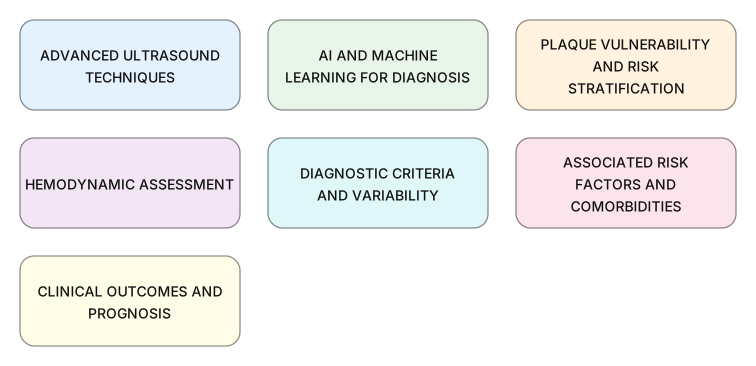
Figure 4. Main extracted research topics
Figure 4. Main extracted research topics (Results)

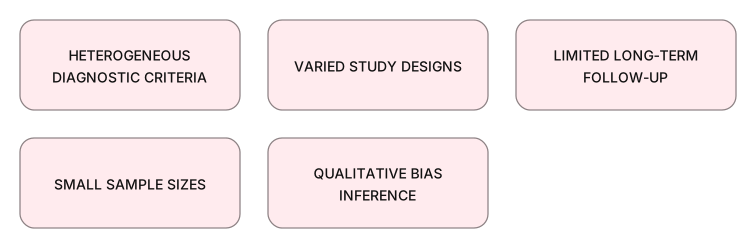
Figure 5. Limitations of current studies (topics)

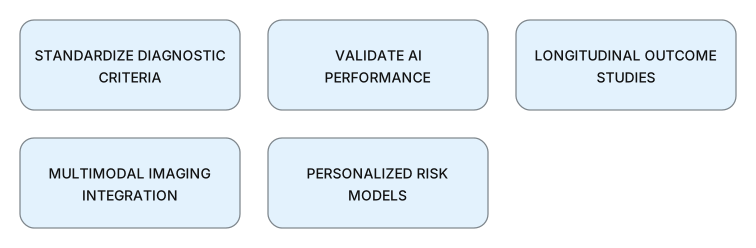
Figure 6. Future research directions (topics)