Venous Bypass vs Prosthetic Bypass in PAD: Systematic Review with ☸️SAIMSARA.


saimsara.com Download PDF

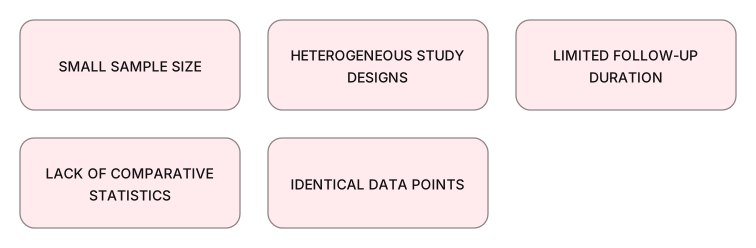
Abstract: The aim of this systematic review is to compare the outcomes, specifically patency rates and complications, of venous bypass grafts against prosthetic bypass grafts in patients undergoing revascularization for Peripheral Artery Disease. The review utilises 4 studies with 156 total participants (naïve ΣN). At 3 years, the median primary patency rate for endovascular transvenous bypass was 43.8% (range 43.8–46.2%), while for prosthetic grafts, it was 22.5%, clearly demonstrating the superior patency of venous-based revascularization. These findings are primarily generalizable to patients with complex TASC-C and D superficial femoral artery lesions. The most significant limitation affecting certainty is the relatively small sample sizes and limited follow-up duration of the included studies. Clinicians should prioritize autogenous venous bypass, followed by endovascular transvenous bypass with awareness of reintervention needs, reserving prosthetic grafts only when other options are exhausted.

Keywords: Peripheral Artery Disease; Vascular Bypass; Autogenous Vein Graft; Prosthetic Graft; Graft Patency; Revascularization; Femoropopliteal Bypass; Limb Ischemia; Surgical Outcomes; Comparative Study

Review Stats
Identification of studies via Semantic Scholar (all fields) Identification Screening Included Records identified:n=50Records excluded:n=0 Records assessed for eligibilityn=50Records excluded:n=46 Studies included in reviewn=4 PRISMA Diagram generated by ☸️ SAIMSARA
⛛OSMA Triangle Head-to-Head (A vs B) venous bypass vs prosthetic bypass — PAD Legend: “Favours venous bypass” = left edge, “Favours prosthetic bypass” = right edge; “Neutral” = vertical. Favours venous bypass ΣN=104 (67%) Favours prosthetic bypass ΣN=0 (0%) Neutral ΣN=52 (33%) 0 ⛛OSMA Triangle generated by ☸️SAIMSARA
Show OSMA legend
Outcome-Sentiment Meta-Analysis (OSMA): (LLM-only)
Frame: Head-to-Head (A vs B) • Source: Semantic Scholar
Comparators: A = venous bypass; B = prosthetic bypass
Outcome: PAD Typical timepoints: 3-y, 12-mo. Reported metrics: %.
Common endpoints: Common endpoints: patency, recurrence, complications.
Predictor: venous bypass vs prosthetic bypass — exposure/predictor.

  • 1) A favored (venous bypass) — PAD with venous bypass vs prosthetic bypass — [3], [4] — ΣN=104
  • 2) B favored (prosthetic bypass) — PAD with venous bypass vs prosthetic bypass — — — ΣN=0
  • 3) Neutral (no difference) — PAD with venous bypass vs prosthetic bypass — [1], [2] — ΣN=52


1) Introduction
Peripheral Artery Disease (PAD) is a common circulatory problem in which narrowed arteries reduce blood flow to the limbs. Revascularization procedures, including bypass surgery, are critical for restoring blood flow, alleviating symptoms, and preventing limb loss. Among the available bypass options, autogenous venous grafts and prosthetic grafts are frequently employed, each with distinct advantages and disadvantages. This paper aims to synthesize current evidence comparing the efficacy and outcomes of venous bypass versus prosthetic bypass in patients with PAD.

2) Aim
The aim of this systematic review is to compare the outcomes, specifically patency rates and complications, of venous bypass grafts against prosthetic bypass grafts in patients undergoing revascularization for Peripheral Artery Disease.

3) Methods
Systematic review with multilayer AI research agent: keyword normalization, retrieval & structuring, and paper synthesis (see SAIMSARA About section for details).


4) Results
4.1 Study characteristics:
The included studies comprised mixed [1, 3, 4] and cross-sectional [2] designs, primarily focusing on patients with complex TASC-C and D superficial femoral artery (SFA) lesions, often presenting with Rutherford 3–5 classification and an ankle-brachial index (ABI) below 0.7 [1, 3, 4]. Sample sizes were typically around 52 patients for comparative studies [1, 3, 4], with follow-up periods extending up to 3 years [1, 3, 4].

4.2 Main numerical result aligned to the query:
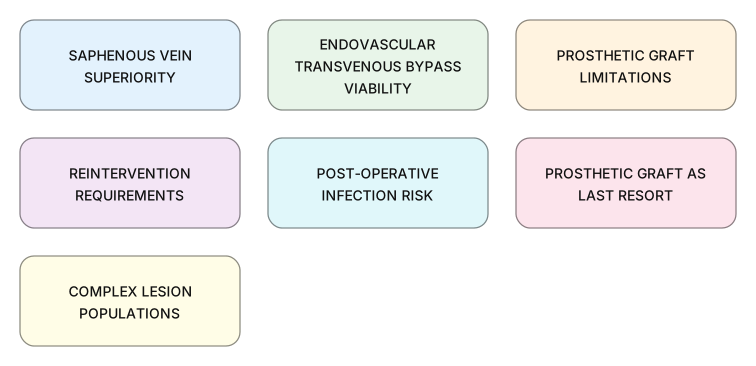
At 3 years, the median primary patency rate for endovascular transvenous bypass was 43.8% (range 43.8–46.2%) [1, 3, 4], while for prosthetic grafts, it was 22.5% [1]. In contrast, saphenous vein bypass demonstrated a 3-year primary patency of 70.5% [1]. The median 3-year secondary patency for endovascular transvenous bypass was 73.9% (range 73.9–76.9%) [1, 3, 4], significantly higher than the 28.2% reported for prosthetic grafts [1], and comparable to the 77.3% for venous bypass [1].

4.3 Topic synthesis:


5) Discussion
5.1 Principal finding:
At 3 years, the median primary patency rate for endovascular transvenous bypass was 43.8% (range 43.8–46.2%) [1, 3, 4], while for prosthetic grafts, it was 22.5% [1], indicating a clear superiority of venous-based approaches over prosthetic materials in maintaining vessel patency.

5.2 Clinical implications:


5.3 Research implications / key gaps:


5.4 Limitations:


5.5 Future directions:


6) Conclusion
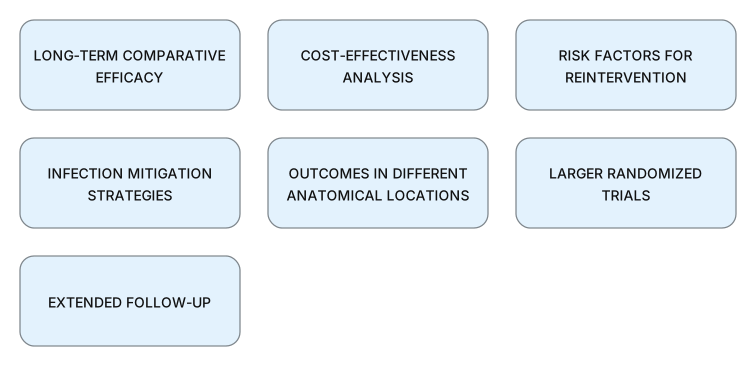
At 3 years, the median primary patency rate for endovascular transvenous bypass was 43.8% (range 43.8–46.2%) [1, 3, 4], while for prosthetic grafts, it was 22.5% [1], clearly demonstrating the superior patency of venous-based revascularization. These findings are primarily generalizable to patients with complex TASC-C and D superficial femoral artery lesions. The most significant limitation affecting certainty is the relatively small sample sizes and limited follow-up duration of the included studies. Clinicians should prioritize autogenous venous bypass, followed by endovascular transvenous bypass with awareness of reintervention needs, reserving prosthetic grafts only when other options are exhausted.

References
SAIMSARA Session Index — session.json

Figure 1. Publication-year distribution of included originals

Figure 2. Study-design distribution of included originals
Figure 2. Study-design distribution

Figure 3. Study-type (directionality) distribution of included originals
Figure 3. Directionality distribution

Figure 4. Main extracted research topics
Figure 4. Main extracted research topics (Results)

Figure 5. Limitations of current studies (topics)

Figure 6. Future research directions (topics)